The Fresh Start Effect: Your Calendar's Reset Button
The year is winding down, and part of your brain is already whispering, "I'll start fresh in January." That whisper has a name. Researchers call it the fresh start effect, and it is one of the most useful (and most misused) ideas in goal science. Used well, it turns ordinary dates into launch pads. Used badly, it turns them into excuses.
This is a deep dive into what the research actually shows, where it falls short, and how to use it on purpose. The deep dive is followed by a practical playbook you can use any time of year.
Where the fresh start effect came from
In 2014, Wharton researchers Hengchen Dai, Katherine Milkman, and Jason Riis published "The Fresh Start Effect" in Management Science [1]. They started from a simple question: if New Year's resolutions are so popular, do people also tackle goals right after other meaningful dates?
They checked three very different datasets [1]:
- Google searches for "diet." Relative to baseline, searches rose at the start of a new week (by 14.4%), a new month (3.7%), and a new year (82.1%), and after federal holidays (10.2%). Control terms like "news" and "weather" didn't show the same pattern.
- University gym visits. The probability of a visit rose at the start of a new week (33.4%), month (14.4%), year (11.6%), and semester (47.1%), and after school breaks (24.3%). It also rose 7.5% after birthdays (excluding the 21st).
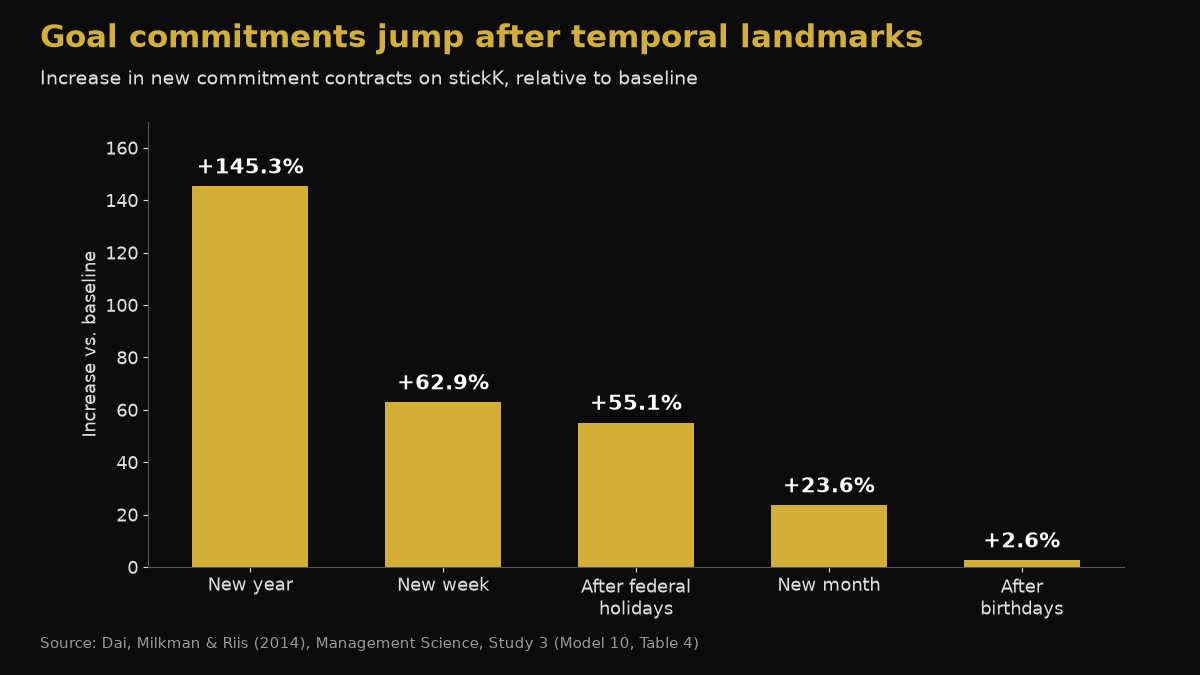
- Goal commitments on stickK, a commitment-contract website. People were more likely to commit to goals at the start of a new week (62.9%), month (23.6%), and year (145.3%), after federal holidays (55.1%), and after birthdays (2.6%).
Dai and colleagues call these dates temporal landmarks: moments that stand out in time and divide it into chapters. Their explanation is that landmarks open new "mental accounting periods." Past slip-ups get filed under the old chapter, and you're nudged to step back and look at your life as a whole [1].
Why a new chapter feels so powerful
Those first findings came from real-world data, so they showed a pattern but couldn't prove cause and effect. A year later, the same trio ran five lab experiments to test the mechanism [2]. In one of them, people chose a date for an email reminder about a goal. The only difference between groups was how one date was labeled: March 20 was either "The First Day of Spring" or "The Third Thursday in March." With the new-beginning label, 25.61% of participants picked March 20 for their reminder. With the ordinary label, 7.23% did [2].
The same date got a new label and drew more than three times as many sign-ups. The researchers found that the motivation boost comes partly from psychological distance from your "past, imperfect self" [2]. A fresh start doesn't make you a new person. It makes the old failures feel like they belonged to someone else.
Timing is a central theme of Katy Milkman's 2021 book How to Change [9]. One disclosure: Milkman co-authored several of the studies cited here, so the book is partly a summary of her own research. It's a great read, but not independent confirmation.
The fine print: fresh starts that fizzle
Now for the reality check, in three parts.
1. Landmarks help you start. Staying with it is a different problem. In a randomized trial with 15,011 insurance customers, Dai and colleagues mailed medication-adherence reminders timed to birthdays or the New Year, with or without "fresh start" wording [5]. Adherence over 90 days was no better than with reminders sent on ordinary dates. The authors suggest that fresh starts mainly boost starting a goal, and that taking medication every day depends on persistence. They also note that many New Year reminders didn't arrive until late January [5]. Disclosure: the trial was funded by the insurer Humana, and several authors reported Humana grants [5].
2. Waiting for Monday has a real cost. Marie Hennecke and Benjamin Converse found that planners prefer to start on days just after a temporal boundary, partly because they overlook practical obstacles on those days [3]. In their field experiment, aspiring dieters were more likely to give up a week of access to an expensive weight-loss program just to start on a day that felt like a boundary [3]. If you've ever said "I'll start Monday" on a Wednesday, you've paid this tax.
3. The "stale start." When a landmark is coming up, people coast. Minjung Koo, Hengchen Dai, Ke Michael Mai, and Camilla Song found that when an upcoming new beginning becomes salient, people treat their future self as a separate person who will handle things. They put in less effort now and often don't make up for it after the landmark [4]. The fix they found was to remind people of the everyday things they already do consistently toward the goal [4]. A review by Dai and Claire Li also notes that landmarks can stop motivating, or even backfire, under some conditions [10]. That's why late October is the danger zone for "I'll just restart in January."
Do New Year's resolutions actually work?
The biggest landmark of the year deserves a separate look. Psychologist John Norcross and colleagues followed 159 New Year's resolvers and 123 similar people who wanted to change a problem later [7]. At six months, 46% of resolvers were continuously successful, compared with 4% of non-resolvers. Confidence in their ability to change, change skills, and readiness to change all predicted success [7]. One caveat: people chose their own group and reported their own results, so this isn't a controlled experiment.
A larger randomized study by Martin Oscarsson, Per Carlbring, Gerhard Andersson, and Alexander Rozental followed 1,066 Swedish adults [8]. At one year, 55% of those who responded considered themselves successful. People with approach goals ("start running") did better than people with avoidance goals ("stop snacking"): 58.9% vs. 47.1%. The group that got some support did best, ahead of both no support and extended support [8]. Disclosure: three of the authors receive royalties from a book on New Year's resolutions that is partly based on this study [8].
The fresh start effect works on more than willpower
The most practical proof comes from money. John Beshears, Hengchen Dai, Katherine Milkman, and Shlomo Benartzi mailed 6,082 university employees an offer to save more for retirement, either now or at a future date [6]. When that future date was framed as a fresh start (for example, "after your birthday" or "the first day of spring"), more people signed up for the later increase, by 1.4 percentage points. And it didn't come at the cost of fewer people saving right away [6]. Over eight months, contribution rates rose 23%-26% compared with the control group [6].
The takeaway is to lock in the fresh-start decision ahead of time. Getting excited and waiting for the date is the weaker move. That idea drives the playbook below.

The Landmark Playbook: how to restart goals any time of year
This is how to restart goals using the research, starting with your own calendar.
Step 1: Spot your upcoming landmarks. Write them down:
- The next Monday. Weekly landmarks come around most often, and they showed a boost in all three original datasets [1]. Use your Monday motivation to begin something, not to judge your whole week.
- The first of next month. When the first falls on a weekend, the following Monday doubles as a start-of-month and start-of-week landmark in one.
- The Monday after a major holiday. Holidays were landmarks in both the search and stickK data [1]. Think Thanksgiving, Labor Day, or any break that resets your routine.
- Your birthday, a new job, or another life milestone. Personal landmarks count too [1].
- January 1. It's the big one, but don't let it be your only one.
Step 2: Don't wait for the big date. Make a landmark now. In the lab, simply relabeling a date changed people's choices [2]. Name your own: "Day 1 of my Q4 sprint" or "Chapter 2 starts Saturday." Pick the closest date that honestly feels like a new beginning, not the most impressive one. That way you avoid the Monday tax [3].
Step 3: Pre-commit at the landmark. Do what the retirement study did: decide today what changes on the landmark date, and schedule it [6]. Put the date, the first action, and a time on your calendar, and frame the goal as something to start rather than stop [8].
Step 4: Prevent a stale start. Before any big landmark, list two or three things you already do consistently for the goal, and keep doing them right up to the date [4]. Habits shouldn't pause just because a new chapter is coming. (For the difference between the two, see habits vs. goals.)
Step 5: Plan for persistence. The landmark gets you started, and something else has to keep you going [5]. Recruit one supportive person [8], track progress on a regular schedule, and get the basics right with our goal-setting starter guide.
Step 6: Make restarts cheap. Missed a week? You don't need to wait for January. Next Monday is never more than seven days away.
This is exactly what Goald AI is being built for. You can schedule a restart on a real landmark, pair the goal with daily habits, and have the AI Mentor nudge you when a "stale start" is creeping in. (Curious how far AI coaching can take you? Read AI for productivity: what the research busts.) Goald AI is an upcoming iOS app: Free for up to 3 goals, or Pro for $9.99/month or $99.99/year, with goals, habits, fitness tracking, smart scheduling, and the AI Mentor.
Your next landmark is closer than January. Join the waitlist and get there first.
Sources
- Dai, H., Milkman, K. L., & Riis, J. (2014). The Fresh Start Effect: Temporal Landmarks Motivate Aspirational Behavior. Management Science, 60(10), 2563-2582. https://doi.org/10.1287/mnsc.2014.1901
- Dai, H., Milkman, K. L., & Riis, J. (2015). Put Your Imperfections Behind You: Temporal Landmarks Spur Goal Initiation When They Signal New Beginnings. Psychological Science, 26(12), 1927-1936. https://doi.org/10.1177/0956797615605818
- Hennecke, M., & Converse, B. A. (2017). Next Week, Next Month, Next Year: How Perceived Temporal Boundaries Affect Initiation Expectations. Social Psychological and Personality Science. https://doi.org/10.1177/1948550617691099
- Koo, M., Dai, H., Mai, K. M., & Song, C. E. (2020). Anticipated temporal landmarks undermine motivation for continued goal pursuit. Organizational Behavior and Human Decision Processes, 161, 142-157. https://doi.org/10.1016/j.obhdp.2020.06.002
- Dai, H., Mao, D., Riis, J., Volpp, K. G., Relish, M. J., Lawnicki, V. F., & Milkman, K. L. (2017). Effectiveness of Medication Adherence Reminders Tied to "Fresh Start" Dates: A Randomized Clinical Trial. JAMA Cardiology, 2(4), 453-455. https://doi.org/10.1001/jamacardio.2016.5794
- Beshears, J., Dai, H., Milkman, K. L., & Benartzi, S. (2021). Using Fresh Starts to Nudge Increased Retirement Savings. Organizational Behavior and Human Decision Processes, 167, 72-87. https://doi.org/10.1016/j.obhdp.2021.06.005
- Norcross, J. C., Mrykalo, M. S., & Blagys, M. D. (2002). Auld Lang Syne: Success Predictors, Change Processes, and Self-Reported Outcomes of New Year's Resolvers and Nonresolvers. Journal of Clinical Psychology, 58(4), 397-405. https://doi.org/10.1002/jclp.1151
- Oscarsson, M., Carlbring, P., Andersson, G., & Rozental, A. (2020). A large-scale experiment on New Year's resolutions: Approach-oriented goals are more successful than avoidance-oriented goals. PLOS ONE, 15(12), e0234097. https://doi.org/10.1371/journal.pone.0234097
- Milkman, K. (2021). How to Change: The Science of Getting from Where You Are to Where You Want to Be. Portfolio/Penguin. https://www.penguinrandomhouse.com/books/607813/how-to-change-by-katy-milkman-foreword-by-angela-duckworth/
- Dai, H., & Li, C. (2019). How experiencing and anticipating temporal landmarks influence motivation. Current Opinion in Psychology, 26, 44-48. https://doi.org/10.1016/j.copsyc.2018.04.012
Goald AI is coming to iOS.
Join the waitlist — be first in when we launch.
Related posts
goals
The Right Way to Set Goals (And Why Most People Get It Wrong)
Most goal-setting advice focuses on what to aim for. But the real problem is structure — here's how to build goals that actually convert into daily action.
productivity
Your Brain Is Still in That Email: A 5-Day Focus Test
Task switching leaves your brain stuck on the last thing you did. Try this 5-day focus experiment, backed by studies, to track and shrink attention residue.
productivity
AI for Productivity: 5 Myths the Research Busts
Does AI for productivity really make you faster? Five popular myths meet the randomized trials, from coding and writing to consulting and critical thinking.