Your Brain Is Still in That Email: A 5-Day Focus Test

You closed the email. You opened the slide deck. Your eyes are on slide three. But part of your brain is still back in the inbox, rereading that one weird sentence from your boss.
That leftover pull is the hidden tax of task switching. Every jump between tasks can cost a little time, a little stress, and a slice of attention that stays stuck on whatever you just left.
So instead of another list of focus tips, let's run an experiment. Five days, five protocols, each one built on a real study. You'll track simple numbers, score each day, and finish with a scorecard that tells you which tricks are worth keeping. Your brain is the lab. Let's go.
Why task switching costs more than you think
Psychologists have measured switch costs in the lab for decades. In a classic set of four experiments, Joshua Rubinstein of the Federal Aviation Administration and David Meyer and Jeffrey Evans of the University of Michigan found that switching between tasks took longer when the task rules were more complex, and less time when a cue signaled what was coming next [2]. Their model splits each switch into two stages: shifting your goal ("now I'm doing this") and loading the rules for the new task [2].
Then Sophie Leroy, a management researcher then at the University of Minnesota, asked a sneakier question: what happens to the part of your mind that doesn't switch? She called it attention residue: thoughts about Task A that keep running in the background while you work on Task B [1]. As Leroy points out, even when people do one task at a time on the outside, their minds can keep multitasking on the inside [1].
Translation: multitasking isn't only juggling two tabs. It's also the quiet version, where your body is on the new task and your head is still on the old one.
The good news: Leroy's work, plus a few other studies, points to specific moves that seem to shrink the residue. That's what the next five days are for.
How the experiment works
- Pick a normal workweek. Run one protocol per day, Monday to Friday.
- Score every evening. Rate your focus from 1 to 10 and jot down the day's numbers in the scorecard at the end of this post.
- Do a residue check. A few times a day, right as you start a new task, rate from 1 to 5 how much your mind is still on the last one (1 = fully here, 5 = totally elsewhere). Average them.
- Keep everything else steady. Same caffeine, similar sleep, so the changes are easier to read.
- Remember the fine print. This is a personal experiment, not a clinical trial. You're looking for what works for you.
Day 1: Count your switches (the baseline)
The science: You can't shrink what you don't measure. In the lab, switch costs grew as tasks got more complex [2], and real workdays are rarely simple.
The protocol: Work as you normally would. Keep a sticky note nearby and make a tally mark every time you switch to a different task, app, or conversation. Checking your phone counts. So does "just glancing" at email.
Track: Total switches. Residue check average (1-5). Focus (1-10).
Score it: No winners today. This is your baseline, and every other day gets compared with it.
Day 2: Email in three batches
The science: Kostadin Kushlev and Elizabeth Dunn, psychologists at the University of British Columbia, ran a two-week experiment with 124 adults [4]. For one week, people checked email only three times a day, with the inbox closed and notifications off in between. For the other week, they checked as often as they liked. In the limited week, they checked about 4.7 times a day instead of about 12.5, and they reported lower daily stress and felt less distracted by email [4]. Fair caveats: the authors called the study exploratory, stress was the most consistent result, and the participants were heavy email users with some control over their schedules [4].
The protocol: Pick three email windows (say 9:00, 12:30, and 4:30). Close the inbox and turn off email alerts the rest of the time. If phone notifications are your bigger culprit, our dopamine detox guide covers notification batching, too.
Track: Email checks (tally). Stress at day's end (1-5). Residue check (1-5). Focus (1-10).
Score it: Fewer checks than your usual and lower stress count as a win.
Day 3: Finish lines and doable deadlines
The science: This one comes straight from Leroy's lab [1]. In her second study, 78 students worked on a first task that they either finished or didn't, under high or low time pressure. Then came a surprise second task: reviewing résumés and recalling what was in them. Only one group stood out. People who finished the first task under time pressure recalled about 65 accurate ideas, versus 44 to 47 for everyone else [1]. Leroy found that feeling confident about having met the first task's goal helped explain the gap [1]. In her first study, leaving a task unfinished produced more attention residue [1].
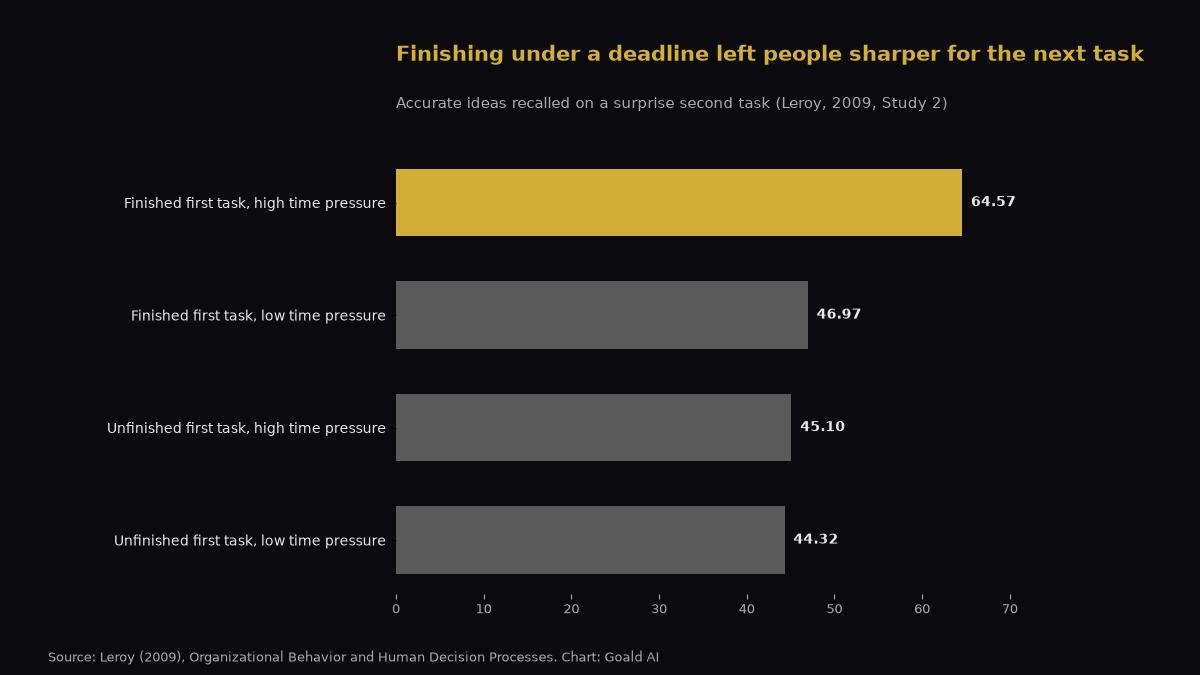
The protocol: Before each work block, define a finish line you can realistically cross before a timer runs out, like "draft the intro" instead of "work on the report." Set the timer for 25 to 50 minutes. Leroy suggests that deadlines people can actually meet may make transitions easier [1], so keep the finish line small enough to hit.
Track: Blocks started vs. finished. Residue check (1-5). Focus (1-10).
Score it: Most blocks finished and a lower residue average than Day 1 = a win.
Day 4: The parking-lot plan
The science: Sometimes you can't finish. Meetings happen. E. J. Masicampo and Roy Baumeister, then at Florida State University, found that unfinished goals tended to pop back into people's minds and drag down performance on unrelated tasks [5]. But making a specific plan for the unfinished goal made those effects disappear [5]. In one study, people reminded of an unfulfilled goal solved about 6.6 anagrams on average, while people who also made a plan for it solved about 9.6, statistically on par with the control group's 8.4 [5].
The protocol: Whenever you have to leave a task unfinished, take 60 seconds to write a "parking-lot" note: the very next step, plus when you'll do it. "Finish the slide 4 chart, tomorrow at 10 a.m." Then switch.
Track: Tasks parked. Intrusive thoughts (a tally mark each time a parked task pops into your head). Residue check (1-5). Focus (1-10).
Score it: A lower residue average than Day 1, even though you still switched, means the parking lot is doing its job.
Day 5: One protected deep work block
The science: Interruptions don't always slow you down, which is the sneaky part. Gloria Mark of the University of California, Irvine, with Daniela Gudith and Ulrich Klocke of Humboldt University Berlin, interrupted 48 people every few minutes during a simulated email task [3]. The interrupted groups actually finished faster (about 20.3 to 20.6 minutes vs. 22.8) with no measurable drop in quality, though they wrote shorter emails [3]. The price showed up elsewhere: "After only 20 minutes of interrupted performance people reported significantly higher stress, frustration, workload, effort, and pressure" [3]. Stress ratings rose from about 6.9 to about 9.1 to 9.5 on a 20-point scale [3].
What about your phone? A widely shared 2017 study by Adrian Ward of the University of Texas at Austin and colleagues found that students who left their phone in another room did better on working-memory and reasoning tests than students whose phone sat on the desk [6]. Honest footnote: at least two later replication attempts didn't find the effect [7][8]. So treat "your phone drains your brain just by sitting there" as unsettled. Putting it in another room is still the simplest way to take the interruption option off the table.
The protocol: Use time blocking to put one 90-minute deep work block on your calendar for your most important task. Notifications off, phone in another room, email closed. Bring your Day 3 finish line and your Day 4 parking lot for stray thoughts.
Track: Interruptions during the block. What you finished. Stress (1-5). Residue check (1-5). Focus (1-10).
Score it: Compare stress and focus with Days 1 and 2. Did 90 protected minutes get more done than a typical morning? Be honest.
Your 5-day task switching scorecard
Copy this into a notes app or onto paper and fill it in each evening.
| Day | Experiment | Key metric | Your number | Residue (1-5) | Focus (1-10) | Keep it? |
|---|---|---|---|---|---|---|
| 1 | Baseline | Switches counted | n/a | |||
| 2 | Email in 3 batches | Email checks | ||||
| 3 | Finish lines | Blocks finished / started | ||||
| 4 | Parking-lot plan | Intrusive thoughts | ||||
| 5 | Deep work block | Interruptions |
How to read your results (our rule of thumb, not a research threshold):
- Keep it if focus rose 2+ points over Day 1 or your residue average dropped by 1+.
- Tweak it if it helped a little but felt clunky. Try a different time window or block length next week.
- Drop it if it felt like a chore with no payoff.
- Trust the numbers over your gut. In our look at AI for productivity myths, people's sense of being faster didn't match the stopwatch. Your scorecard is your stopwatch.
Then add your keepers to next week one at a time. Turning a keeper into a default is a habit question, and our breakdown of habits vs. goals shows how the two work together.
How Goald AI fits in
Every experiment above comes down to two moves: decide what deserves your focus, then actually protect that time. Goald AI is built for both. Set a focus goal, track your daily experiment as a habit, and use smart scheduling to find real time in your week for time blocking and deep work. Your AI Mentor remembers your goals and history, so it can help you review your scorecard and adjust next week's plan.
Goald AI is coming soon to iOS. The free tier covers up to 3 goals, and Goald AI Pro is $9.99/month or $99.99/year. Join the waitlist.
Sources
- Leroy S. "Why is it so hard to do my work? The challenge of attention residue when switching between work tasks." Organizational Behavior and Human Decision Processes, 2009.
- Rubinstein JS, Meyer DE, Evans JE. "Executive control of cognitive processes in task switching." Journal of Experimental Psychology: Human Perception and Performance, 2001.
- Mark G, Gudith D, Klocke U. "The cost of interrupted work: more speed and stress." Proceedings of CHI 2008, 2008.
- Kushlev K, Dunn EW. "Checking email less frequently reduces stress." Computers in Human Behavior, 2015.
- Masicampo EJ, Baumeister RF. "Consider it done! Plan making can eliminate the cognitive effects of unfulfilled goals." Journal of Personality and Social Psychology, 2011.
- Ward AF, Duke K, Gneezy A, Bos MW. "Brain Drain: The Mere Presence of One's Own Smartphone Reduces Available Cognitive Capacity." Journal of the Association for Consumer Research, 2017.
- Hartmann M, Martarelli CS, Reber TP, Rothen N. "Does a smartphone on the desk drain our brain? No evidence of cognitive costs due to smartphone presence in a short-term and prospective memory task." Consciousness and Cognition, 2020.
- Ruiz Pardo AC, Minda JP. "Reexamining the 'brain drain' effect: A replication of Ward et al. (2017)." Acta Psychologica, 2022.
Goald AI is coming to iOS.
Join the waitlist — be first in when we launch.
Related posts
productivity
AI for Productivity: 5 Myths the Research Busts
Does AI for productivity really make you faster? Five popular myths meet the randomized trials, from coding and writing to consulting and critical thinking.
goals
The Fresh Start Effect: Your Calendar's Reset Button
The fresh start effect explains why Mondays, birthdays, and January 1 make goals easier to start. Here's the science, plus a playbook for your next restart.
habits
Breathwork Benefits: What Works and What Doesn't
Real breathwork benefits vs. hype: what the studies show about cyclic sighing, box breathing, slow breathing for HRV, Wim Hof breathing, and mouth taping.