Dopamine Detox: What Works and What Doesn't
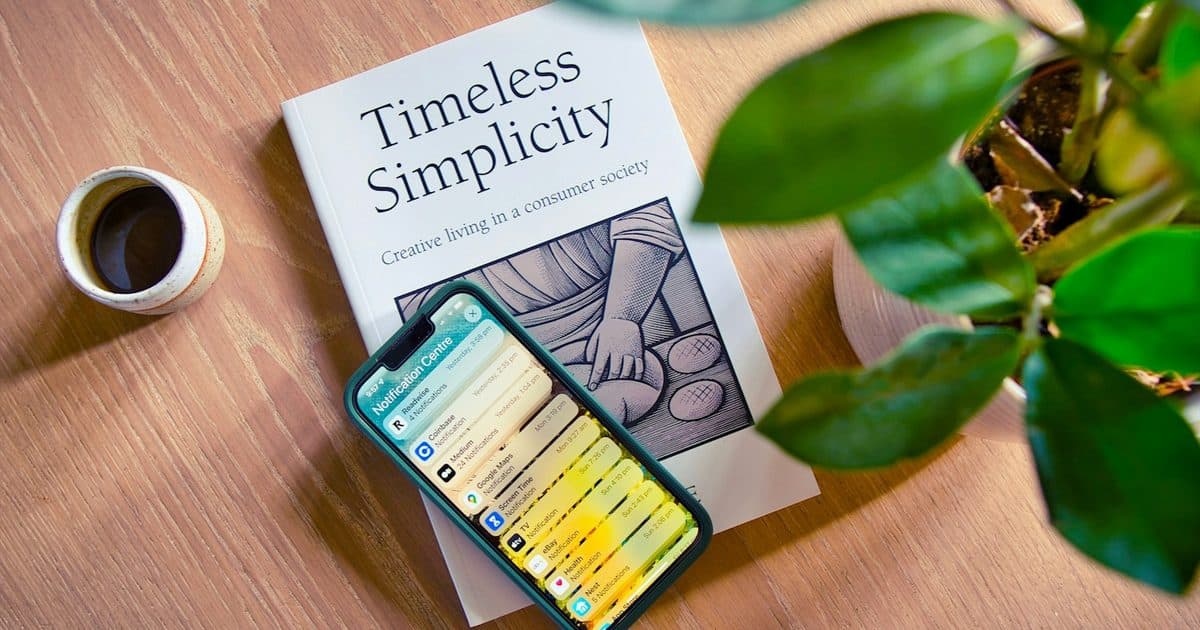
Somewhere right now, a guy is sitting in a dark room, refusing to make eye contact, eating plain rice, and calling it a dopamine detox. TikTok is full of "dopamine reset" challenges, and Silicon Valley made "dopamine fasting" a thing back in 2019. The promise: starve your brain of pleasure for a weekend, and everything boring (work, reading, the gym) suddenly feels amazing again.
Here's the twist. The brain chemistry behind that promise is mostly wrong. But some of the habits under the hype are backed by solid experiments. Let's sort the science from the vibes.
Where the dopamine detox trend came from
The idea took off with Cameron Sepah, a California clinical psychologist and clinical professor of psychiatry at UCSF. In 2019 he published "The Definitive Guide to Dopamine Fasting 2.0." His version was never about lowering a brain chemical. In his own words, "we ARE NOT fasting from dopamine itself, but from impulsive behaviors reinforced by it" [1].
Sepah built his approach on two classic cognitive behavioral therapy (CBT) tools [1]:
- Stimulus control: put the trigger (like your phone) away or make it harder to reach, or do something that's incompatible with it.
- Exposure and response prevention: feel the urge, or the boredom or stress behind it, without automatically acting on it.
He also said to target only the specific behaviors causing problems for you, not all pleasure [1]. His suggested schedule was gentle: one to four hours at the end of the day, one weekend day, one weekend per quarter, and one week per year [2].
Then the internet got hold of it. As Peter Grinspoon, a physician who writes for Harvard Health Publishing, put it, people started avoiding food, exercise, music, and even conversation. That was never part of Sepah's idea [2]. Sepah himself told The New York Times the name is "not to be taken literally" [2].
What dopamine actually does (spoiler: it's not a fuel tank)
The viral version treats dopamine like a battery you've drained by scrolling. Rest it for a weekend and it recharges. That's not how it works.
Dopamine is a neurotransmitter involved in reward, motivation, and learning. One of its best-studied jobs is teaching. Neuroscientist Wolfram Schultz has spent decades showing that dopamine neurons encode reward prediction errors. They fire more when something is better than expected, hold steady when a reward is fully predicted, and dip when things turn out worse than expected [3]. Dopamine is less a "pleasure juice" and more a "huh, update your expectations" signal.
That may help explain why endless feeds, notifications, and autoplay feel so sticky: they're unpredictable. Fitz and colleagues compared phone notifications to a slot machine that exploits "our inherent psychological bias for variable rewards" [4].
And the "fast"? Avoiding stimulation doesn't drain or refill some dopamine reserve. Grinspoon is blunt: dopamine rises in response to rewards, "it doesn't actually decrease when you avoid overstimulating activities, so a dopamine 'fast' doesn't actually lower your dopamine levels" [2]. There are no "depleted dopamine stores" waiting to refill [2].
Translation: you can't detox from a molecule your brain makes all day for basic functions. But you can change the habits and cues your brain has learned to chase. That part is real, and it's where the evidence lives.
What works, part 1: less social media, not zero
This is where the research gets genuinely encouraging.
- The 30-minute experiment. Melissa Hunt and colleagues at the University of Pennsylvania randomly assigned 143 undergrads to either use social media as usual or limit Facebook, Instagram, and Snapchat to 10 minutes per platform per day, for three weeks. The limited group had significant drops in loneliness and depression compared with the control group [5]. Fun bonus: both groups had less anxiety and FOMO than at baseline, which the authors think came from simply tracking their usage [5].
- The Facebook deactivation study. Economists Hunt Allcott, Luca Braghieri, Sarah Eichmeyer, and Matthew Gentzkow paid US users to deactivate Facebook for four weeks before the 2018 midterms. People spent more time offline, including with friends and family. They reported small but significant gains in happiness, life satisfaction, depression, and anxiety (about 0.09 standard deviations on their well-being index). They also kept using Facebook less after the experiment ended [6]. One honest trade-off: they also knew less about the news [6].
So a social media break helps, but the effect is modest. It's a nudge, not a miracle.
What works, part 2: cutting back beats quitting
If total abstinence were the magic move, the strictest detox would win. It doesn't.
Julia Brailovskaia and her team at Ruhr University Bochum randomly assigned 619 smartphone users in Germany to one of three groups. One group gave up their smartphone completely for a week. One cut daily use by one hour. One changed nothing [7]. Both interventions reduced depressive and anxiety symptoms and boosted life satisfaction and physical activity. But most effects were stronger and lasted longer (four months) in the one-hour reduction group [7]. Only that group also smoked fewer cigarettes a day [7].
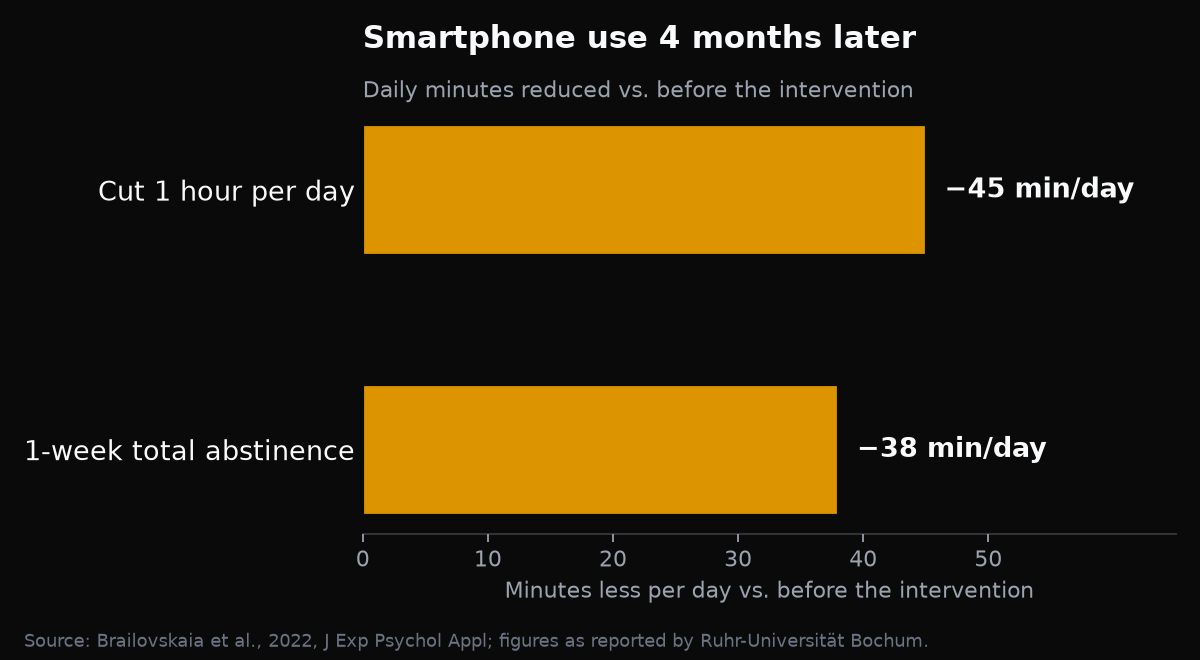
Even four months later, the abstinence group used their phones about 38 minutes less per day than before. The reduction group was down about 45 minutes [8]. Brailovskaia's takeaway: "It's not necessary to completely give up the smartphone to feel better" [8].
If you want to reduce screen time, aim for sustainable, not heroic.
What works, part 3: change the cue, not your willpower
This is Sepah's stimulus control in action, and it's the most underrated tool in the box.
In a randomized field experiment with 237 people, Nicholas Fitz, Kostadin Kushlev, and colleagues tested phone notifications delivered as usual, batched into three predictable deliveries a day, or turned off entirely [4]. The batched group felt more attentive, more productive, in a better mood, and more in control of their phones, with lower stress and fewer interruptions [4]. Plot twist: people who got no notifications at all saw few of those benefits and felt more anxiety and FOMO [4].
That's the whole dopamine detox story in miniature. Extreme restriction backfires. Smart structure wins.
What works, part 4: train your boredom tolerance
Here's the uncomfortable truth behind the trend: a lot of us really don't like being alone with our thoughts.
In a 2014 study in Science, Timothy Wilson and colleagues left people alone in a room for 15 minutes with nothing to do but think. They could also press a button to give themselves a mild electric shock, one they had already said they'd pay to avoid. Still, 67% of men (12 of 18) and 25% of women (6 of 24) shocked themselves at least once [9]. One participant did it 190 times [9].
That's why "just stop scrolling" fails. The scroll is often an escape from boredom, stress, or loneliness. Building boredom tolerance is basically Sepah's exposure and response prevention [1]: notice the itch, sit with it for a minute, and let it pass. It's a skill, and like any skill, reps make it easier.
What works, part 5: replace it with something good (hello, exercise)
Sepah's framework says to swap problem behaviors for healthy, values-aligned ones, like exercise and socializing [1]. The evidence for the exercise part is huge. A 2023 umbrella review in the British Journal of Sports Medicine, led by Ben Singh, pooled 97 systematic reviews covering 1,039 trials and 128,119 adults. Physical activity produced medium-sized reductions in depression, anxiety, and psychological distress compared with usual care [10].
You can't scroll and do intervals at the same time. That's stimulus control and a mood boost in one move. If you need a starting point, our guide to Zone 2 training is a great low-stress way in.
What doesn't work
- Avoiding all pleasure. Your dopamine levels aren't "resetting" while you stare at a wall [2].
- Avoiding people. Social contact is one of the healthy replacements, not the enemy [2].
- A one-off weekend detox followed by a binge. The benefits in the studies came from sustained changes over weeks [5][6][7].
- Going nuclear on notifications. Batching beat turning them all off [4].
A 7-day dopamine detox protocol you can actually stick to
- Pick one or two target behaviors. Not "all fun." Something like late-night scrolling or doom-checking email [1].
- Measure first. Check your screen-time stats for a few days. In the Hunt study, simply tracking usage seemed to help too [5].
- Cut, don't quit. Aim for about 30 minutes a day of social media [5], or one hour less phone time than your baseline [7].
- Batch your notifications. Three check-in windows a day, not hourly, and not zero [4].
- Add friction. Phone in another room during focus blocks and at bedtime [1]. Bonus: it protects your sleep routine, and sleep consistency matters more than you think.
- Practice 10 boring minutes a day. A walk with no podcast, or waiting in line without your phone. Notice the urge and let it pass [1][9].
- Swap in movement. Every time you'd normally scroll after work, take a walk or do a short workout instead [10].
Then repeat next week. A dopamine detox only works as a habit, not a one-time event. That's the same lesson from habits vs. goals: the goal sets the direction, and the daily system does the work.
How Goald AI fits in
The hard part of any dopamine detox isn't knowing what to do. It's doing it on day 9, when the novelty has worn off and your thumb is on autopilot.
Goald AI is built for exactly that. Set a goal like "cut phone time by an hour a day," then pair it with daily habits like a phone-free bedtime, three notification check-ins, and a 20-minute walk. Goald AI tracks your habits and workouts in one place. Smart scheduling finds room for the replacement habits in your real calendar. And your AI Mentor remembers your goals and history, so when a stressful week pulls you back into the scroll, it adjusts your plan instead of letting the streak quietly die.
Goald AI is coming to iOS soon. The free tier covers up to 3 goals, and Goald AI Pro is $9.99/month or $99.99/year. See all the features or Join the waitlist.
Not medical advice. This article is for general education only. If phone, gaming, gambling, or other compulsive behaviors are seriously affecting your life, or you're dealing with depression or anxiety, talk to a doctor or licensed mental health professional.
Sources
- Sepah C. "The Definitive Guide to Dopamine Fasting 2.0 - The Hot Silicon Valley Trend." LinkedIn, 2019. https://www.linkedin.com/pulse/dopamine-fasting-new-silicon-valley-trend-dr-cameron-sepah
- Grinspoon P. "Dopamine fasting: Misunderstanding science spawns a maladaptive fad." Harvard Health Blog, Harvard Health Publishing, 2020. https://www.health.harvard.edu/blog/dopamine-fasting-misunderstanding-science-spawns-a-maladaptive-fad-2020022618917
- Schultz W. "Dopamine reward prediction error coding." Dialogues in Clinical Neuroscience, 2016. https://pmc.ncbi.nlm.nih.gov/articles/PMC4826767/
- Fitz N, Kushlev K, et al. "Batching smartphone notifications can improve well-being." Computers in Human Behavior, 2019. https://doi.org/10.1016/j.chb.2019.07.016
- Hunt MG, Marx R, Lipson C, Young J. "No More FOMO: Limiting Social Media Decreases Loneliness and Depression." Journal of Social and Clinical Psychology, 2018. https://doi.org/10.1521/jscp.2018.37.10.751
- Allcott H, Braghieri L, Eichmeyer S, Gentzkow M. "The Welfare Effects of Social Media." American Economic Review, 2020. https://www.aeaweb.org/articles?id=10.1257/aer.20190658
- Brailovskaia J, et al. "Finding the 'sweet spot' of smartphone use: Reduction or abstinence to increase well-being and healthy lifestyle?! An experimental intervention study." Journal of Experimental Psychology: Applied, 2022. https://pubmed.ncbi.nlm.nih.gov/35389685/
- Ruhr-Universität Bochum. "Fewer smartphones, more well-being" (press release). Ruhr-Universität Bochum, 2022. https://news.rub.de/english/2022-04-20-psychology-fewer-smartphones-more-well-being
- Wilson TD, et al. "Just think: The challenges of the disengaged mind." Science, 2014. https://doi.org/10.1126/science.1250830
- Singh B, et al. "Effectiveness of physical activity interventions for improving depression, anxiety and distress: an overview of systematic reviews." British Journal of Sports Medicine, 2023. https://pubmed.ncbi.nlm.nih.gov/36796860/
Goald AI is coming to iOS.
Join the waitlist — be first in when we launch.
Related posts
habits
Habits vs Goals — Why You Need Both
Goals give you direction. Habits give you the engine. Here's why treating them as separate systems is one of the biggest mistakes in personal productivity.
fitness
CGM Without Diabetes: What Works and What Doesn't
Thinking about a CGM without diabetes? Here's what research says about glucose spikes, sensor accuracy, and food anxiety, plus how to actually use one well.
fitness
Protein Per Meal: Is the 30 g Limit a Myth?
Can your body only use 30 g of protein per meal? Newer studies say no. Here's what the research shows, what doesn't work, and how much protein to actually eat.