CGM Without Diabetes: What Works and What Doesn't

A few years ago, the little white disc on someone's arm meant one thing: diabetes. Now it might mean your gym buddy is running a "banana vs. oatmeal" experiment and texting you screenshots of her glucose curve.
Wearing a CGM without diabetes has gone mainstream. Real-time data from inside your own body? Irresistible. But does watching your blood sugar make healthy people healthier, or is it the world's most expensive way to feel bad about a bagel? Let's get into it.
First, a 30-second CGM refresher
A continuous glucose monitor (CGM) is a small sensor with a tiny filament under your skin. It measures glucose in the interstitial fluid around your cells, not your blood. That tracks blood glucose closely, but with an unavoidable time delay that matters most when levels change fast, like during exercise [1]. (Disclosure: one author of that review serves on Abbott's advisory board.)
For years, you needed a prescription. Then 2024 happened:
- March 2024: the FDA cleared Dexcom Stelo as the first over-the-counter CGM, for adults 18+ who don't use insulin, including people without diabetes curious how diet and exercise affect their glucose. Each sensor lasts up to 15 days. It's not for people with problematic low blood sugar, and users shouldn't make medical decisions from it without talking to a clinician [2].
- June 2024: Abbott got FDA clearance for Lingo, a 14-day over-the-counter CGM aimed at general consumers 18+ not on insulin, paired with a coaching app. Abbott says it's not intended to diagnose disease, including diabetes [3].
So yes, an over-the-counter CGM is now a checkout-button purchase. The more interesting question is what the data means.
What "normal" glucose actually looks like
Here's the reassuring part. A 2019 study led by Viral Shah put blinded Dexcom G6 sensors on 153 healthy, non-obese people without diabetes, aged 7 to 80, for up to 10 days [4]. The results:
- Average glucose was 98–99 mg/dL in every age group except people over 60, who averaged 104 mg/dL [4].
- People spent a median 96% of the day between 70 and 140 mg/dL [4].
- Median time above 140 mg/dL was 2.1%, about 30 minutes a day. Median time below 70 mg/dL was 1.1%, about 15 minutes a day [4].
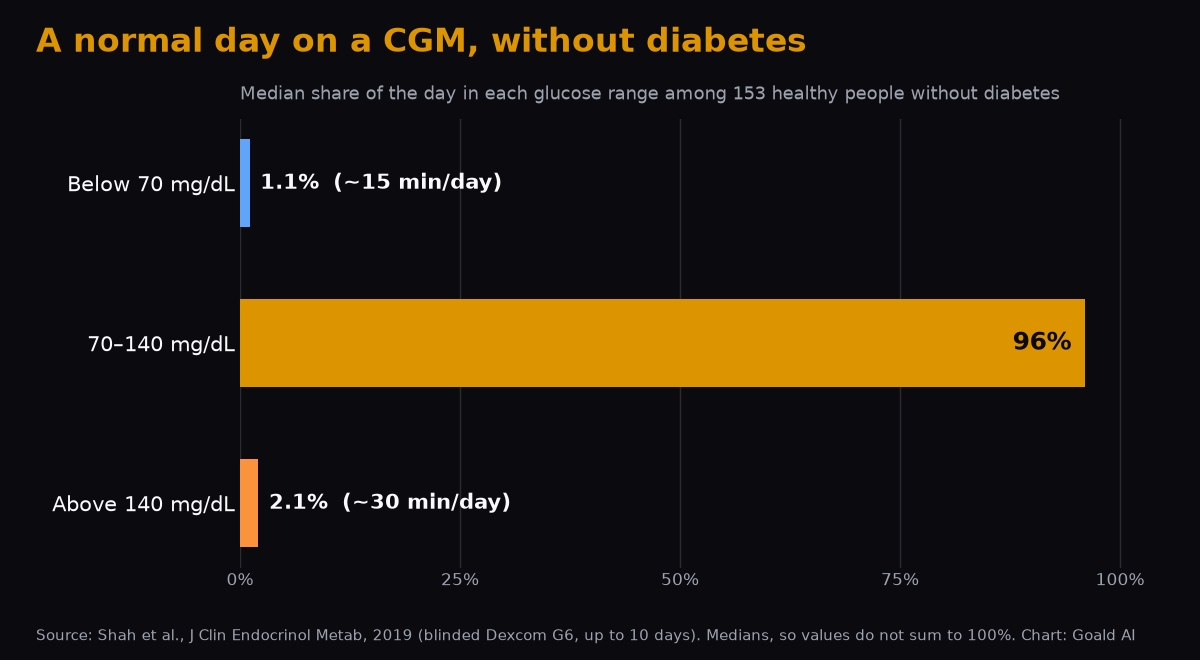
Translation: a healthy body lets glucose rise after meals and brings it back down. A short trip above 140 isn't a malfunction. It's what metabolism looks like.
Glucose spikes in healthy people: real, but what do they mean?
Not every study paints such a calm picture. In a 2018 Stanford study led by Heather Hall, 57 people wore CGMs for two to four weeks. Even people who looked normal on standard tests had glucose spikes that reached the prediabetic range 15% of the time and the diabetic range 2% of the time [5].
Sounds alarming, but it tells you spikes happen, not that they harm a healthy person. And one reading means very little. In a 2024 Nature Medicine study of 8,315 adults without diabetes, a team led by Smadar Shilo found fasting glucose varied by about 7.5 mg/dL (standard deviation) from morning to morning. Of the people whose first fasting reading was normal, 40% would have been reclassified into the prediabetes range based on their later readings, and 3% into the diabetes range [6].
So glycemic variability is real, and some is normal. What isn't clear is whether healthy people who flatten their curves end up healthier. A 2024 Diabetic Medicine review led by Zhanna Oganesova found a lack of consistent, high-quality evidence that CGMs help people without diabetes detect problems, change behavior, or improve metabolic health. It also noted that clinical guidelines don't recommend CGMs outside type 1 or insulin-treated type 2 diabetes [7].
The coolest finding: your glucose response is personal
This is the part that made CGMs famous. In 2015, a Weizmann Institute team led by David Zeevi tracked a week of glucose in 800 people across 46,898 meals and found high variability in how different people responded to identical meals [8]. A machine-learning model using blood tests, diet, activity, body measurements, and gut microbes predicted each person's response, and in a blinded randomized trial, personalized diets based on it lowered post-meal glucose [8].
The 2020 PREDICT 1 study, led by Sarah Berry, backed up the "everyone's different" part. Among 1,002 healthy UK adults, glucose responses to identical meals varied widely between people [9]. But here's the twist the hype skips: for glucose, the meal itself still mattered a lot. Meal macronutrients explained 15.4% of the variation in glucose responses, more than the gut microbiome did (6.0%) [9]. Personal biology matters, but carbs are still carbs.
The accuracy problem nobody puts on the box
Ranking meals "good" or "bad" by their spikes requires a precise sensor. That's where things get wobbly.
In a 2020 NIH study, Rebecca Howard and Kevin Hall had 16 adults without diabetes wear a Dexcom and an Abbott sensor at the same time over 28 inpatient days. The two devices often disagreed about which meals were "best," and picking meals by one sensor missed about half the glucose reduction measured by the other. Their conclusion: personalizing meals this way "may be premature" [10].
To be fair, a larger 2022 PREDICT 1 analysis led by Jordi Merino found much better agreement: in 394 people wearing two sensors, meal rankings correlated strongly (about 0.9 for two same-brand sensors, 0.7 across brands). Several authors work for or consult for ZOE, the nutrition company behind PREDICT [11].
Then there's the margin of error. John Pemberton, a pediatric diabetes dietitian and co-author of Oganesova's review, noted that the most accurate CGMs read within about 20% of true glucose most of the time. So a truly normal 7.8 mmol/L (about 140 mg/dL) could display as high as 9.4 mmol/L (about 169 mg/dL) [12]. That's a fake "spike" with real stress attached.
The hidden risk: food anxiety
Here's what doesn't work: treating every curve like a report card. The review, led by University College London (UCL), found evidence that CGM use in people without diabetes could cause anxiety about what "normal" eating and glucose look like, and it flagged a possible risk of disordered eating, such as orthorexia (an unhealthy obsession with eating "pure" food) [7][12]. Senior author Adrian Brown, a UCL dietitian, warned that people may misinterpret their data and avoid certain foods unnecessarily [12].
Even Abbott's Lingo fine print tells users to talk to a healthcare professional before changing their diet or exercise if they have an eating disorder or a history of one [3]. If a sensor makes you scared of fruit, it's not a health tool anymore. Take it off.
What works: using a CGM without diabetes the smart way
If you're curious and in a good place with food, a CGM can be a fun, short-term learning tool. Here's the evidence-based playbook:
- Run it like an experiment, not a lifestyle. We suggest a short experiment of roughly two to four weeks—wear one or two sensors, test a few specific questions, then stop. Change one thing at a time, and since readings vary day to day, repeat any test meal before drawing conclusions [6][10].
- Take short walks after you eat. A 2022 meta-analysis led by Aidan Buffey pooled seven one-day trials, mostly in adults with overweight or obesity. Breaking up long sitting with light walking lowered post-meal glucose and insulin versus staying seated, and beat standing breaks [13]. Walking after meals is the easiest, cheapest win here, and it pairs nicely with your Zone 2 training.
- Eat veggies and protein first, carbs last. In a study led by Alpana Shukla, 15 adults with prediabetes ate the same meal in different orders. Eating protein and vegetables first cut the glucose peak by more than 40% versus carbs first [14]. A small study in eight healthy young adults pointed the same way: rice eaten last gave the smallest glucose and insulin rise [15]. If you've been planning protein at every meal, you're already halfway there.
- Watch trends, not single numbers. A quick bump that comes back down is normal [4]. Look at your average and how you feel, not one alert.
- Notice your sleep, stress, and training. CGMs can make the effects of stress and exercise on glucose visible [1]. Weird numbers after a short night? A good nudge toward a consistent sleep schedule.
- Take real worries to a doctor. A CGM isn't a diagnostic test [2][3]. If you're concerned about prediabetes or diabetes, get proper lab testing.
Our take
- The tech is legit. Over-the-counter CGMs are FDA-cleared and genuinely fun for learning how you respond to food and movement [2][3].
- Spikes are normal. Healthy people spend most of the day in range and still rise above 140 mg/dL for a short time [4].
- Personal responses are real, but the meal itself still matters a lot [8][9].
- Precision is the weak spot. Sensors can disagree and readings bounce day to day, so don't build a diet around one curve [6][10][11][12].
- Long-term benefit for healthy people is unproven [7].
- The best moves don't need a sensor: walk after meals, eat veggies and protein first, sleep well, and train consistently [13][14][15].
How Goald AI fits in
A CGM can tell you a walk after dinner flattens your curve. It can't make you take the walk on a rainy Tuesday. That part is about habits.
Goald AI turns what you learn into a routine. Set a goal like "improve my metabolic health," then add supporting habits, such as a 10-minute walk after dinner or veggies and protein first at lunch. Track workouts and meals in one place, use smart scheduling to fit those walks into your real calendar, and let the AI Mentor adjust your plan when life gets busy. See how goals, habits, and the AI Mentor work together.
Goald AI is coming to iOS soon. Free covers up to 3 goals, and Pro is $9.99/month or $99.99/year. Join the waitlist.
Not medical advice. This article is for general education only. Talk to your doctor before using a CGM if you have diabetes, take insulin or glucose-lowering medication, are pregnant, have a history of disordered eating, or have any other medical condition. A consumer CGM is not a diagnostic test.
Sources
- Holzer R, Bloch W, Brinkmann C. "Continuous Glucose Monitoring in Healthy Adults—Possible Applications in Health Care, Wellness, and Sports." Sensors, 2022. https://pmc.ncbi.nlm.nih.gov/articles/PMC8915088/
- U.S. Food and Drug Administration. "FDA Clears First Over-the-Counter Continuous Glucose Monitor" (press announcement). FDA, 2024. https://www.fda.gov/news-events/press-announcements/fda-clears-first-over-counter-continuous-glucose-monitor
- Abbott. "Abbott Receives U.S. FDA Clearance for Two New Over-the-Counter Continuous Glucose Monitoring Systems" (press release). Abbott, 2024. https://abbott.mediaroom.com/2024-06-10-Abbott-Receives-U-S-FDA-Clearance-for-Two-New-Over-the-Counter-Continuous-Glucose-Monitoring-Systems
- Shah VN, DuBose SN, Li Z, et al. "Continuous Glucose Monitoring Profiles in Healthy Nondiabetic Participants: A Multicenter Prospective Study." Journal of Clinical Endocrinology & Metabolism, 2019. https://pubmed.ncbi.nlm.nih.gov/31127824/
- Hall H, Perelman D, Breschi A, et al. "Glucotypes reveal new patterns of glucose dysregulation." PLOS Biology, 2018. https://pmc.ncbi.nlm.nih.gov/articles/PMC6057684/
- Shilo S, Keshet A, Rossman H, et al. "Continuous glucose monitoring and intrapersonal variability in fasting glucose." Nature Medicine, 2024. https://pubmed.ncbi.nlm.nih.gov/38589602/
- Oganesova Z, Pemberton J, Brown A. "Innovative solution or cause for concern? The use of continuous glucose monitors in people not living with diabetes: A narrative review." Diabetic Medicine, 2024. https://pubmed.ncbi.nlm.nih.gov/38925143/
- Zeevi D, Korem T, Zmora N, et al. "Personalized Nutrition by Prediction of Glycemic Responses." Cell, 2015. https://pubmed.ncbi.nlm.nih.gov/26590418/
- Berry SE, Valdes AM, Drew DA, et al. "Human postprandial responses to food and potential for precision nutrition." Nature Medicine, 2020. https://pmc.ncbi.nlm.nih.gov/articles/PMC8265154/
- Howard R, Guo J, Hall KD. "Imprecision nutrition? Different simultaneous continuous glucose monitors provide discordant meal rankings for incremental postprandial glucose in subjects without diabetes." American Journal of Clinical Nutrition, 2020. https://pmc.ncbi.nlm.nih.gov/articles/PMC7528568/
- Merino J, Linenberg I, Bermingham KM, et al. "Validity of continuous glucose monitoring for categorizing glycemic responses to diet: implications for use in personalized nutrition." American Journal of Clinical Nutrition, 2022. https://pubmed.ncbi.nlm.nih.gov/35134821/
- University College London. "Use of glucose monitors by people not living with diabetes needs more regulation." UCL News, 2024. https://www.ucl.ac.uk/news/2024/jun/use-glucose-monitors-people-not-living-diabetes-needs-more-regulation
- Buffey AJ, Herring MP, Langley CK, Donnelly AE, Carson BP. "The Acute Effects of Interrupting Prolonged Sitting Time in Adults with Standing and Light-Intensity Walking on Biomarkers of Cardiometabolic Health in Adults: A Systematic Review and Meta-analysis." Sports Medicine, 2022. https://pmc.ncbi.nlm.nih.gov/articles/PMC9325803/
- Shukla AP, Dickison M, Coughlin N, et al. "The impact of food order on postprandial glycaemic excursions in prediabetes." Diabetes, Obesity and Metabolism, 2019. https://pmc.ncbi.nlm.nih.gov/articles/PMC7398578/
- Nishino K, Sakurai M, Takeshita Y, Takamura T. "Consuming Carbohydrates after Meat or Vegetables Lowers Postprandial Excursions of Glucose and Insulin in Nondiabetic Subjects." Journal of Nutritional Science and Vitaminology, 2018. https://pubmed.ncbi.nlm.nih.gov/30381620/
Goald AI is coming to iOS.
Join the waitlist — be first in when we launch.
Related posts
fitness
Protein Per Meal: Is the 30 g Limit a Myth?
Can your body only use 30 g of protein per meal? Newer studies say no. Here's what the research shows, what doesn't work, and how much protein to actually eat.
fitness
Zone 2 Training: What Works (and What Doesn't)
Zone 2 training builds a real aerobic base, but it isn't uniquely best for mitochondria. Here's what the evidence says, what doesn't work, and what to do.
fitness
Creatine for Your Brain? What the Science Actually Says
Creatine is having a moment as a brain supplement. Here's what the research really shows, where the hype runs ahead of the data, and who might benefit most.