Creatine for Your Brain? What the Science Actually Says
Creatine used to live in one place: the gym bag of the person grunting through their fifth set of squats. Now it's in your group chat, your favorite podcast, and your coworker's morning coffee, sold as a brain supplement.
So is creatine the new nootropic, or just the newest wellness rebrand? Good news: this is one trend with real science behind it. The fun part is figuring out which bits hold up and which don't.
Let's get into it.
First, a 30-second creatine refresher
Creatine is a compound your body makes, and you also get it from food, mostly red meat and seafood. About 95% of your body's creatine sits in skeletal muscle. The other ~5% is in places like your brain [1]. It helps recycle ATP, your cells' energy currency, which is why it shines during short, hard efforts.
For muscles, the evidence is rock solid. Creatine supplements reliably improve high-intensity exercise performance and training adaptations. It's one of the most-studied sports supplements on the planet [1]. A normal diet delivering 1–2 g a day leaves your muscle stores only about 60–80% full. Supplementing can raise muscle creatine and phosphocreatine by 20–40% [1]. For context, a pound of uncooked beef or salmon gives you roughly 1–2 g [1].
Your brain runs on energy too, and it's a very hungry organ. That's the logic behind the brain hype. But logic isn't proof, so let's look at what the studies found.
What the brain research actually found
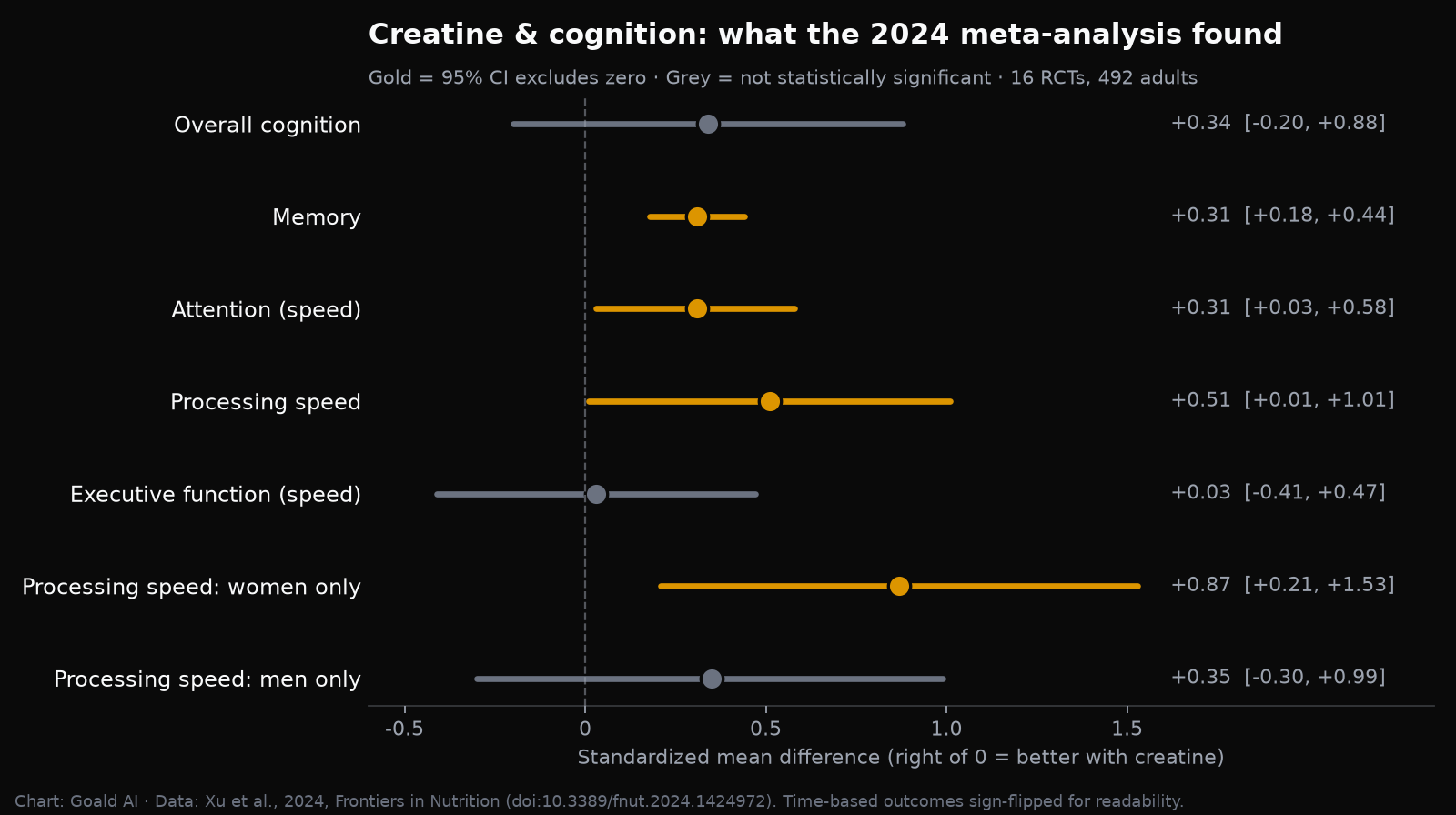
The biggest recent piece of evidence is a 2024 systematic review and meta-analysis in Frontiers in Nutrition. It pooled 16 randomized controlled trials covering 492 adults aged roughly 21 to 76 [2]. Here's the scorecard:
- Memory: a small but significant improvement. The researchers rated the certainty of this finding as moderate, the strongest in the paper [2].
- Attention and processing speed: significant improvements, but with low certainty [2].
- Overall cognition and executive function: no significant effect [2].
This lines up with an earlier 2018 systematic review of six trials in healthy people. It found that short-term memory and reasoning may improve with creatine, while results for other skills were mixed. Performance in young people mostly stayed the same. Vegetarians saw bigger memory gains than meat-eaters [3], which makes sense, because vegetarians start with lower creatine stores [1].
So: promising, with a clear signal for memory. Now for the plot twist.
The regulators aren't convinced (yet)
In 2024, a supplement ingredient maker asked European and UK regulators to approve an official "creatine improves cognitive function" health claim. Both said no.
The European Food Safety Authority (EFSA) pointed out that the working-memory boost showed up in studies using 20 g a day for 5–7 days. It did not show up at lower doses (2.2–14 g/day), or with 5 g a day for six weeks after a loading phase [4]. EFSA also criticized the 2024 meta-analysis for pooling several related tests from the same studies, which double-counts participants and inflates the sample size. Its verdict: a cause-and-effect link between creatine and better cognition "has not been established" [4].
The UK's Nutrition and Health Claims Committee looked at a proposed dose of 3 g a day or less. It found only one relevant trial (22 people taking 2.2 g a day for six weeks), and that trial showed no difference versus placebo on any cognitive test [5].
Translation: the brain benefits look real in some situations and at some doses. They're just not proven for everyday people taking a normal scoop. That's the honest state of the science in 2026.
Where creatine may shine: the tired brain
The most interesting clue is when creatine seems to help: when your brain is under stress.
In a 2024 study in Scientific Reports, researchers gave people a single large dose of creatine (0.35 g per kg of body weight) or a placebo during a night of sleep deprivation. With creatine, participants did better on cognitive tests and processing speed. Brain scans also showed changes in the brain's energy chemistry [6]. According to the research center that ran it, the study had 15 participants. Effects appeared about three hours after the dose, peaked around four hours, and lasted up to nine [7].

Before you plan a creatine-fueled all-nighter: for a 70 kg (154 lb) person, that dose works out to about 24.5 g, many times the usual daily amount. The lead researcher said explicitly that people shouldn't take a dose that high at home for now [7]. Treat this as a cool proof of concept, not a hack. (Also, just sleep. Sleep is undefeated.)
Why women are part of this conversation
One of the biggest shifts in creatine talk is who it's for. A 2021 review in Nutrients notes that women tend to have lower creatine stores than men, and that research on women has lagged behind [8]. The authors suggest creatine may matter most during hormonal transitions like menstruation, pregnancy, postpartum, and menopause, though much of that is still being studied [8]. In the same review, supplementation improved strength and exercise performance in pre-menopausal women. Post-menopausal women may gain muscle and bone benefits, especially when creatine is paired with resistance training [8].
On the brain side, the 2024 meta-analysis found that processing-speed benefits were significant in women but not in men [2]. Only four studies fed into that result, so call it "intriguing," not "settled."
The frontier: aging brains
Researchers are now testing creatine in older adults and in disease. In a small 2025 pilot, 20 people with Alzheimer's disease took 20 g of creatine a day for eight weeks. Brain creatine rose by 11%, and scores improved on several cognitive tests [9]. The big caveat: there was no placebo group, so it shows the approach is feasible, not that it works. Bigger trials come next.
Is it safe?
For healthy people, the safety record is one of creatine's strongest selling points. The International Society of Sports Nutrition concluded that doses up to 30 g a day for five years were safe and well tolerated in healthy people [1]. A 2025 analysis of 685 clinical trials, with nearly 13,000 people on creatine and over 13,000 on placebo, found side effects reported in 13.7% of creatine studies vs. 13.2% of placebo studies. That's no significant difference, and there were no differences in markers of kidney function [10].
The real secret: consistency
Here's the part the hype skips. Creatine works by saturation, not by instant kick. At 3–5 g a day, muscle stores fill up over about 3–4 weeks, and 3–5 g a day keeps them topped off [1]. The benefit comes from taking it every day for weeks, not from a heroic scoop now and then.
Which makes creatine less a supplement question and more a habit question. It's the same reason your training, protein, and sleep only pay off when they're consistent. This is exactly the kind of small daily action Goald is built to track, right next to the workouts it's supporting.
Our take
- Muscle and performance: strong evidence. Worth it for most people who train.
- Brain, everyday use: promising, especially for memory, but not proven at normal doses.
- Brain under stress (sleep loss, aging): the most exciting research, still early.
- Women: probably under-using one of the best-researched supplements out there.
- Form: creatine monohydrate is what nearly all the studies used [2][10]. No need for fancy versions.
How Goald fits in
Supplements are the easy part. Sticking with them, and with the training, sleep, and nutrition they support, is the hard part.
Goald connects your goals, habits, and fitness tracking in one place: workouts, reps, runs, and macros. Your AI Mentor remembers your goals and history. If you add a daily creatine habit to support a strength goal, Goald tracks it alongside your lifts. When life gets messy, your mentor adjusts your plan instead of letting the streak quietly die.
Goald is coming to iOS soon, with a free tier for up to 3 goals. Join the waitlist.
Not medical advice. This article is for general education only. Talk to your doctor before starting creatine or any supplement, especially if you have kidney disease, are pregnant or breastfeeding, take medication, or are under 18.
Sources
- Kreider RB, et al. "International Society of Sports Nutrition position stand: safety and efficacy of creatine supplementation in exercise, sport, and medicine." Journal of the International Society of Sports Nutrition, 2017. https://pmc.ncbi.nlm.nih.gov/articles/PMC5469049/
- Xu C, et al. "The effects of creatine supplementation on cognitive function in adults: a systematic review and meta-analysis." Frontiers in Nutrition, 2024. https://www.frontiersin.org/journals/nutrition/articles/10.3389/fnut.2024.1424972/full
- Avgerinos KI, et al. "Effects of creatine supplementation on cognitive function of healthy individuals: A systematic review of randomized controlled trials." Experimental Gerontology, 2018. https://pmc.ncbi.nlm.nih.gov/articles/PMC6093191/
- EFSA Panel on Nutrition, Novel Foods and Food Allergens. "Creatine and improvement in cognitive function: Evaluation of a health claim pursuant to Article 13(5) of Regulation (EC) No 1924/2006." EFSA Journal, 2024. https://pmc.ncbi.nlm.nih.gov/articles/PMC11574456/
- UK Nutrition and Health Claims Committee (UKNHCC). "Scientific Opinion for the substantiation of a health claim on creatine supplementation and improved cognitive function." UK Government (GOV.UK), 2024. https://assets.publishing.service.gov.uk/media/66bc73fcb45d6a81cd3145ef/004-uknhcc-scientific-opinion_creatine-supplementation-and-improved-cognitive-function.pdf
- Gordji-Nejad A, et al. "Single dose creatine improves cognitive performance and induces changes in cerebral high energy phosphates during sleep deprivation." Scientific Reports, 2024. https://pmc.ncbi.nlm.nih.gov/articles/PMC10902318/
- Forschungszentrum Jülich. "Creatine Improves Cognitive Performance During Sleep Deprivation" (press release). Forschungszentrum Jülich, 2024. https://www.fz-juelich.de/en/news/archive/press-release/2024/creatine-improves-cognitive-performance-during-sleep-deprivation
- Smith-Ryan AE, et al. "Creatine Supplementation in Women's Health: A Lifespan Perspective." Nutrients, 2021. https://pmc.ncbi.nlm.nih.gov/articles/PMC7998865/
- Smith AN, et al. "Creatine monohydrate pilot in Alzheimer's: Feasibility, brain creatine, and cognition." Alzheimer's & Dementia: Translational Research & Clinical Interventions, 2025. https://pmc.ncbi.nlm.nih.gov/articles/PMC12089086/
- Kreider RB, et al. "Safety of creatine supplementation: analysis of the prevalence of reported side effects in clinical trials and adverse event reports." Journal of the International Society of Sports Nutrition, 2025. https://pmc.ncbi.nlm.nih.gov/articles/PMC11983583/
Goald AI is coming to iOS.
Join the waitlist — be first in when we launch.
Related posts
habits
Habits vs Goals — Why You Need Both
Goals give you direction. Habits give you the engine. Here's why treating them separately is one of the biggest mistakes in personal productivity.
goals
The Right Way to Set Goals (And Why Most People Get It Wrong)
Most goal-setting advice focuses on what to aim for. The real problem is structure — here's how to build goals that actually convert into action.