We Graded the AI Personal Trainer. Here's the Report Card
You've seen the posts. Someone asks ChatGPT for a workout, gets a clean 12-week program in seconds, and declares the personal trainer obsolete. But is that AI workout plan actually good? Would it get you stronger, or get you hurt?
Turns out, researchers have in effect been grading the AI personal trainer. Sports scientists and exercise physiologists put ChatGPT and GPT-4 through rigorous evaluations, rating them on everything from safety to progression. The results look a lot like a school report card: some A's, some D's, and a few subjects where the AI needs to stay after class.
Let's see how it scored.
The AI Workout Plan Report Card
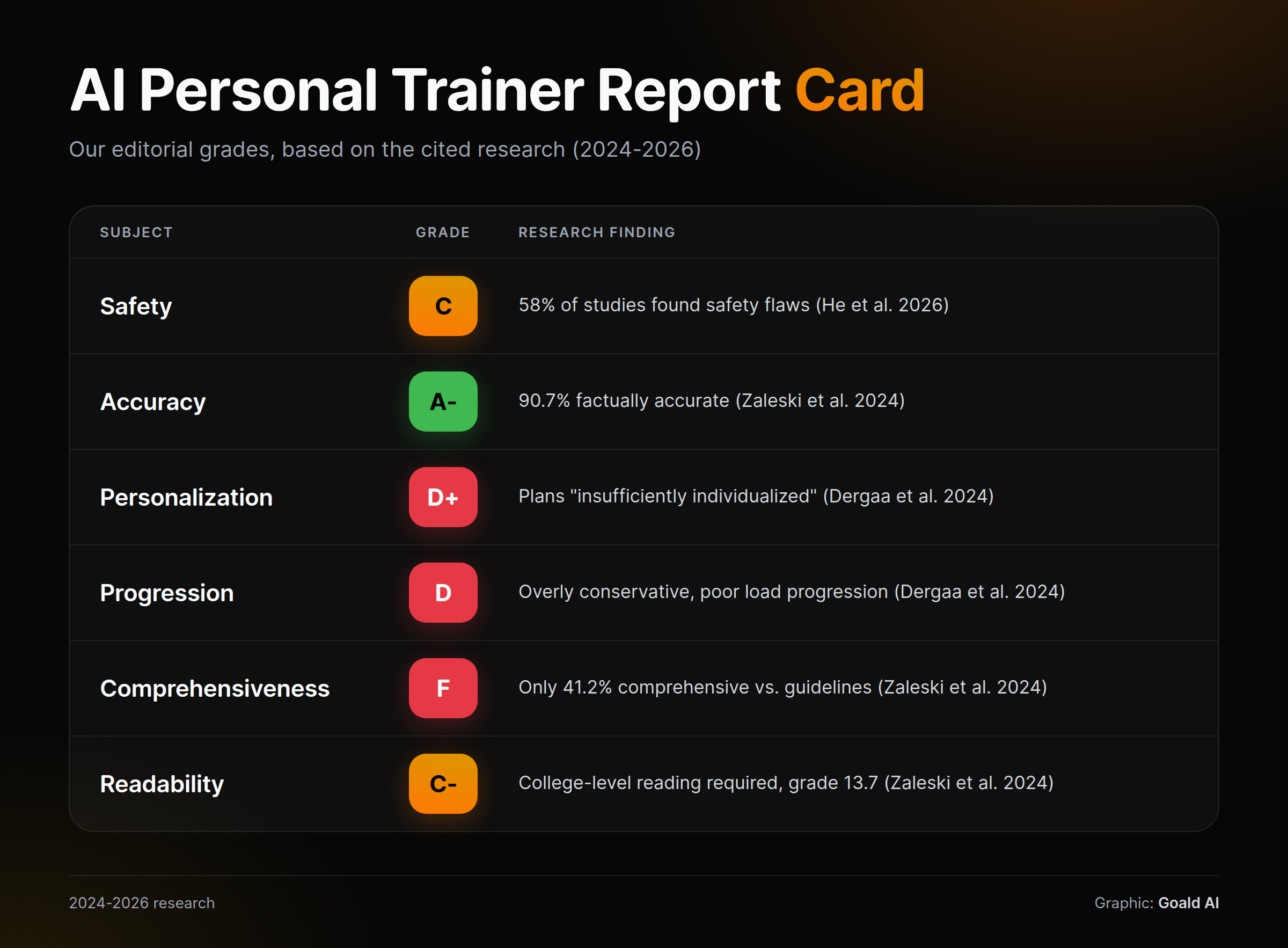
Across multiple peer-reviewed studies from 2024 to 2026, researchers tested AI-generated exercise prescriptions against gold-standard guidelines and expert judgment. Here's how the AI stacked up in six key subjects. The letter grades below are Goald AI's own read of the published findings—the researchers themselves did not assign letter grades.
| Subject | Grade | What the Research Found |
|---|---|---|
| Safety | C | 58% of studies found safety flaws [1] |
| Accuracy | A- | 90.7% factually accurate [2] |
| Personalization | D+ | Plans "insufficiently individualized" [3] |
| Progression | D | Overly conservative, poor load increases [3] |
| Comprehensiveness | F | Only 41.2% comprehensive vs. guidelines [2] |
| Readability | C- | College-level reading required [2] |
Let's break down each grade.
Safety: C — "Shows promise, but watch closely"
This is the subject that matters most—and where the AI struggles in ways that aren't obvious at first glance.
A 2026 systematic review by Tianyuan He and colleagues in Biology of Sport analyzed 24 studies with 2,512 participants [1]. They found systemic safety flaws in 14 of 24 studies (58%). The problems? AI models sometimes recommended contraindicated exercises for clinical populations. One striking example: a model generated a high-intensity interval training plan for a user with diabetic retinopathy that included heavy lifting and rapid head movements—activities that can dramatically increase intraocular pressure and risk retinal detachment [1].
The AI also tended toward an "overcautious" approach that sounds safe but can backfire. Ismail Dergaa and colleagues at multiple institutions tested GPT-4's 30-day exercise programs for five hypothetical patients with conditions like lumbar disc herniation and type 2 diabetes [3]. Experts found the plans prioritized safety to the point of being ineffective—moderate intensity when progression was appropriate, and no adjustments based on individual response [3].
Translation: The AI errs on both sides. Sometimes it's dangerously blind to medical conditions. Other times it's so cautious you'd never get stronger.
Accuracy: A- — "Knows the textbook, mostly"
Here's where the AI shines. Amanda Zaleski and colleagues at Hartford HealthCare and the University of Connecticut prompted a ChatGPT workout for 26 different clinical populations and had experts grade the output [2]. Factual accuracy hit 90.7%—not bad for a chatbot.
But here's the catch: most of the inaccuracies (53%) involved unnecessary medical clearance recommendations [2]. The AI kept telling healthy people to see a doctor before basic exercise, which contradicts current guidelines that encourage activity for most people without prior screening [2].
The Journal of Sports Science and Medicine published a study comparing ChatGPT answers to those from level-4 certified personal trainers on common exercise questions [4]. ChatGPT outperformed the trainers on scientific correctness in 5 of 9 questions [4]. For straightforward Q&A, the AI knows its stuff.
Personalization: D+ — "Needs to pay more attention"
Ask the AI for an AI workout plan, and you'll get a workout. But will it fit you?
Dergaa's team found that GPT-4 programs were "insufficiently individualized" [3]. The AI generated plans that looked professional but didn't adapt meaningfully to each user's health condition, fitness level, or goals.
Jad Adrian Washif and colleagues at multiple sports science institutions tested ChatGPT's resistance training programs for hypothetical intermediate and advanced trainees [5]. The good news: GPT-4 recognized training experience and adjusted somewhat—more sets, higher intensity for advanced lifters. The bad news: male and female participants got "objectively similar" programs despite well-documented sex differences in training response [5].
Progression: D — "Not improving over time"
This is where exercise prescription gets tricky, and where the AI falls flat.
The ACSM's position stand on resistance training progression recommends that when you can complete one to two reps beyond your target, you increase load by 2-10% [6]. That kind of responsive, ongoing adjustment is the bread and butter of effective strength training.
But AI-generated plans don't adapt in real time. Dergaa's team noted that GPT-4 programs were static and lacked "variability" [3]. The AI gave you a fixed plan, not a coach who watches your form and bumps up the weight when you're ready.
The systematic review found that in head-to-head trials comparing AI to human experts, LLM-generated plans were inferior in 5 out of 6 cases for driving physiological adaptations like strength gains, muscle hypertrophy, and cardiovascular fitness [1]. The AI plan might look good on paper, but it doesn't get you as fit.
Comprehensiveness: F — "Incomplete work"
This is the AI's worst subject.
Zaleski's team scored AI recommendations against 10 categories from gold-standard guidelines: health-condition benefits, screening, frequency, intensity, time, type, volume, progression, special considerations, and literature references [2]. The AI hit only 41.2% of those categories [2].
The biggest gaps were in the FITT principle—frequency, intensity, time, and type—especially for resistance and flexibility training [2]. The AI would say "do strength training" without specifying how many sets, what rest periods, or how to progress. It's like a recipe that lists ingredients but skips the instructions.
Readability: C- — "Could explain it better"
Even when the AI gets the science right, it doesn't always communicate clearly.
Zaleski's study found an average Flesch reading ease score of 31.1, which means "difficult to read," and a Flesch-Kincaid grade level of 13.7—college-level reading [2]. If you're not already fluent in exercise science, the ChatGPT workout can feel like a dense textbook.
This matters because the people who most need accessible health information—those without professional guidance—are the least likely to understand jargon-heavy AI output.
What the AI Gets Right
It's not all D's and F's. The AI shows real strengths:
- Fast, free, always available. No scheduling, no cost barrier.
- Broadly aligned with guidelines. The WHO recommends 150-300 minutes of moderate activity or 75-150 minutes of vigorous activity per week, plus muscle-strengthening on two or more days [7]. AI plans generally hit these targets.
- Good for general education. If you want to understand the basics of exercise snacks or why rest matters, the AI can explain it quickly and correctly.
- Useful as a draft. Washif's team concluded that ChatGPT "may serve as a complementary tool for writing 'draft' programmes, but likely requires human expertise to maximise training programme effectiveness" [5].
Teacher's Comments + Homework: Fix Your AI Workout Plan
The AI personal trainer has potential, but it's not ready to fly solo. Here's how to use it as a study buddy instead of a substitute teacher.
Give these prompts to your AI for a better AI workout plan:
-
"I have [specific condition]. List any exercises I should avoid and explain why, citing current guidelines." Forces the AI to surface contraindications instead of burying them.
-
"Design a 4-week program with specific sets, reps, rest periods, and a weekly progression rule. Use the ACSM FITT framework." Pushes the AI toward the comprehensiveness it lacks by default.
-
"After each week, I'll tell you my RPE for each session. Adjust the next week's intensity based on that feedback." Creates the progression loop the AI can't do on its own.
-
"Write this at an 8th-grade reading level with no jargon." Fixes the readability problem.
-
"Explain how this plan differs for a 25-year-old male vs. a 55-year-old female with the same goals." Tests whether the AI is actually personalizing.
When to see a human pro:
- You have a medical condition, injury history, or take medications that affect exercise.
- You're returning to training after a long break or major life change.
- You've plateaued and need someone to watch your form and adjust on the fly.
- You want accountability and motivation—areas where AI coaching helps but can't fully replace human connection.
The studies are clear: AI can inform, but it can't yet replace the judgment, real-time adaptation, and safety checks of a qualified professional [1][3][5]. Use it as a starting point, not the finish line. And if you've read about AI productivity myths, you know this pattern—AI boosts the average but doesn't replace expertise.
How Goald AI Fits In
The gap in AI fitness tools isn't knowledge—it's follow-through and adaptation. That's what Goald AI is built for.
Goald AI connects your goals, habits, and fitness tracking in one place. Set a strength training goal, and Goald AI helps you build the daily habits that move it forward, tracks your workouts, and uses smart scheduling to find real time in your week. Your AI Mentor remembers your history and adjusts your plan as life changes—not a static 12-week PDF, but an evolving system that learns with you.
Goald AI is coming to iOS soon. Free for up to 3 goals; Goald AI Pro is $9.99/month or $99.99/year. Join the waitlist.
Sources
- He T, Lu D, Ma Y, et al. "The AI recommendation paradox: a systematic review evaluating the promise, peril, and path forward for large language models in exercise recommendation." Biology of Sport, 2026.
- Zaleski AL, Berkowsky R, Thomas Craig KJ, Pescatello LS. "Comprehensiveness, Accuracy, and Readability of Exercise Recommendations Provided by an AI-Based Chatbot: Mixed Methods Study." JMIR Medical Education, 2024.
- Dergaa I, et al. "Using artificial intelligence for exercise prescription in personalised health promotion: A critical evaluation of OpenAI's GPT-4 model." Biology of Sport, 2024.
- D'hoe B, Kirk D, Boone J, Colosio A. "ChatGPT Outperforms Personal Trainers in Answering Common Exercise Training Questions." Journal of Sports Science and Medicine, 2026.
- Washif JA, et al. "Artificial intelligence in sport: Exploring the potential of using ChatGPT in resistance training prescription." Biology of Sport, 2024.
- American College of Sports Medicine. "Progression Models in Resistance Training for Healthy Adults." Medicine & Science in Sports & Exercise, 2009.
- World Health Organization. "WHO Guidelines on physical activity and sedentary behaviour." 2020.
Goald AI is coming to iOS.
Join the waitlist — be first in when we launch.
Related posts
fitness
Exercise Snacks: A Workout Hidden in Your Workday
Busy day, no gym? Exercise snacks—short, vigorous bursts scattered through your workday—offer real health payoffs in just minutes. Here's the research.
fitness
Biological Age Tests: What Works and What Doesn't
Is that biological age test worth it? Here's what research says about epigenetic clocks, test variability, and what actually moves the needle on aging.
fitness
Time-Restricted Eating: What Works and What Doesn't
Time-restricted eating is trending hard. Here's what trials say works (modest glycemic help), what doesn't (ultra-short windows), and a simple protocol.