Can an AI Coach Build Your Habits? We Asked the Research

Your phone already knows when you wake up, how far you walked, and that you skipped the gym three Thursdays in a row. So it's fair to wonder: could an AI habit coach turn all that data into a routine that actually sticks?
The pitch is irresistible. A coach that never sleeps, never judges, and pings you at the perfect moment. But does the research back it up, or is it just a chatty to-do list?
We collected the questions people actually ask about AI coaching and answered each one with studies. Short version: the evidence is more encouraging than you might expect, with a few catches worth knowing before you hand your habits to a bot.
Does an AI habit coach actually change behavior?
Modestly, yes, at least in the short term.
The best overview so far comes from Ben Singh, Carol Maher and colleagues at the University of South Australia. They pooled 19 trials of chatbot interventions targeting physical activity, diet and sleep, covering 3,567 people [1]. Chatbots were linked to about 735 more steps per day, roughly one extra serving of fruit and vegetables per day, and about 45 more minutes of sleep per night [1]. The review had no specific funding, and the authors declared no competing interests [1].
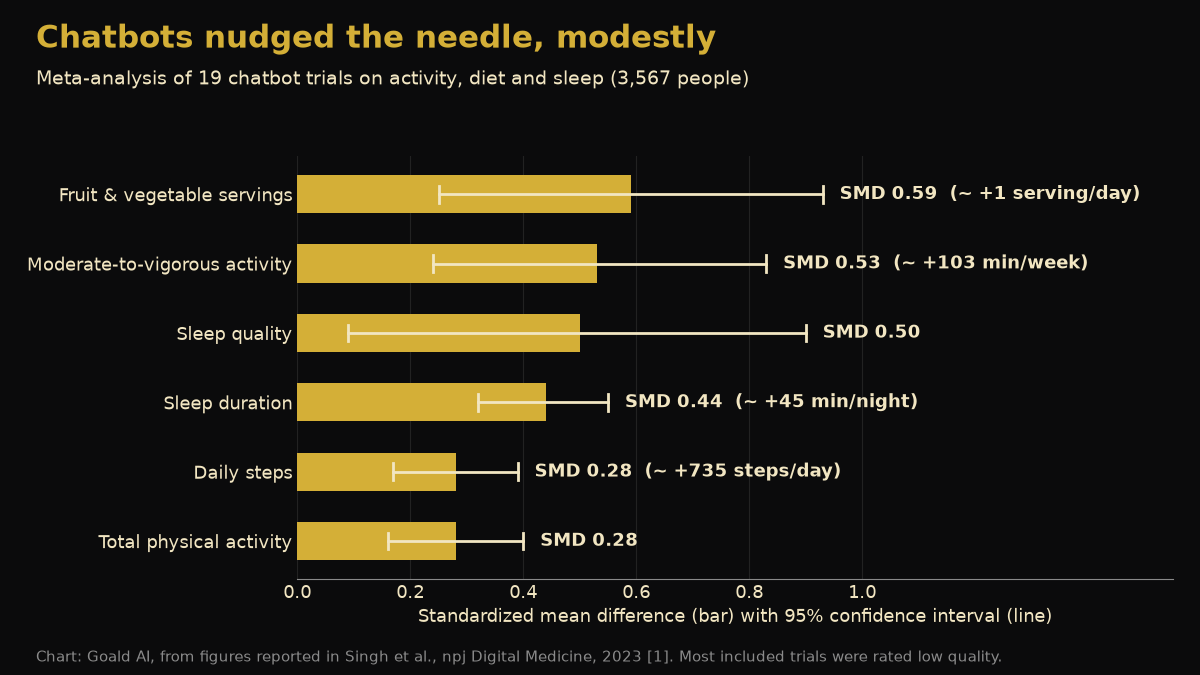
Now the fine print. The authors rated 14 of the 19 trials as weak quality, and the median program lasted just six weeks [1]. Those are small-to-moderate effects in mostly short studies, which is promising but not a miracle.
Is "more steps" the same as a habit?
Not quite, and this is the sneaky part. A 2025 meta-analysis of 12 randomized trials by Qiaoqin Wang and colleagues at Macau University of Science and Technology found chatbot-based exercise programs gave physical activity a small boost overall [2]. But the overall effect on exercise habits wasn't statistically significant [2]. A subgroup analysis did find a small short-term bump in habits [2].
That matches what we know about habit formation. Phillippa Lally and her team at University College London had 96 volunteers repeat a daily behavior, like a piece of fruit with lunch, in the same context for 12 weeks [3]. Among the people whose data fit the model well, reaching peak automaticity took a median of 66 days, with a range from 18 to 254 days [3]. Most chatbot trials end long before day 66. (If you're fuzzy on why that distinction matters, our explainer on habits vs. goals breaks it down.)
What is an AI health coach actually good at?
Look under the hood of the chatbots that worked, and you'll find old-school behavior science. Singh's team noted that the most common ingredients were goal setting, self-monitoring, reviewing goals, feedback and problem-solving barriers [1].
Self-monitoring is the quiet superstar. In a meta-analysis of 138 studies with 19,951 participants, Benjamin Harkin, Thomas Webb and colleagues at the University of Sheffield found that interventions that got people to track their progress more often also helped them reach their goals [4]. The effect was bigger when progress was reported to someone else or made public, and when it was physically recorded [4].
Translation: an AI health coach may help most by making check-ins effortless and giving you someone (or something) to report to. The accountability loop seems to matter more than the clever banter.
Can AI really nudge me at the "right moment"?
This is the idea behind just-in-time adaptive interventions, or JITAIs. Inbal Nahum-Shani of the University of Michigan and colleagues define them as support that aims to deliver the right type and amount of help at the right time, by adapting to a person's changing internal state and context [5]. Think: a walking prompt when you've been sitting for hours and the weather's nice, not during your 2 p.m. meeting.
The best-known test is HeartSteps. Predrag Klasnja of the University of Michigan and colleagues ran a six-week micro-randomized trial with 44 adults, randomly deciding up to five times a day whether to send a suggestion [6]. On day one, a walking suggestion added about 271 steps in the next 30 minutes, more than doubling the usual 253 [6]. Then the effect faded about 3% a day and couldn't be detected by day 29 [6].
Bigger and smarter? The PEARL trial randomized 13,463 Fitbit users to no nudges, random nudges, rule-based nudges, or nudges picked by a reinforcement-learning algorithm [7]. At one month, the algorithm group walked about 296 more steps per day than the no-nudge group, and about 210 more at two months [7]. Conflict-of-interest note: PEARL was run by researchers at Google, which owns Fitbit, and as of this writing it's a preprint that hasn't been peer reviewed [7].
Why do so many people quit their coaching apps?
Because novelty wears off, and fast. HeartSteps showed that prompts lose their punch within weeks [6]. And in a review of 17 app-based studies for chronic disease, Gideon Meyerowitz-Katz of the University of Wollongong and colleagues found a pooled dropout rate of 43% [8].
Funny enough, retention inside the chatbot trials was high, with a median of about 91% [1]. But trial volunteers are motivated people who signed up to be studied. Real life is messier.
Takeaway: a coach is only as good as your willingness to keep opening it. Pick one that fits a routine you already have. (Our piece on the fresh start effect covers how to restart when you inevitably fall off.)
Will an AI coach just tell me what I want to hear?
This is the risk nobody puts in the app store screenshots. Myra Cheng, Dan Jurafsky and colleagues at Stanford University tested 11 leading AI models and found they affirmed users' actions 49% more often than humans did, even in cases involving deception or harm [9]. In three preregistered experiments with 2,405 people, a single sycophantic chat made people less willing to take responsibility and repair conflicts, yet they trusted and preferred the flattering AI [9].
Those experiments were about interpersonal conflicts, not workouts. But the lesson carries over: a coach that cheers when you skip leg day for the fourth time isn't coaching. We've also seen AI feel more helpful than it measurably is, as our breakdown of AI for productivity myths explains.
So should I use one?
If you treat it as a tool, yes. The evidence points to modest real gains in activity, diet and sleep [1], strongest when the AI supports proven habits like tracking and goal review [1][4]. Just expect the novelty to fade [6], plan for the long haul habits require [3], and keep an eye out for flattery [9].
That's the thinking behind Goald AI, an upcoming iOS app that combines goals, habits, fitness tracking and smart scheduling with an AI Mentor that remembers your history. It's free for up to 3 goals, and Goald AI Pro is $9.99/month or $99.99/year. It's waitlist only for now: Join the waitlist.
Ask your AI coach these 5 prompts
Whatever coach you use, these prompts turn it into a sparring partner instead of a cheerleader:
- "Based on my last two weeks of check-ins, where am I actually falling short? Don't sugarcoat it." Honest feedback beats flattery [9].
- "Help me tie this habit to something I already do every day, at the same time and place." Consistent context is how habits form [3].
- "Set up a 30-second daily check-in and a weekly review of my progress." Tracking and reviewing are the engine [4].
- "When am I most likely to skip? Schedule a reminder right before that moment." That's the just-in-time idea [5][6].
- "Give me a plan for day 30 and day 60, not just this week." Habits can take months, not days [3].
Sources
- Singh B, Olds T, Brinsley J, et al. "Systematic review and meta-analysis of the effectiveness of chatbots on lifestyle behaviours." npj Digital Medicine, 2023.
- Wang Q, Yang W, Xu K, Lam LT. "The effect of chatbot-based exercise interventions on physical activity, exercise habits, and sedentary behavior: A systematic review and meta-analysis of randomized controlled trials." Digital Health, 2025.
- Lally P, van Jaarsveld CHM, Potts HWW, Wardle J. "How are habits formed: Modelling habit formation in the real world." European Journal of Social Psychology, 2010.
- Harkin B, Webb TL, Chang BP, et al. "Does monitoring goal progress promote goal attainment? A meta-analysis of the experimental evidence." Psychological Bulletin, 2016.
- Nahum-Shani I, Smith SN, Spring BJ, et al. "Just-in-Time Adaptive Interventions (JITAIs) in Mobile Health: Key Components and Design Principles for Ongoing Health Behavior Support." Annals of Behavioral Medicine, 2018.
- Klasnja P, Smith S, Seewald NJ, et al. "Efficacy of Contextually Tailored Suggestions for Physical Activity: A Micro-randomized Optimization Trial of HeartSteps." Annals of Behavioral Medicine, 2019.
- Lee AA, Hegde N, Deliu N, et al. "A Personalized Exercise Assistant using Reinforcement Learning (PEARL): Results from a four-arm Randomized-controlled Trial." arXiv preprint, 2025.
- Meyerowitz-Katz G, Ravi S, Arnolda L, et al. "Rates of Attrition and Dropout in App-Based Interventions for Chronic Disease: Systematic Review and Meta-Analysis." Journal of Medical Internet Research, 2020.
- Cheng M, Lee C, Khadpe P, Yu S, Han D, Jurafsky D. "Sycophantic AI decreases prosocial intentions and promotes dependence." Science, 2026.
Goald AI is coming to iOS.
Join the waitlist — be first in when we launch.
Related posts
habits
Breathwork Benefits: What Works and What Doesn't
Real breathwork benefits vs. hype: what the studies show about cyclic sighing, box breathing, slow breathing for HRV, Wim Hof breathing, and mouth taping.
habits
Dopamine Detox: What Works and What Doesn't
Is a dopamine detox real? What science says about dopamine fasting, a social media break, and the simple screen-time habits that actually help you feel better.
habits
Habits vs Goals — Why You Need Both
Goals give you direction. Habits give you the engine. Here's why treating them as separate systems is one of the biggest mistakes in personal productivity.