Breathwork Benefits: What Works and What Doesn't

Your feed has probably sold you at least one breathing hack this year. Breathe like a Navy SEAL. Hyperventilate your way to an "immune upgrade." Tape your mouth shut at night. Train your "CO2 tolerance." Breathing is free, you already do it thousands of times a day, and suddenly it's a whole wellness industry.
So what are the real breathwork benefits, and what's just a viral rebrand of "take a deep breath"? Good news: a few techniques have surprisingly solid data. Others are mostly hype, and one can be dangerous in the wrong place. Let's sort the science from the vibes.
What the research says about breathwork benefits overall
Start with the big picture. In 2023, Guy William Fincham and colleagues at the University of Sussex pooled randomized controlled trials of breathwork in Scientific Reports [1]. For self-reported stress (12 trials, 785 adults), breathwork beat control conditions with a small-to-medium effect (Hedges' g = -0.35) [1]. Results for anxiety (20 trials, g = -0.32) and depressive symptoms (18 trials, g = -0.40) were similar [1].
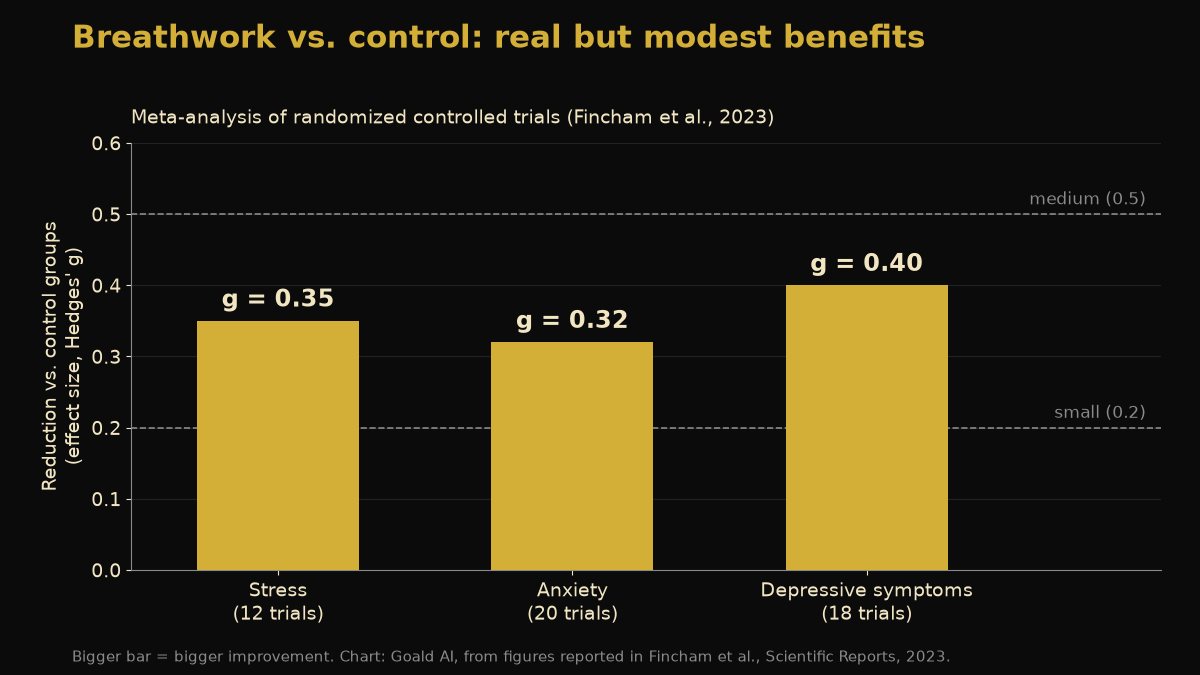
The fine print matters, though. Most of the studies had a moderate risk of bias, and the authors urged caution and called for better-designed studies "to avoid a miscalibration between hype and evidence" [1]. Translation: breathing exercises for stress are a legit tool. They're a nudge, not a miracle.
What works, part 1: cyclic sighing (a.k.a. the physiological sigh, on repeat)
This is the study that launched a thousand Reels. A Stanford team led by Melis Yilmaz Balban, with David Spiegel and Andrew Huberman among the co-authors, ran a remote, randomized study during the COVID-19 pandemic, published in 2023 [2]. They enrolled 108 people, mostly Stanford undergrads, and gave each one a 5-minute daily practice for a month [2]:
- Cyclic sighing: inhale slowly, take a second short inhale to top off your lungs, then slowly exhale all the way out [2].
- Box breathing: inhale, hold, exhale, and hold for equal counts (like 4 seconds each) [2].
- Cyclic hyperventilation with retention: 30 deep breaths, then a short breath hold with empty lungs, in rounds [2].
- Mindfulness meditation: focused attention with no breath control (the comparison group) [2].
All four groups felt less anxious and in a better mood after their daily sessions [2]. But cyclic sighing, the exhale-focused style often called the "physiological sigh" online, came out on top. It was the only style whose mood boost was significantly bigger than meditation's, and it lowered people's breathing rate over the month more than meditation did [2]. The more days people practiced it, the bigger the mood benefit seemed to get [2].
Box breathing and cyclic hyperventilation also edged out meditation, but those differences weren't statistically significant [2]. None of the groups showed significant changes in heart rate variability (HRV) or resting heart rate [2].
Keep it in perspective: the authors called it exploratory. It was registered after the fact, run fully remotely, and lasted four weeks with no follow-up [2]. Participants' physiology was tracked with WHOOP wearable straps, and the paper discloses that Huberman became an advisor to WHOOP in June 2022 [2]. Promising, not settled. But at 5 minutes a day, it's an easy experiment to run.
What works, part 2: slow breathing and HRV
If you watch your HRV like a stock price, this is where breathing has some of its strongest evidence.
Sylvain Laborde and colleagues at the German Sport University Cologne analyzed 223 studies on voluntary slow breathing [3]. Slow breathing increased vagally mediated HRV, a marker of your "rest and digest" nervous system, during sessions, right after a single session, and after multi-week programs [3]. The authors called it a "low-tech and low-cost" tool with few adverse effects expected [3].
What's the sweet spot? Paul Lehrer and Richard Gevirtz, two longtime HRV biofeedback researchers, explain that most people breathe 9 to 24 times a minute [4]. However, "most studies find that maximum effects usually are achieved when breathing at a rate of approximately 0.1 Hz (six breaths per minute)" [4]. That's the so-called resonance frequency. It varies a bit by person; in their research it averaged about 5.5 breaths per minute, or roughly 11 seconds per breath [4].
Try it: inhale for about 5 seconds and exhale for 5 to 6 seconds, for 5 to 10 minutes. It makes a great wind-down before bed. Pair it with a steady bedtime, because sleep consistency beats duration.
The Wim Hof breathing reality check
Now for the most hyped style of all. Wim Hof breathing is the cyclic hyperventilation behind the "Iceman" method: about 30 deep breaths, then a long breath hold, repeated for a few rounds [5].
The famous study is legit and genuinely surprising. In 2014, Matthijs Kox, Peter Pickkers, and colleagues at Radboud University Medical Center published a randomized trial in PNAS [6]. Healthy young men trained for about 10 days with Wim Hof and his instructors in meditation, breathing, and cold exposure, including ice-water dips [6]. Then 24 volunteers (12 trained, 12 untrained) got an IV dose of bacterial endotoxin, which triggers a brief, controlled bout of flu-like symptoms [6].
The trained group's adrenaline (epinephrine) spiked while they did the breathing. Their anti-inflammatory IL-10 came out 194% higher, and inflammatory markers TNF-α, IL-6, and IL-8 came out about 51% to 57% lower [6]. Their peak flu-like symptoms were 56% lower too [6].
Before you sign up for a retreat, three big caveats:
- It was a package deal. The authors said their design couldn't pin down which part of the breathing did the work, and they couldn't rule out the cold training either [6].
- The evidence base is tiny. Omar Almahayni and Lucy Hammond's 2024 systematic review in PLOS One found only 9 papers (8 trials) [7]. Every trial had a very high risk of bias, samples were small (15 to 48 people), and 86.4% of participants were male [7]. The method may reduce inflammation; exercise performance results were mixed [7]. Their verdict: "More evidence needs to be synthesised about WHM before being recommended to the public" [7].
- The oxygen marketing doesn't match the data. The official Wim Hof Method site says the breathing is "supercharging the oxygen levels in your blood" [5]. But in the Kox trial, average arterial oxygen pressure "remained virtually unaltered," and oxygen saturation briefly dropped to around 50% during breath holds [6]. What the breathing really did was blow off CO2, pushing blood pH as high as 7.75 in some participants [6].
Safety first: never do hyperventilation breathing in water
This part is non-negotiable. Hyperventilating lowers your carbon dioxide, delaying your urge to breathe while oxygen keeps falling. That's how swimmers black out underwater without warning [8].
A CDC MMWR report by Christopher Boyd and colleagues reviewed dangerous underwater breath-holding cases in New York State from 1988 to 2011. It found 16 cases and 4 deaths [8]. All four people who died were 17 to 22 years old, advanced or expert swimmers, and had been intentionally hyperventilating [8]. These drownings can happen at any water depth [8].
Even the official Wim Hof Method site warns that the breathing "can in rare cases lead to loss of consciousness" and that passing out "can potentially be very dangerous in or near water, or when driving a vehicle." It recommends practicing only seated or lying down [5]. So: never in a pool, a bathtub, a cold plunge, or the car. Ever.
What's overhyped: mouth taping and "CO2 tolerance"
Mouth taping. Breathing through your nose is a perfectly good default. (For easy cardio, our Zone 2 training guide has a simpler pace check: the talk test.) Taping your mouth shut at night is a different story. In 2025, Jess Rhee and colleagues in otolaryngology at London Health Sciences Centre in Ontario published a systematic review titled, fittingly, "Breaking social media fads" [9]. They found just 10 studies with 213 patients. Two showed significant improvements in sleep apnea markers, others showed no difference, and some raised risks including asphyxiation if your nose is blocked [9]. Their conclusion: there's "a potentially serious risk of harm for individuals indiscriminately practicing this trend" [9]. If you snore or wake up gasping, get a sleep evaluation instead of a roll of tape.
"CO2 tolerance" training. Breath-hold scores and "CO2 tolerance" drills often borrow from the Buteyko method. The best evidence we found for that style of training is in people with asthma, not healthy people chasing a higher score. A 2020 Cochrane review by Thayla Santino and colleagues covered 22 trials with 2,880 adults with asthma, and only two used Buteyko-style training [10]. Breathing exercises in general "may have some positive effects on quality of life, hyperventilation symptoms, and lung function," but the certainty of evidence ranged from moderate to very low [10]. If you have asthma, that's a conversation for your doctor, alongside your meds, not instead of them.
A 5-minute breathwork routine you can actually stick to
- Pick one technique. Cyclic sighing for a fast mood reset [2], or slow breathing at about 6 breaths per minute for HRV and wind-down [3][4].
- Anchor it to a cue. After your morning coffee, after your last meeting, or right before bed.
- Start with 5 minutes a day. That's all the Stanford groups did, and the benefit seemed to build with consistency [2].
- Keep box breathing as a backup. It's simple and easy to do on the spot. It just hasn't clearly beaten meditation head-to-head [2].
- Keep intense breathing on dry land. Seated or lying down, and never before or during swimming or while driving [5][8].
- Swap it in for the scroll. Feel the urge to grab your phone when you're stressed? Do two minutes of cyclic sighing instead. It's the same "change the cue" trick from our dopamine detox guide.
How Goald AI fits in
Learning a breathing technique takes about 30 seconds. The hard part is doing it on day 12, when you're busy, stressed, and "too slammed to breathe."
Goald AI is built for exactly that. Set a goal like "lower my stress before bed," then add a daily habit like 5 minutes of cyclic sighing after work. Goald AI tracks your habits and workouts in one place, and smart scheduling finds a real slot for the session in your calendar. When a chaotic week knocks you off track, your AI Mentor remembers your goals and adjusts your plan instead of letting the habit fade.
Goald AI is coming to iOS soon. The free tier covers up to 3 goals, and Goald AI Pro is $9.99/month or $99.99/year. Join the waitlist.
Not medical advice. This article is for general education only. If you have a heart, lung, or seizure condition, are pregnant, or tend to faint, talk to a doctor before trying intense breathing techniques. For persistent anxiety, depression, or possible sleep apnea, see a doctor or licensed mental health professional.
Sources
- Fincham GW, Strauss C, Montero-Marin J, Cavanagh K. "Effect of breathwork on stress and mental health: A meta-analysis of randomised-controlled trials." Scientific Reports, 2023. https://doi.org/10.1038/s41598-022-27247-y
- Balban MY, Neri E, Kogon MM, et al. "Brief structured respiration practices enhance mood and reduce physiological arousal." Cell Reports Medicine, 2023. https://doi.org/10.1016/j.xcrm.2022.100895
- Laborde S, Allen MS, Borges U, et al. "Effects of voluntary slow breathing on heart rate and heart rate variability: A systematic review and a meta-analysis." Neuroscience & Biobehavioral Reviews, 2022. https://doi.org/10.1016/j.neubiorev.2022.104711
- Lehrer PM, Gevirtz R. "Heart rate variability biofeedback: how and why does it work?" Frontiers in Psychology, 2014. https://pmc.ncbi.nlm.nih.gov/articles/PMC4104929/
- Wim Hof Method. "Wim Hof Breathing: The Official Technique." WimHofMethod.com, accessed 2026. https://www.wimhofmethod.com/breathing-exercises
- Kox M, van Eijk LT, Zwaag J, et al. "Voluntary activation of the sympathetic nervous system and attenuation of the innate immune response in humans." PNAS, 2014. https://pmc.ncbi.nlm.nih.gov/articles/PMC4034215/
- Almahayni O, Hammond L. "Does the Wim Hof Method have a beneficial impact on physiological and psychological outcomes in healthy and non-healthy participants? A systematic review." PLOS One, 2024. https://doi.org/10.1371/journal.pone.0286933
- Boyd C, Levy A, McProud T, et al. "Fatal and Nonfatal Drowning Outcomes Related to Dangerous Underwater Breath-Holding Behaviors — New York State, 1988–2011." MMWR, CDC, 2015. https://www.cdc.gov/mmwr/preview/mmwrhtml/mm6419a3.htm
- Rhee J, Iansavitchene A, Mannala S, Graham ME, Rotenberg B. "Breaking social media fads and uncovering the safety and efficacy of mouth taping in patients with mouth breathing, sleep disordered breathing, or obstructive sleep apnea: A systematic review." PLOS One, 2025. https://doi.org/10.1371/journal.pone.0323643
- Santino TA, Chaves GS, Freitas DA, Fregonezi GA, Mendonça KM. "Breathing exercises for adults with asthma." Cochrane Database of Systematic Reviews, 2020. https://pmc.ncbi.nlm.nih.gov/articles/PMC7096190/
Goald AI is coming to iOS.
Join the waitlist — be first in when we launch.
Related posts
habits
Dopamine Detox: What Works and What Doesn't
Is a dopamine detox real? What science says about dopamine fasting, a social media break, and the simple screen-time habits that actually help you feel better.
habits
Habits vs Goals — Why You Need Both
Goals give you direction. Habits give you the engine. Here's why treating them as separate systems is one of the biggest mistakes in personal productivity.
fitness
Biological Age Tests: What Works and What Doesn't
Is that biological age test worth it? Here's what research says about epigenetic clocks, test variability, and what actually moves the needle on aging.