Biological Age Tests: What Works and What Doesn't

Spit in a tube, mail it off, and get back a number that claims to reveal how old you really are. The biological age test has gone from niche longevity-nerd obsession to Instagram-ad mainstream. Companies promise your "true" age based on epigenetic markers in your DNA—sometimes with supplement upsells attached.
Here's the awkward truth: the science behind these clocks is genuinely fascinating, but the consumer test experience is messier than the marketing suggests. Results can vary by years between runs and between companies. The clocks often disagree with each other. And the evidence that watching your score helps you live longer or healthier? Thin at best.
Let's break down what we actually know, what falls apart under scrutiny, and what reliably moves health and aging markers—no saliva kit required.
What is a biological age test, anyway?
The pitch is seductive: your biological age vs chronological age might be very different. Chronological age is just the calendar. Biological age is supposed to capture how worn-down your cells and organs actually are—the aging that matters for disease risk and lifespan.
Most consumer tests measure this through DNA methylation, a chemical tagging system that modifies your DNA without changing the underlying code. Certain methylation patterns change predictably with age, and researchers have trained algorithms to predict age from those patterns [1][2].
The resulting predictors are called epigenetic clocks. The first big one came from Steve Horvath at UCLA in 2013: 353 DNA sites that together estimate "DNAm age" across many tissue types [1]. Gregory Hannum and colleagues published a blood-based clock the same year using 71 sites [2]. Since then, newer clocks have appeared—PhenoAge (2018), GrimAge (2019), DunedinPACE (2022)—each trained to predict not just age but mortality, disease, or the pace of aging [3][4][5].
These are real scientific tools used in thousands of studies. The question is whether mailing your spit to a consumer company delivers anything useful.
The noise problem: tests that disagree with themselves
Here's the part the glossy landing pages skip. In a 2022 Nature Aging study, Albert Higgins-Chen and colleagues found that technical noise—not real biological change—can produce large deviations between replicate samples for popular epigenetic clocks [6]. The Horvath clock showed a median deviation of 1.8 years and a maximum of 4.8 years between samples that should have matched. PhenoAge showed even bigger swings: a median deviation of 2.4 years and a maximum of 8.6 years [6].
That's not a subtle measurement wobble. If your test says you're 5 years younger than your calendar age, and the error can swing nearly a decade, what exactly are you learning?
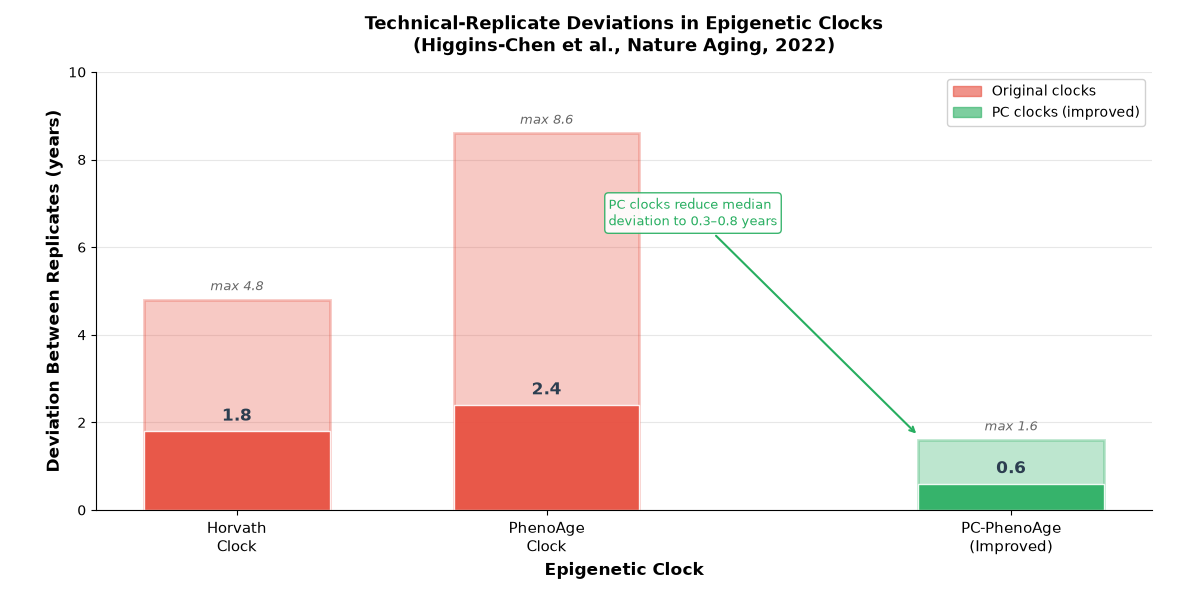
The researchers proposed a fix—using principal-component analysis to filter out unreliable signals—which brought most replicates within 1–1.5 years of each other [6]. Companies rarely publish which algorithms or reliability data they use, and even the improved versions haven't been validated for guiding individual health decisions.
The inter-company problem: your age depends on who you ask
Aging researcher Matt Kaeberlein, professor emeritus at the University of Washington and CEO of the longevity company Optispan, ran an informal experiment on himself [7]. He sent the same samples, collected on the same day, to four consumer test companies, two kits each. At a chronological age of 53.1, his results ranged from about 43 to 61—wide variation between companies and between duplicate kits [7]. It's one person's experiment, not a peer-reviewed study, but it lines up with the replicate noise researchers have measured [6].
Kaeberlein's blunt take: these tests aren't currently actionable for individuals. Different labs use different clocks, different normalization methods, and different proprietary adjustments. There's no FDA regulation of biological age claims, no standardized protocol, and no independent validation that tracking your score improves outcomes [7][8].
Steve Horvath, who developed the original clock and co-founded the nonprofit Clock Foundation (which also offers the GrimAge test to consumers), has acknowledged the limits himself. He told NPR the tests are most useful for scientists studying aging, and that he tries to point out limitations and how to interpret results [8].
Can lifestyle actually change your epigenetic age?
This is where the marketing gets slippery. Several small studies suggest that lifestyle interventions may shift epigenetic clock readings—but the evidence is weaker than headlines imply.
The most-cited trial is Kara Fitzgerald's 2021 pilot study: 43 healthy men aged 50–72 followed an 8-week program of diet, sleep, exercise, relaxation, and supplements [9]. Using Horvath's 2013 clock on saliva samples, the treatment group scored an average 3.23 years younger than controls (p=0.018) [9]. Within-group change was 1.96 years, with a trend toward significance [9].
Sounds promising—but caveats pile up. The study was small, included only men, lasted only 8 weeks, and used a methylation-targeted diet plus supplements designed to feed the very pathways the clock measures [9]. The lead authors disclosed that they use the intervention in clinical practice, are named in a related patent application, and receive earnings from associated educational products. The trial was funded by an unrestricted grant from supplement maker Metagenics [9]. The study hasn't been replicated in larger or longer trials, and the same interventions haven't been tested with other clocks or in diverse populations.
A larger and more rigorous test came from the CALERIE trial, a two-year randomized controlled study that targeted 25% caloric restriction in 220 healthy adults, though participants achieved about 12% on average [10]. The result? Restriction slowed DunedinPACE, a measure of the pace of aging, by about 2–3% [10]. But it did not significantly change PhenoAge or GrimAge—the "how old are you now" clocks [10]. And the effect sizes were small. The authors noted that longer follow-up is needed to know whether that translates into fewer diseases or longer life [10].
Translation: we don't yet have strong evidence that moving a clock score means you've actually slowed aging in any way that matters. The clocks may be measuring real biology, but whether that biology is changeable in meaningful ways—and whether changing it helps—remains an open question.
What reliably predicts health and longevity?
Here's the good news. While fancy tests wobble, some boring old markers have rock-solid associations with how long you live and how well you age. And they're cheaper.
Cardiorespiratory fitness (VO2 max): A 2022 meta-analysis of 37 cohort studies and over 2.2 million people found that people in the top third of fitness had 45% lower all-cause mortality compared to the bottom third [11]. Every 1-MET increase (about 3.5 mL/kg/min of VO2) was linked to an 11% drop in mortality risk [11]. The American Heart Association has called for assessing cardiorespiratory fitness as a "clinical vital sign" [12].
Grip strength: A meta-analysis of 30 studies in nearly 195,000 older adults found higher grip strength associated with 18% lower all-cause mortality [13]. The large PURE study—140,000 people across 17 countries—found grip strength was a stronger predictor of cardiovascular and all-cause mortality than systolic blood pressure [14].
Standard bloodwork and vital signs: Blood pressure, fasting glucose, lipid panels, and HbA1c have decades of validated associations with disease risk. They're cheap, repeatable, and your doctor already knows how to interpret them.
None of these require mailing anything to a startup. And unlike epigenetic age, the interventions that improve them—exercise, diet quality, not smoking, managing weight—have been tested in randomized trials with hard endpoints like heart attacks and death.
How to slow aging (the evidence-based version)
If you want to know how to slow aging, the honest answer is: do the things epidemiology and intervention trials have been showing for decades. No secret clock hack required.
-
Move regularly. Cardiorespiratory fitness is one of the strongest longevity predictors we have [11][12]. Mix Zone 2 aerobic work with strength training. Build a base that lets you stay active for decades.
-
Sleep consistently. Large accelerometer studies link irregular sleep timing to higher mortality and cardiovascular risk—sometimes more strongly than sleep duration alone [15]. Consistent bedtimes beat weekend catch-up.
-
Don't smoke. Smoking accelerates epigenetic aging in multiple clocks, and quitting at any age is linked to lower death rates from lung disease, heart disease, and cancer [16].
-
Eat mostly whole foods. In the PREDIMED randomized trial, a Mediterranean diet supplemented with olive oil or nuts led to fewer major cardiovascular events than a reduced-fat control diet [17]. No supplement stack matches vegetables, fiber, and reasonable protein.
-
Manage chronic stress. Easier said than done, but chronic psychological stress is associated with accelerated epigenetic aging in observational studies [18]. The interventions with the best evidence? Exercise, sleep, social connection, and breaking the doom-scroll cycle—the same things that help everything else.
-
Track what's proven. If you want a number to chase, track your estimated VO2 max (many fitness watches approximate it), your resting heart rate trend, your blood pressure, and your grip strength. These have validated relationships with longevity and respond to training.
When might a biological age test be fun vs. a waste of money?
If you're a biohacker who genuinely enjoys tracking experiments and won't panic at a noisy number, a test can be a curiosity. Just know:
- Take any single result with a shaker of salt. Test-retest variability is high [6][7].
- Don't compare across companies. Different algorithms, different answers.
- A "younger" result after an intervention might be noise, regression to the mean, or a change in the intervention you weren't tracking.
- No consumer clock is validated for guiding individual health decisions [7][8].
If you're anxious, obsessive, or looking for medical guidance, skip it. The emotional cost of a bad number you can't interpret outweighs any insight.
Our take
- Epigenetic clocks are real science—but consumer tests are noisy, non-standardized, and not validated for personal health decisions [6][7][8].
- Results can vary by years between runs and between companies, making it hard to know if a change is real [6][7].
- Small trials show lifestyle may shift scores, but effect sizes are modest and it's unclear whether that means anything for lifespan or healthspan [9][10].
- VO2 max, grip strength, and standard bloodwork have far stronger, more validated links to mortality and disease—and they're cheaper [11][12][13][14].
- The proven playbook—exercise, sleep, diet quality, not smoking—doesn't need a fancy test to justify.
How Goald AI fits in
A biological age test can tell you a number. It can't make you do the intervals, hit the sleep window, or remember your vegetables on a Tuesday.
Goald AI is built for the follow-through. Set a goal like "improve my cardiorespiratory fitness," then stack habits that research actually supports—consistent training, a regular sleep schedule, strength work twice a week. Track workouts and habits in one place. Let the AI Mentor adjust your plan when travel or a late meeting wrecks the week—instead of quietly abandoning the routine for a month.
Goald AI is coming to iOS soon. Free covers up to 3 goals; Pro is $9.99/month or $99.99/year, with goals, habits, fitness tracking, smart scheduling, and an AI Mentor that remembers your history. Join the waitlist.
Not medical advice. This article is for general education only. Talk to your doctor before using a biological age test to make health decisions, especially if you have a medical condition, take medication, or are concerned about aging-related disease.
Sources
- Horvath S. "DNA methylation age of human tissues and cell types." Genome Biology, 2013. https://doi.org/10.1186/gb-2013-14-10-r115
- Hannum G, et al. "Genome-wide Methylation Profiles Reveal Quantitative Views of Human Aging Rates." Molecular Cell, 2013. https://doi.org/10.1016/j.molcel.2012.10.016
- Levine ME, et al. "An epigenetic biomarker of aging for lifespan and healthspan." Aging, 2018. https://pmc.ncbi.nlm.nih.gov/articles/PMC5940111/
- Lu AT, et al. "DNA methylation GrimAge strongly predicts lifespan and healthspan." Aging, 2019. https://pmc.ncbi.nlm.nih.gov/articles/PMC6366976/
- Belsky DW, et al. "DunedinPACE, a DNA methylation biomarker of the pace of aging." eLife, 2022. https://doi.org/10.7554/eLife.73420
- Higgins-Chen AT, et al. "A computational solution for bolstering reliability of epigenetic clocks: implications for clinical trials and longitudinal tracking." Nature Aging, 2022. https://doi.org/10.1038/s43587-022-00248-2
- Kaeberlein M. "I Took 4 Different Biological Age Tests & Compared the Results." Optispan (YouTube), 2024. Kaeberlein is CEO of Optispan. https://www.youtube.com/watch?v=NnWpkwUgCjs
- Chatterjee R. "How do biological age tests work and are they accurate or helpful?" NPR Health Shots, 2024. https://www.npr.org/sections/health-shots/2024/02/05/1228753141/biological-age-test-dna
- Fitzgerald KN, et al. "Potential reversal of epigenetic age using a diet and lifestyle intervention: a pilot randomized clinical trial." Aging, 2021. https://pmc.ncbi.nlm.nih.gov/articles/PMC8064200/
- Waziry R, et al. "Effect of long-term caloric restriction on DNA methylation measures of biological aging in healthy adults from the CALERIE trial." Nature Aging, 2023. https://doi.org/10.1038/s43587-022-00357-y
- Laukkanen JA, Isiozor NM, Kunutsor SK. "Objectively Assessed Cardiorespiratory Fitness and All-Cause Mortality Risk: An Updated Meta-analysis of 37 Cohort Studies Involving 2,258,029 Participants." Mayo Clinic Proceedings, 2022. https://pubmed.ncbi.nlm.nih.gov/35562197/
- Ross R, et al. "Importance of Assessing Cardiorespiratory Fitness in Clinical Practice: A Case for Fitness as a Clinical Vital Sign: A Scientific Statement From the American Heart Association." Circulation, 2016. https://www.ahajournals.org/doi/10.1161/CIR.0000000000000461
- Lee J. "Associations Between Handgrip Strength and Disease-Specific Mortality Including Cancer, Cardiovascular, and Respiratory Diseases in Older Adults: A Meta-Analysis." Journal of Aging and Physical Activity, 2020. https://doi.org/10.1123/japa.2018-0348
- Leong DP, et al. "Prognostic value of grip strength: findings from the Prospective Urban Rural Epidemiology (PURE) study." The Lancet, 2015. https://doi.org/10.1016/S0140-6736(14)62000-6
- Windred DP, et al. "Sleep regularity is a stronger predictor of mortality risk than sleep duration: A prospective cohort study." SLEEP, 2024. https://pmc.ncbi.nlm.nih.gov/articles/PMC10782501/
- Jha P, et al. "Smoking Cessation and Short- and Longer-Term Mortality." NEJM Evidence, 2024. https://evidence.nejm.org/doi/full/10.1056/EVIDoa2300272
- Estruch R, et al. "Primary Prevention of Cardiovascular Disease with a Mediterranean Diet Supplemented with Extra-Virgin Olive Oil or Nuts." New England Journal of Medicine, 2018. https://www.nejm.org/doi/full/10.1056/NEJMoa1800389
- Oblak L, et al. "A systematic review of biological, social and environmental factors associated with epigenetic clock acceleration." Ageing Research Reviews, 2021. https://doi.org/10.1016/j.arr.2021.101348
Goald AI is coming to iOS.
Join the waitlist — be first in when we launch.
Related posts
fitness
Time-Restricted Eating: What Works and What Doesn't
Time-restricted eating is trending hard. Here's what trials say works (modest glycemic help), what doesn't (ultra-short windows), and a simple protocol.
fitness
Cold Plunge Benefits: What Works and What Doesn't
Cold plunge benefits, minus the hype: what science says about ice baths for soreness, muscle growth, mood, brown fat, and immunity, and how to plunge safely.
fitness
CGM Without Diabetes: What Works and What Doesn't
Thinking about a CGM without diabetes? Here's what research says about glucose spikes, sensor accuracy, and food anxiety, plus how to actually use one well.