Cold Plunge Benefits: What Works and What Doesn't
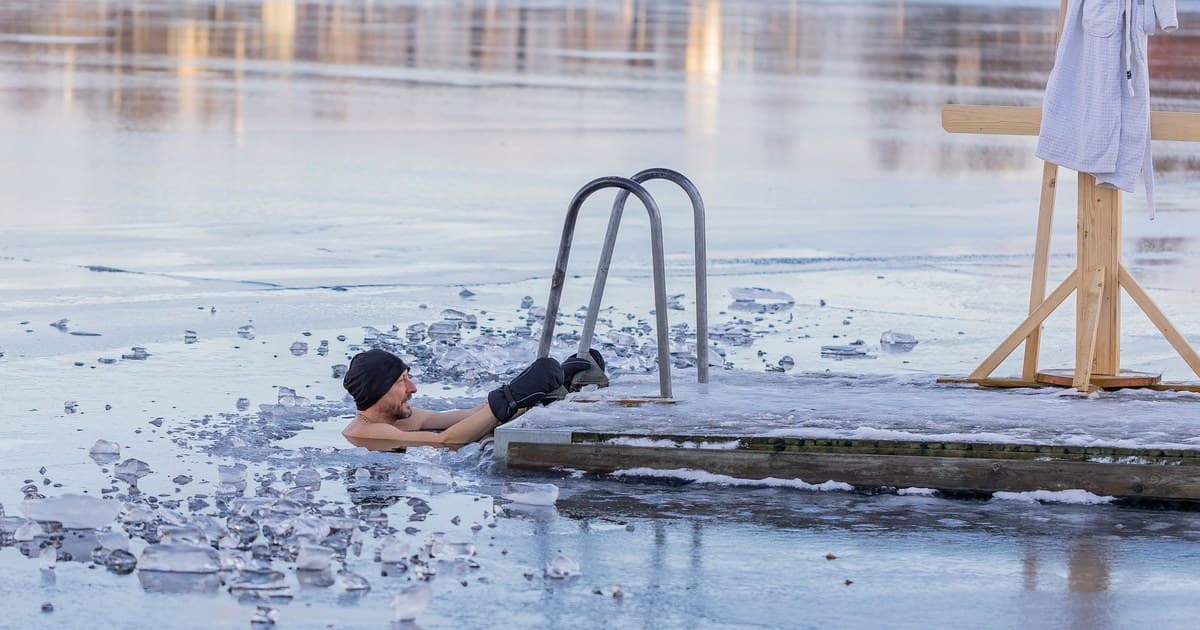
Your feed is full of people sitting in tubs of ice at 6 a.m., breathing through clenched teeth and promising it'll fix your mood, melt fat, and supercharge your immune system. So what are the real cold plunge benefits, and what's just good lighting and a dramatic exhale?
We dug through the research on cold water immersion so you don't have to. Short version: some claims hold up, one popular habit may quietly cost you gains, and a few are still mostly vibes. Even a major review led by cold-water physiologist Michael Tipton concluded that for some claims, "the supporting data remain at the level of anecdotal speculation" [1].
Cold plunge benefits for recovery: the ice bath after workout
This is the strongest part of the case. In 2022, Emma Moore and colleagues pooled 52 studies comparing cold water immersion with passive recovery in physically active people [2]. After high-intensity exercise, cold water helped people feel less sore and more recovered 24 hours later, brought back muscular power faster, and lowered creatine kinase, a blood marker of muscle damage [2]. It didn't help strength bounce back faster, though [2].
An earlier meta-analysis by Aryane Flauzino Machado and colleagues zoomed in on soreness. Cold water immersion "can be slightly better" than sitting around, and the sweet spot seemed to be 11-15°C (about 52-59°F) for 11-15 minutes [3]. Moore's team noted that sweet spot rests on only a handful of studies, and since you can't blind anyone to an ice bath, some of the soreness relief may be placebo [2].
Translation: an ice bath after workout can take the edge off soreness, especially between hard sessions or during a tournament weekend. Real effect, modest size.
Cold plunge muscle growth: the catch nobody posts about
Here's the plot twist for lifters. The cooling that calms sore muscles may also dull the signals that help them grow.
- The classic study. Llion Roberts and colleagues had 21 active men strength train twice a week for 12 weeks, followed by either 10 minutes in about 10°C (50°F) water or an easy active cooldown [4]. The cooldown group gained more strength and muscle. Their fast-twitch (type II) fibers grew 17%, while the cold group's didn't significantly change [4]. A second experiment found cold water blunted muscle-building signals, including satellite cell activity [4].
- The follow-up. Jackson Fyfe and colleagues had 16 men lift three times a week for seven weeks, followed by 15 minutes at 10°C or passive recovery at room temperature [5]. Strength gains were similar, but fast-twitch fiber growth was blunted with cold. The authors' advice: avoid post-exercise cold water immersion "if muscle hypertrophy is desired" [5].
- The big picture. A 2024 meta-analysis of 8 studies led by Alec Piñero (with muscle researcher Brad Schoenfeld) found cold water right after lifting may modestly reduce muscle growth. You still grow, just less [6]. The authors flagged the studies as "relatively fair to poor quality" [6].
On strength, a 2021 meta-analysis by Elvis Malta and colleagues found a harmful effect of regular cold water immersion on strength gains, but no clear effect on endurance performance [7]. So if you're into Zone 2 training, a post-run plunge doesn't look like a problem.
One key detail: the muscle studies tested plunging within about 15 minutes of lifting. Whether a plunge hours later or on a rest day does the same thing is still unknown [6]. If muscle is the goal, nail the basics, like how much protein you eat per meal, and keep the ice away from your post-lift window.
The dopamine and mood claims
The viral stat says cold water raises dopamine 250%. It comes from a 2000 study by P. Šrámek and colleagues at Charles University in Prague [8]. In 14°C (57°F) water, young men's plasma noradrenaline (norepinephrine) jumped 530% and dopamine 250% [8]. Real numbers, but the reels skip the context: they sat in the water for a full hour, and these were blood levels, not brain levels [8]. And dopamine isn't a tank a plunge "fills up," as we covered in our dopamine detox breakdown.
Does it feel good? Possibly. In a small brain-imaging study led by Ala Yankouskaya, 33 adults new to cold water spent 5 minutes in a 20°C (68°F) bath. Afterward they felt more active, alert, and inspired, and less distressed and nervous [9]. There was no control group, though [9]. But a 2025 meta-analysis led by Tara Cain found lower stress 12 hours after a plunge and no clear effect on mood. Better sleep showed up in just one small study, and the authors warned the evidence comes from few, small trials [10]. If better sleep is your goal, a steady sleep schedule has stronger evidence.
Verdict: the post-plunge buzz is plausible, and the fight-or-flight surge may help explain it. Lasting mood benefits aren't established.
Brown fat and the "11 minutes a week" rule
Brown fat is a tissue that burns energy to make heat. Susanna Søberg and colleagues in Copenhagen compared young male winter swimmers, who dipped two to three times a week and used the sauna, with matched controls [11]. During lab cooling, the swimmers ramped up heat production more, though their brown fat's sugar uptake rose about the same as the controls' [11].
That famous "11 minutes of cold per week"? It comes from this study's table describing the swimmers' habits: about 11 minutes of cold water and 57 minutes of sauna a week [11]. It describes what seven guys already did. It was never tested as a dose, the groups weren't randomized, and fat loss wasn't measured. (Disclosure: one author consults for Novo Nordisk on brown fat, and another works with a company developing diabetes and obesity drugs [11].)
Immunity and sick days
In a Dutch trial, Geert Buijze and colleagues had 3,018 adults end their hot shower with 30-90 seconds of cold water, or shower as usual [12]. The cold groups reported 29% less sickness absence from work, but no fewer days of actually being ill [12]. The trial was unblinded and self-reported, and one co-author worked for Dutch insurer Achmea [12]. So maybe you push through a cold more easily. "Cold showers stop you getting sick" isn't what the data says.
Wim Hof and the influencer hype, honestly
In a 2014 study led by Matthijs Kox, 12 volunteers were trained for 10 days by Wim Hof and his trainers in meditation, intense breathing with breath holds, and ice-cold dips [13]. When injected with a bacterial toxin that causes flu-like symptoms, they had lower inflammatory markers and fewer symptoms than 12 untrained people [13].
The twist? When Jelle Zwaag, Kox, and colleagues later split the method into parts, cold training alone didn't meaningfully change the inflammatory response. The breathing did, and cold seemed to boost it [14]. Neither study shows that cold plunges alone make you bulletproof.
Safety: the part influencers skip
The first moments in cold water trigger the cold shock response: a gasp, uncontrollable fast breathing, a racing heart, and a blood pressure spike [15]. Michael Shattock and Tipton proposed that when cold shock collides with the "diving response" from submerging your face and holding your breath, it may trigger dangerous heart rhythms in vulnerable people [15].
- Start mild and short. Ease in feet first and let the gasp and fast breathing settle before going deeper. Beginners should start around 15°C (59°F) for a few minutes, not icy water. Get out if you're shivering hard, numb, or confused.
- Never plunge alone, especially in open water.
- Keep your head out, and don't hold your breath going in [15].
- No hyperventilation breathwork in or near water. Even the official Wim Hof Method FAQ says to "breathe normally during any type of cold exposure involving water," because the breathing can cause fainting and drowning [16].
- Heart condition or high blood pressure? Talk to your doctor first.
How to use deliberate cold exposure without losing gains
- Lifting for muscle? Skip the plunge right after lifting [5] [6]. Use rest days or post-cardio instead; the ideal gap hasn't been tested [6].
- Endurance or sport? Post-session cold water looks fine for adaptations [7] and can help soreness and power between hard sessions [2].
- Dose for soreness: once you're used to cold, about 11-15°C (52-59°F) for 11-15 minutes is the range studies point to, though it rests on only a handful of trials [2] [3].
- Just want the mood kick? Start milder. Even 20°C (68°F) for 5 minutes shifted mood in the lab [9].
- Cold showers count. 30-90 seconds at the end of your shower is the cheap entry point [12].
What works vs. what doesn't
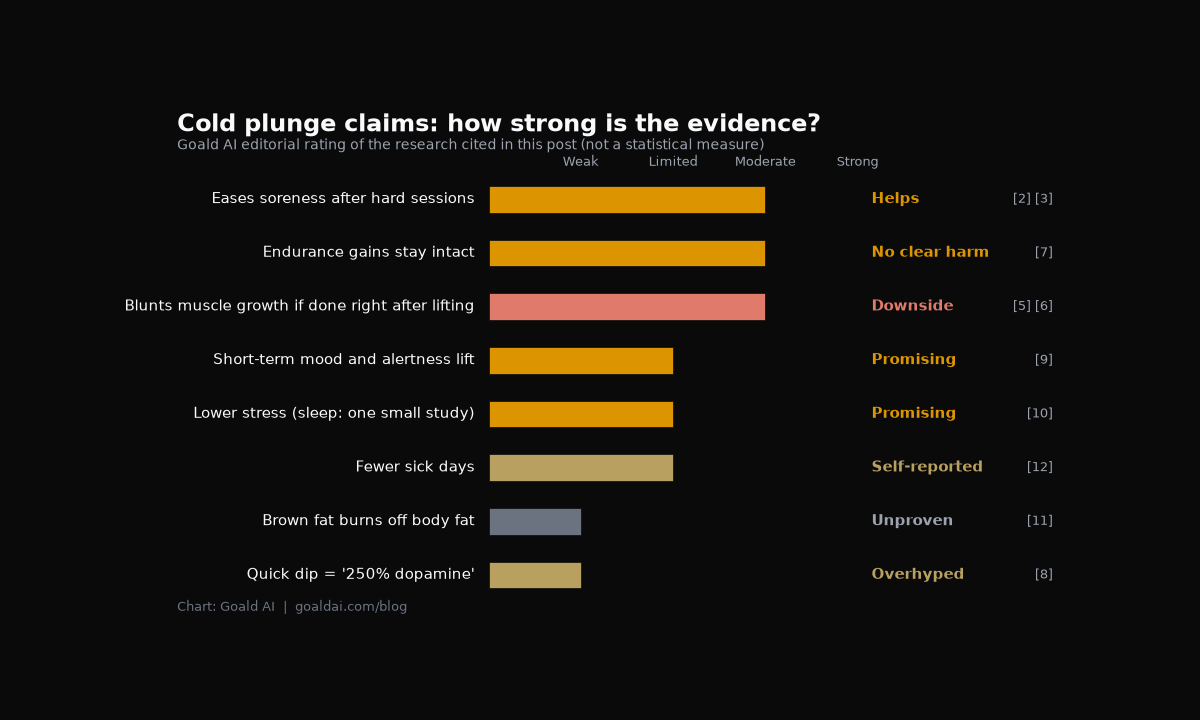
What works: soreness relief and faster power recovery after hard sessions (moderate-quality evidence) [2] [3], no clear harm to endurance gains [7], and a short-term mood lift in small studies [9].
What doesn't (or isn't proven): plunging right after lifting if you want maximal muscle [4] [5] [6], "250% dopamine" from a quick dip [8], fat loss from brown fat [11], and never getting sick [12].
How Goald AI fits in
The best deliberate cold exposure plan fits around your training instead of fighting it. That's a scheduling problem, and Goald AI is built for it.
Goald AI is an upcoming iOS app that brings goals, habits, fitness tracking, smart scheduling, and an AI Mentor into one place. Track plunges or cold showers as a habit, log your lifts and runs, and let smart scheduling put cold sessions on rest days or after cardio, away from leg day. It's free for up to 3 goals, with Pro at $9.99/month or $99.99/year.
Not medical advice. This article is for general education only. Cold water immersion carries real risks. If you have a heart condition, high blood pressure, or any other medical condition, talk to your doctor before trying it.
Sources
- Tipton MJ, Collier N, Massey H, Corbett J, Harper M. "Cold water immersion: kill or cure?" Experimental Physiology, 2017. https://pubmed.ncbi.nlm.nih.gov/28833689/
- Moore E, Fuller JT, Buckley JD, et al. "Impact of Cold-Water Immersion Compared with Passive Recovery Following a Single Bout of Strenuous Exercise on Athletic Performance in Physically Active Participants: A Systematic Review with Meta-analysis and Meta-regression." Sports Medicine, 2022. https://pmc.ncbi.nlm.nih.gov/articles/PMC9213381/
- Machado AF, Ferreira PH, Micheletti JK, et al. "Can Water Temperature and Immersion Time Influence the Effect of Cold Water Immersion on Muscle Soreness? A Systematic Review and Meta-Analysis." Sports Medicine, 2016. https://pmc.ncbi.nlm.nih.gov/articles/PMC4802003/
- Roberts LA, Raastad T, Markworth JF, et al. "Post-exercise cold water immersion attenuates acute anabolic signalling and long-term adaptations in muscle to strength training." The Journal of Physiology, 2015. https://pmc.ncbi.nlm.nih.gov/articles/PMC4594298/
- Fyfe JJ, Broatch JR, Trewin AJ, et al. "Cold water immersion attenuates anabolic signaling and skeletal muscle fiber hypertrophy, but not strength gain, following whole-body resistance training." Journal of Applied Physiology, 2019. https://pubmed.ncbi.nlm.nih.gov/31513450/
- Piñero A, Burke R, Augustin F, et al. "Throwing cold water on muscle growth: A systematic review with meta-analysis of the effects of postexercise cold water immersion on resistance training-induced hypertrophy." European Journal of Sport Science, 2024. https://pmc.ncbi.nlm.nih.gov/articles/PMC11235606/
- Malta ES, Dutra YM, Broatch JR, Bishop DJ, Zagatto AM. "The Effects of Regular Cold-Water Immersion Use on Training-Induced Changes in Strength and Endurance Performance: A Systematic Review with Meta-Analysis." Sports Medicine, 2021. https://pubmed.ncbi.nlm.nih.gov/33146851/
- Šrámek P, Šimečková M, Janský L, Šavlíková J, Vybíral S. "Human physiological responses to immersion into water of different temperatures." European Journal of Applied Physiology, 2000. https://pubmed.ncbi.nlm.nih.gov/10751106/
- Yankouskaya A, Williamson R, Stacey C, Totman JJ, Massey H. "Short-Term Head-Out Whole-Body Cold-Water Immersion Facilitates Positive Affect and Increases Interaction between Large-Scale Brain Networks." Biology, 2023. https://pmc.ncbi.nlm.nih.gov/articles/PMC9953392/
- Cain T, Brinsley J, Bennett H, Nelson M, Maher C, Singh B. "Effects of cold-water immersion on health and wellbeing: A systematic review and meta-analysis." PLOS ONE, 2025. https://pmc.ncbi.nlm.nih.gov/articles/PMC11778651/
- Søberg S, Löfgren J, Philipsen FE, et al. "Altered brown fat thermoregulation and enhanced cold-induced thermogenesis in young, healthy, winter-swimming men." Cell Reports Medicine, 2021. https://pmc.ncbi.nlm.nih.gov/articles/PMC8561167/
- Buijze GA, Sierevelt IN, van der Heijden BCJM, Dijkgraaf MG, Frings-Dresen MHW. "The Effect of Cold Showering on Health and Work: A Randomized Controlled Trial." PLOS ONE, 2016. https://pmc.ncbi.nlm.nih.gov/articles/PMC5025014/
- Kox M, van Eijk LT, Zwaag J, et al. "Voluntary activation of the sympathetic nervous system and attenuation of the innate immune response in humans." PNAS, 2014. https://pmc.ncbi.nlm.nih.gov/articles/PMC4034215/
- Zwaag J, Naaktgeboren R, van Herwaarden AE, Pickkers P, Kox M. "The Effects of Cold Exposure Training and a Breathing Exercise on the Inflammatory Response in Humans: A Pilot Study." Psychosomatic Medicine, 2022. https://pmc.ncbi.nlm.nih.gov/articles/PMC9071023/
- Shattock MJ, Tipton MJ. "'Autonomic conflict': a different way to die during cold water immersion?" The Journal of Physiology, 2012. https://pmc.ncbi.nlm.nih.gov/articles/PMC3459038/
- Wim Hof Method. "Frequently Asked Questions." Wim Hof Method (official site). https://www.wimhofmethod.com/faq
Goald AI is coming to iOS.
Join the waitlist — be first in when we launch.
Related posts
fitness
Biological Age Tests: What Works and What Doesn't
Is that biological age test worth it? Here's what research says about epigenetic clocks, test variability, and what actually moves the needle on aging.
fitness
Time-Restricted Eating: What Works and What Doesn't
Time-restricted eating is trending hard. Here's what trials say works (modest glycemic help), what doesn't (ultra-short windows), and a simple protocol.
fitness
CGM Without Diabetes: What Works and What Doesn't
Thinking about a CGM without diabetes? Here's what research says about glucose spikes, sensor accuracy, and food anxiety, plus how to actually use one well.