Time-Restricted Eating: What Works and What Doesn't

Somewhere right now, someone is skipping breakfast, slamming dinner at 9 p.m., and calling it a longevity protocol. Time-restricted eating (TRE) is everywhere: 16:8 challenges, "metabolic reset" reels, and claims that a shorter clock on your plate will reverse aging. The appeal is obvious. You don't have to count every gram. You just pick an eating window and stop when the clock says so.
Here's the twist. TRE is a real research topic with decent trials behind it. It is also not a free pass to ignore protein, calories, sleep, or common sense. Let's sort what the evidence actually supports from what the hype wants you to believe.
Time-restricted eating vs intermittent fasting (they're related, not twins)
Time-restricted eating usually means you keep a consistent daily eating window—often 8 to 10 hours—and fast the rest of the day, without a forced calorie target. Intermittent fasting is the broader family: TRE, alternate-day fasting, 5:2-style plans, and other patterns that cycle eating and fasting [1][2].
So if you eat from noon to 8 p.m. most days, you're doing TRE (a form of intermittent fasting). If you fast every other day, that's intermittent fasting that is not classic TRE. That distinction matters when you read headlines: a study of alternate-day fasting is not the same as an 8-hour eating window trial.

Why timing might matter (the circadian angle)
Your body is not a 24/7 buffet machine. Insulin sensitivity, glucose handling, and energy expenditure tend to track circadian rhythms, which generally favor daytime eating over midnight snacks [2][3].
That idea got an early clinical stress test in 2018. Elizabeth F. Sutton, PhD (Pennington Biomedical Research Center), nutrition scientist Courtney M. Peterson, PhD (University of Alabama at Birmingham), and colleagues ran a tightly controlled crossover trial of early time-restricted eating in eight men with prediabetes. Participants ate all calories in a 6-hour window ending by about 3 p.m., versus a 12-hour schedule, with food intake matched so weight stayed roughly stable. After five weeks, early TRE improved insulin sensitivity and β-cell responsiveness, lowered blood pressure, and reduced a marker of oxidative stress—even without meaningful weight loss [2].
Caveats, because they matter: tiny sample, men only, highly supervised meals, and a 6-hour window that most people would find brutal at work. It was a proof-of-concept, not a lifestyle prescription. Still, it planted a flag: when you eat may change metabolic markers beyond how much you eat [2].
A 2022 randomized crossover study from Nina Vujović, PhD, and Frank A.J.L. Scheer, PhD, at Brigham and Women's Hospital pushed the late-eating question harder. Sixteen adults with overweight or obesity ate identical calories on an early schedule versus the same meals shifted about four hours later, with sleep, activity, and light controlled. Late eating increased hunger, lowered energy expenditure during wake time, and nudged fat-tissue gene expression in a direction that may favor fat storage [3]. In plain English: late-night eating isn't just "extra willpower failure." It can change the physiology of hunger and calorie burn when everything else is held equal [3].
What works: modest help for some metabolic markers
Personalized 8–10 hour TRE on top of usual care (TIMET)
In 2024, Emily N.C. Manoogian, PhD (Salk Institute), cardiologist Pam R. Taub, MD (UC San Diego), and colleagues published the TIMET randomized trial in Annals of Internal Medicine. Adults with metabolic syndrome (including elevated fasting glucose or HbA1c; meds allowed) got standard-of-care nutrition counseling alone, or counseling plus a personalized 8- to 10-hour TRE plan that shortened their baseline eating window by at least four hours [1].
After three months, TRE improved HbA1c by an extra −0.10 percentage points versus standard care (95% CI −0.19 to −0.003)—a modest drop, but in a range that diabetes-prevention research has treated as meaningful at the population level [1][4]. Adherence tools included the myCircadianClock app, and there were no major adverse events [1].
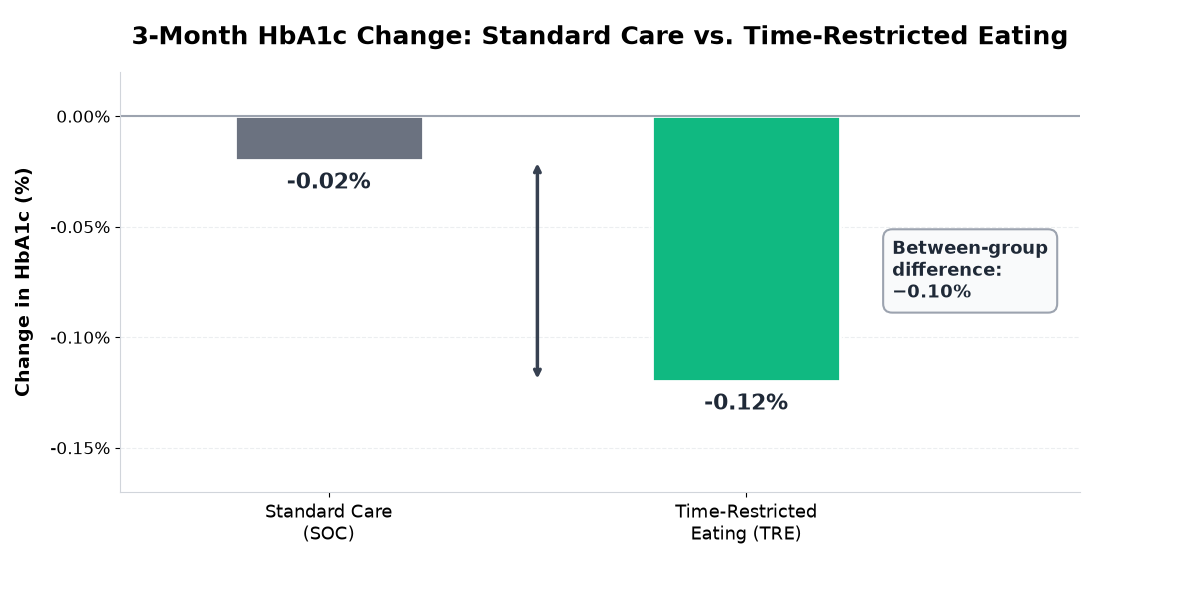
Translation: for people already dealing with metabolic syndrome, a realistic eating window on top of counseling (and often meds) may nudge glycemic control a bit. It is not a replacement for medical care.
Early windows and glucose (Spain TRE + Mediterranean education)
Manuel Dote-Montero, PhD, Antonio Clavero-Jimeno, and colleagues ran a 12-week multicenter RCT published in Nature Medicine (2024 article ID; published online early 2025). Nearly 200 adults with overweight or obesity got Mediterranean-diet education alone, or education plus an 8-hour early, late, or self-selected TRE schedule [5][6].
Primary outcome—visceral adipose tissue on MRI—did not improve more with TRE than with Mediterranean education alone [5]. That is a big, honest null for the "TRE melts organ fat" pitch. Secondary findings were more nuanced: all TRE arms lost more body weight than usual care, early TRE reduced subcutaneous abdominal fat more, and early TRE was linked with lower fasting and nocturnal glucose versus usual care [5][6]. Adherence was high (about 85–88%), and serious adverse events were not reported [5].
So early TRE may help some glucose markers for some people—especially when the comparison is "same nutrition education, different clocks"—but it is not a guaranteed VAT shredder [5][6].
What else seems to work in practice
- A consistent daily window is easier for many people than meticulous calorie counting. That adherence advantage is part of the pitch in TIMET and the Spanish trial [1][5].
- Stopping late-night eating lines up with circadian physiology and the Brigham late-eating experiment [2][3].
- Pairing TRE with food quality still matters. TRE plus Mediterranean education is not the same as TRE plus drive-thru [5]. For protein specifically, timing and per-meal targets are their own rabbit hole—see our take on the protein-per-meal myth.
- If you're curious about glucose patterns, a continuous monitor is a research tool and a lifestyle gadget with trade-offs; we unpacked that in CGM without diabetes.
What doesn't work (or doesn't prove what the internet claims)
Treating TRE like a longevity drug
There is no solid evidence that an 8-hour eating window alone is a longevity therapy in humans. The best recent trials measure months of weight, fat, and blood markers—not decades of lifespan [1][5][7]. Longevity claims are mostly extrapolation and marketing.
Expecting big weight loss from a gentle 10-hour window
The RESET trial, led by Jonas Salling Quist, PhD, and colleagues at Steno Diabetes Center Copenhagen, randomized 100 adults at high risk of type 2 diabetes to habitual living or a self-selected 10-hour eating window (between 6 a.m. and 8 p.m.) for three months, with three months of follow-up [7]. In the intention-to-treat analysis, weight differed by only −0.8 kg (95% CI −1.7 to 0.2; p=0.099) versus control after three months—not a clinically meaningful win. The authors concluded that three months of 10-hour TRE did not produce clinically relevant weight effects in this group [7].
If your only goal is dropping pounds fast, a soft window without other changes may disappoint. That does not erase TIMET's glycemic signal in metabolic syndrome [1]. It does mean "any TRE, any outcome" is wishful thinking.
Ultra-short windows as magic
Four- to six-hour schedules make great screenshots. They also collide with social life, training, and adequate protein. Sutton's early TRE used six hours under lab supervision [2]. Real life is messier. Shorter is not automatically better—especially if you under-eat, trash sleep, or rebound-binge.
Ignoring sleep, protein, and total intake
TRE is a timing tool, not a complete diet. Short sleep and irregular sleep wreck metabolic health on their own; sleep consistency often beats raw duration. If your window is "healthy" but your plate is chaos, don't expect miracles.
The scary "TRE kills" headline (read the fine print)
In March 2024, an American Heart Association EPI|Lifestyle abstract from Victor Wenze Zhong, PhD (Shanghai Jiao Tong University School of Medicine), and colleagues linked an eating duration under 8 hours with higher cardiovascular mortality in NHANES participants (a 91% higher risk, versus a 12–16 hour reference) [8][9]. Headlines went nuclear.
Important limitations the abstract and AHA coverage themselves flag [8][9]:
- Conference abstract, not a peer-reviewed paper at the time of release—full methodology and data were not yet available for independent scrutiny.
- Observational, not a randomized trial—association ≠ causation.
- Based on two 24-hour diet recalls, which are noisy proxies for years of habit.
- Confounding (illness, under-eating, shift work, diet quality) is hard to fully remove.
- Experts commenting for the AHA noted missing detail on nutrient quality and baseline differences across window groups [8].
This is a caution light on ultra-restrictive long-term windows in free-living data. It is not proof that a supervised 8–10 hour TRE trial will kill you. Hold both ideas: short-term RCTs look reasonably safe and sometimes helpful [1][5]; long-term observational signals deserve humility, not panic or denial [8][9].
A practical TRE protocol you can actually stick to
- Pick an 8–10 hour eating window you can repeat on weekdays. TIMET used personalized 8–10 hour windows; RESET's 10-hour plan was gentle and, alone, didn't move weight much [1][7].
- Bias earlier if your life allows. Early TRE has the strongest mechanistic and some clinical signals for glucose and insulin markers [2][5][6]. If early isn't realistic, a consistent midday window still beats chaotic grazing.
- End eating 2–3 hours before bed when you can. That targets late-night eating without requiring a 6 a.m. breakfast club [1][3].
- Keep protein and veggies non-negotiable. Timing does not replace nutrition [5].
- Track adherence for two weeks, not vibes. Apps helped TIMET participants stay honest [1][4].
- Watch sleep and stress. A perfect window with terrible sleep is a half-finished experiment.
- Talk to a clinician if you have diabetes on meds, a history of disordered eating, are pregnant, or take medications that require food. TRE is not for everyone.
How Goald AI fits in
The hard part of time-restricted eating isn't understanding an 8-hour window. It's protecting that window on a chaotic Tuesday, after a late meeting, when every food app is yelling at you.
Goald AI helps you turn the protocol into a system. Set a goal like "10-hour eating window ending by 7 p.m.," then stack habits: a protein-forward first meal, a phone-free kitchen after dinner, and a consistent bedtime. Goald AI tracks goals, habits, and workouts in one place. Smart scheduling finds room for meal prep and training in your real calendar. Your AI Mentor remembers what blew up last week—travel, late dinners, skipped breakfasts—and adjusts the plan instead of pretending streak numbers are a personality.
Goald AI is coming to iOS soon. Free covers up to 3 goals; Goald AI Pro is $9.99/month or $99.99/year. See all the features or Join the waitlist.
Not medical advice. This article is for general education only. Time-restricted eating can interact with medications, blood sugar, and eating-disorder risk. Talk with a doctor or registered dietitian before changing how or when you eat, especially if you have diabetes, take glucose-lowering drugs, are pregnant or breastfeeding, or have a history of disordered eating.
Sources
- Manoogian ENC, Wilkinson MJ, O'Neal M, et al. "Time-Restricted Eating in Adults With Metabolic Syndrome: A Randomized Controlled Trial." Annals of Internal Medicine, 2024. https://www.acpjournals.org/doi/10.7326/M24-0859
- Sutton EF, Beyl R, Early KS, Cefalu WT, Ravussin E, Peterson CM. "Early Time-Restricted Feeding Improves Insulin Sensitivity, Blood Pressure, and Oxidative Stress Even without Weight Loss in Men with Prediabetes." Cell Metabolism, 2018. https://pmc.ncbi.nlm.nih.gov/articles/PMC5990470/
- Vujović N, et al. "Late isocaloric eating increases hunger, decreases energy expenditure, and modifies metabolic pathways in adults with overweight and obesity." Cell Metabolism, 2022. https://doi.org/10.1016/j.cmet.2022.09.007
- UC San Diego Health. "Study: Time-Restricted Eating May Improve Health of Adults with Metabolic Syndrome" (press release). September 30, 2024. https://health.ucsd.edu/news/press-releases/2024-09-30-study-time-restricted-eating-may-improve-health-of-adults-with-metabolic-syndrome/
- Dote-Montero M, Clavero-Jimeno A, et al. "Effects of early, late and self-selected time-restricted eating on visceral adipose tissue and cardiometabolic health in participants with overweight or obesity: a randomized controlled trial." Nature Medicine, 2024/2025. https://www.nature.com/articles/s41591-024-03375-y
- Ruiz JR. "Uncovering the Role of the Timing of Time-Restricted Eating for Cardiometabolic Health." Springer Nature Research Communities, 2025. https://communities.springernature.com/posts/uncovering-the-role-of-the-timing-of-time-restricted-eating-for-cardiometabolic-health
- Quist JS, Pedersen HE, Jensen MM, et al. "Effects of 3 months of 10-h per-day time-restricted eating and 3 months of follow-up on bodyweight and cardiometabolic health in Danish individuals at high risk of type 2 diabetes: the RESET single-centre, parallel, superiority, open-label, randomised controlled trial." The Lancet Healthy Longevity, 2024. https://www.thelancet.com/journals/lanhl/article/PIIS2666-7568(24)00028-X/fulltext
- American Heart Association Newsroom. "8-hour time-restricted eating linked to a 91% higher risk of cardiovascular death." March 18, 2024. https://newsroom.heart.org/news/8-hour-time-restricted-eating-linked-to-a-91-higher-risk-of-cardiovascular-death
- Zhong VW, et al. "Abstract P192: Association Between Time-Restricted Eating and All-Cause and Cause-Specific Mortality." Circulation, 2024 (AHA EPI|Lifestyle abstract). https://www.ahajournals.org/doi/10.1161/circ.149.suppl_1.P192
- Cox CE. "Time-Restricted Eating Tightens Glycemic Control in Patients With Metabolic Syndrome." TCTMD, October 4, 2024. https://www.tctmd.com/news/time-restricted-eating-tightens-glycemic-control-patients-metabolic-syndrome
Goald AI is coming to iOS.
Join the waitlist — be first in when we launch.
Related posts
fitness
Biological Age Tests: What Works and What Doesn't
Is that biological age test worth it? Here's what research says about epigenetic clocks, test variability, and what actually moves the needle on aging.
fitness
Cold Plunge Benefits: What Works and What Doesn't
Cold plunge benefits, minus the hype: what science says about ice baths for soreness, muscle growth, mood, brown fat, and immunity, and how to plunge safely.
fitness
CGM Without Diabetes: What Works and What Doesn't
Thinking about a CGM without diabetes? Here's what research says about glucose spikes, sensor accuracy, and food anxiety, plus how to actually use one well.