Your To-Do List Is Lying: Fix the Planning Fallacy

Monday you: "I'll knock out the slide deck, the budget, the side project, and the gym. Easy."
Friday you: staring at a to-do list that looks exactly like Monday's, wondering where the week went.
You're not lazy. You're human. Psychologists call this the planning fallacy: predicting that our own tasks will go smoothly, even when we know most similar tasks ran late. The good news? Decades of research point to a few simple moves that seem to shrink the gap between "should take an hour" and "took all afternoon." Below, we bundle them into one four-step method and run it on a real-looking week.
What the planning fallacy is (and why smart people fall for it)
Daniel Kahneman and Amos Tversky coined the term in 1979 to describe a confident belief that your own project will go as planned, even while knowing that most similar projects have run late [1].
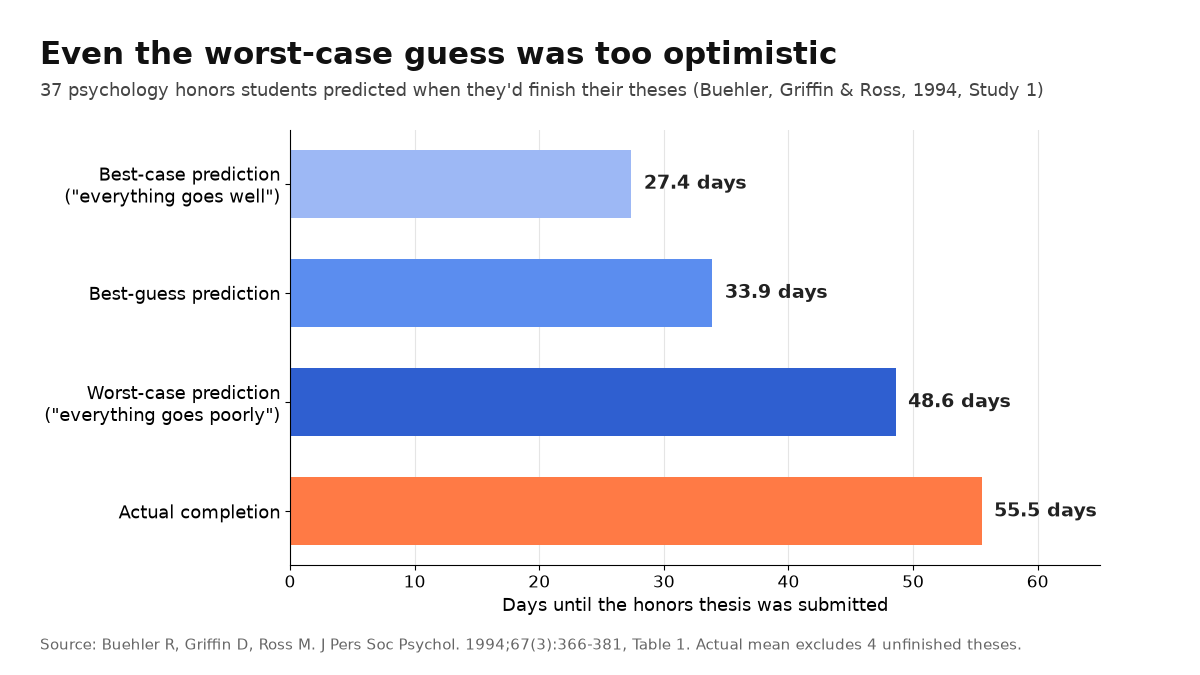
The most famous test came from psychologists Roger Buehler of Simon Fraser University and Dale Griffin and Michael Ross of the University of Waterloo [1]. They phoned 37 psychology honors students in their final semester and asked when they'd hand in their thesis. The students' best guess averaged 33.9 days. The real average was 55.5 days, and only 29.7% finished by their own best-guess date [1].
Then comes the plot twist. The researchers also asked for a worst-case prediction, "if everything went as poorly as it possibly could." That averaged 48.6 days, still a week short of reality [1].
Why does it happen? Researchers have found a few likely culprits:
- We stare at the plan, not the past. When Buehler's team had people think aloud while predicting, they mostly described future scenarios, not how similar tasks had gone before [1]. Kahneman and Dan Lovallo call this the "inside view": you focus on the details of this one case and skip the track record of similar ones [2].
- We explain away old misses. In Buehler's studies, people tended to blame past delays on outside, one-off, specific causes, which made those delays feel irrelevant to the next prediction [1].
- Our memories cheat. Psychologists Michael Roy, Nicholas Christenfeld, and Craig McKenzie reviewed evidence that people often remember past tasks as having taken less time than they actually did [3]. If the memory is short, the forecast built on it will be short, too. In their review, correcting people's memory of past durations seemed to improve their predictions [3].
- Big tasks hide their parts. Justin Kruger and Matt Evans of the University of Illinois argued that people don't naturally "unpack" a task like "write the report" into all its little pieces, so the pieces don't get counted [4].
Fun detail: the bias seems to be about your own stuff. In Buehler's fifth study, outside observers actually overestimated how long other people would take [1].
The RULE method: 4 steps to better time estimation
Each step targets one of the culprits above. Use it as a pre-flight checklist for any task, goal, or week.
Step 1: Reference (look back before you look ahead)
Start with the outside view. Bent Flyvbjerg, a planning scholar who studies megaprojects, turned it into a formal technique called reference class forecasting [5]. It has three steps: pick a class of similar past projects, look at how long (or how much money) they actually took, then place your project within that range [5]. Flyvbjerg described the method being used to set budget estimates for big UK transport projects, including London's Crossrail [5].
Kahneman's own story shows why it matters. While developing a high school curriculum, his team estimated it would take 18 to 30 months to finish a draft. When he asked a curriculum expert on the team how similar teams had fared, the expert admitted that about 40% never finished, and he couldn't recall any that took less than seven years [2]. Ouch.
Your version: For each task, ask: "What did the last three similar tasks actually take?" Since memory runs short [3], check real records if you can: calendar entries, file timestamps, sent emails, app logs.
Step 2: Unpack (list every piece)
Kruger and Evans asked people to estimate tasks like holiday shopping, getting ready for a date, formatting a document, and cooking a meal [4]. People who first listed the steps gave longer estimates, and in the formatting and cooking experiments, those estimates were less biased [4]. A fifth experiment found that the more complex the task, the bigger the payoff from unpacking [4].
Your version: Break each task into its sub-steps, then estimate each one. Don't forget the boring bits: setup, waiting on other people, review, fixes, and the "final" version that is never final.
Step 3: Lock it in (decide when and where)
This step is about doing, not just guessing. Sander Koole of the Free University Amsterdam and Mascha van 't Spijker of the University of Nijmegen gave Nijmegen undergraduates an assignment to write a report [6]. Half also made an implementation intention: a specific plan for where and when they'd write it. Those planners predicted they'd be faster, and they were faster by an even bigger margin [6]. Their optimism gap (actual minus predicted) shrank from about 1.2 days to about 0.2 days, and they reported fewer interruptions, which seemed to explain part of the effect [6].
Your version: Give every unpacked chunk a calendar slot with a time and a place. "Draft budget, Tuesday 9-10:30 a.m., desk, phone in the other room." Fewer interruptions matter here; our 5-day focus test has ways to protect those slots.
Step 4: Evaluate (log the real number)
Buehler's team found that simply asking people to recall past tasks wasn't enough. What worked was making them connect those past experiences to the task at hand [1]. In that study, 60% of people in the "connect your past to this task" group finished when they predicted, versus 38.1% who just recalled the past and 29.3% in the control group [1].
Your version: When a task is done, write down estimated vs. actual time. That log becomes next week's reference class (Step 1), and it tackles the short-memory problem from Step 1 by replacing a fuzzy memory with a real number.
Worked example: how to plan your week with RULE
Meet Dana, a made-up but very relatable marketer who wants to launch a personal portfolio site this week. Her Monday plan: "Build the portfolio site: about 4 hours." Here's the same goal after RULE. (The hours below are an illustration, not study data.)
Reference. Dana checks her calendar. Her last two "quick" web projects, a landing page and a newsletter template, took about two and a half times her estimates. Her outside view says: be suspicious of 4 hours.
Unpack. She lists the pieces:
- Pick a template and set up hosting: 1 hour
- Write the bio and the about page: 1.5 hours
- Gather and write up three case studies: 4 hours
- Find, crop, and compress images: 1.5 hours
- Test on phone and fix layout bugs: 1.5 hours
- Ask a friend for feedback and make edits: 1.5 hours
Total: 11 hours. Already almost triple the original guess, before any buffer.
Lock it in. She can't fit 11 hours on top of her job, so she makes a choice. This week she ships the site with one case study (about 8 hours of work), and books it into the calendar: Tuesday and Thursday 7-9 p.m., Saturday 9 a.m.-1 p.m., kitchen table. The other two case studies go on next week's plan.
Evaluate. Each evening she jots down estimate vs. actual. If images took 3 hours instead of 1.5, that's not a failure. It's data for her next project.
The result: a smaller promise she actually keeps, instead of a heroic plan that dies on Wednesday. That's the real secret of how to plan your week: plan less, finish more. If this week is also a reset moment, pair RULE with the fresh start effect to give the new plan a motivational boost.
Can AI planning tools fix the planning fallacy?
Maybe, if you use them as a reality check rather than a cheerleader. Here's the honest picture.
The warning sign: AI doesn't make us immune to bad time estimation; it can even become a new source of it. In a 2025 randomized trial, Joel Becker, Nate Rush, Beth Barnes, and David Rein of the nonprofit research group METR found that experienced open-source developers expected AI tools to make them 24% faster. When AI was allowed, tasks actually took 19% longer, and afterward the developers still believed AI had sped them up by about 20% [7]. METR has since called these early-2025 results out of date, and the findings apply to one specific setting, so don't read them as "AI makes everyone slower" [7]. The lesson is narrower: our gut feeling about how much time a tool saves can be wrong. We dug into the full study in AI for productivity myths.
Where AI can help: We haven't found studies testing AI planning tools against the planning fallacy directly, so treat this as our suggestion, not a research result. The RULE steps happen to be things a chatbot is good at nudging. Ask it to unpack a task into sub-steps (Step 2), to ask you what similar tasks took last time (Step 1), and to slot the chunks into real open times on your calendar (Step 3). Then keep Step 4 for yourself: log the real numbers, because those are data an AI can't invent for you.
How Goald AI fits in
RULE works best when your goals, your calendar, and your track record live in the same place. That's the idea behind Goald AI. Set a goal, break it into steps, and let smart scheduling find real time slots in your week. Track habits and progress as you go, and your AI Mentor remembers your goals and history, so it can help you compare what you planned with what actually happened.
Goald AI is an upcoming iOS app. The free tier covers up to 3 goals, and Goald AI Pro is $9.99/month or $99.99/year. Join the waitlist.
FAQ
What is the planning fallacy in simple terms? It's the tendency to predict that your own tasks will go faster and smoother than they will, even when you know similar tasks ran late before [1].
Does adding a buffer fix it? Sometimes, but a random buffer is a guess on top of a guess. Even worst-case predictions came up short in Buehler's thesis study [1]. A buffer based on your own track record (Step 1) is a better bet.
Is the planning fallacy the same as procrastination? No, though they often travel together. The planning fallacy is an estimation error. Procrastination is delaying action. Bad estimates can make procrastinating feel safe ("I've got plenty of time"), which is one reason Step 3 locks work into real time slots.
Sources
- Buehler R, Griffin D, Ross M. "Exploring the 'planning fallacy': Why people underestimate their task completion times." Journal of Personality and Social Psychology, 1994.
- Kahneman D, Lovallo D. "Timid choices and bold forecasts: A cognitive perspective on risk taking." Management Science, 1993.
- Roy MM, Christenfeld NJS, McKenzie CRM. "Underestimating the duration of future events: Memory incorrectly used or memory bias?" Psychological Bulletin, 2005.
- Kruger J, Evans M. "If you don't want to be late, enumerate: Unpacking reduces the planning fallacy." Journal of Experimental Social Psychology, 2004.
- Flyvbjerg B. "Curbing optimism bias and strategic misrepresentation in planning: Reference class forecasting in practice." European Planning Studies, 2008.
- Koole S, van 't Spijker M. "Overcoming the planning fallacy through willpower: Effects of implementation intentions on actual and predicted task-completion times." European Journal of Social Psychology, 2000.
- Becker J, Rush N, Barnes B, Rein D. "Measuring the Impact of Early-2025 AI on Experienced Open-Source Developer Productivity." arXiv (METR), 2025.
Goald AI is coming to iOS.
Join the waitlist — be first in when we launch.
Related posts
productivity
Decision Fatigue on Trial: Does Willpower Run Out?
Is decision fatigue really draining your willpower? A courtroom trial weighs the classic evidence. Here's the prosecution, the defense, and a verdict.
productivity
Your Brain Is Still in That Email: A 5-Day Focus Test
Task switching leaves your brain stuck on the last thing you did. Try this 5-day focus experiment, backed by studies, to track and shrink attention residue.
productivity
AI for Productivity: 5 Myths the Research Busts
Does AI for productivity really make you faster? Five popular myths meet the randomized trials, from coding and writing to consulting and critical thinking.