Decision Fatigue on Trial: Does Willpower Run Out?

All rise. The court is now in session.
The defendant: decision fatigue, the idea that your willpower drains like a battery and that every choice you make leaves you worse at the next one. For two decades, this theory shaped how we think about self-control—and spawned an industry of productivity advice built on conserving your mental fuel.
But does the science hold up? Today we put decision fatigue on trial.
Opening statement: the case before the court
The prosecution will argue that decision making depletes a limited resource, citing landmark studies on radishes, parole judges, shopping, and antibiotic prescribing. The defense will cross-examine with replications, meta-analyses, and alternative explanations. Then we'll deliver a nuanced verdict and sentence the concept to a new life: practical moves that still work, regardless of the theory behind them.
The stakes are real. If decision fatigue is real, you should protect your mornings for hard calls and automate the trivial stuff. If it's overblown, you might be limiting yourself for no reason. Let's see what the evidence says.
The prosecution's case: decision fatigue and ego depletion
Exhibit A: The radish-and-chocolate experiment (Baumeister et al., 1998)
The trial begins with the study that launched a thousand self-help books. Roy Baumeister, then at Case Western Reserve University, and colleagues brought hungry participants into a room filled with the smell of fresh-baked cookies [1]. Some were told to eat only radishes while resisting the chocolate. Others got to eat the cookies. Then everyone worked on unsolvable puzzles.
The radish group quit after about 8 minutes. The cookie group persisted for nearly 19 minutes. A control group who skipped the food phase lasted about 21 minutes [1]. The interpretation: resisting the cookies depleted a limited resource—what Baumeister called ego depletion—leaving less willpower for the puzzles.
This study, among the most cited in social psychology, became the foundation of the limited-resource model of self-control.
Exhibit B: The hungry judges (Danziger, Levav & Avnaim-Pesso, 2011)
If self-control fades across a workday, you'd expect real-world consequences. Researchers Shai Danziger (Tel Aviv University), Jonathan Levav (then Columbia Business School), and Liora Avnaim-Pesso (Ben-Gurion University) analyzed 1,112 parole rulings by eight Israeli judges over ten months [2].
The finding was dramatic: favorable rulings dropped from about 65% at the start of each session to nearly zero just before a meal break, then spiked back to 65% after the break [2]. The pattern held after the authors accounted for factors like the severity of the crime and prior incarcerations, which suggested the timing of meals mattered.
Exhibit C: Choice overload depletes you (Vohs et al., 2008)
Kathleen Vohs of the University of Minnesota and colleagues tested whether merely making choices—not just resisting temptation—could drain the tank. In four lab studies, participants who made repeated consumer choices later showed less physical stamina, less persistence on frustrating tasks, and more procrastination [3]. A field study found the same: shoppers who reported making more active decisions had weaker grip strength afterward [3].
Exhibit D: Doctors prescribe more antibiotics as the day wears on (Linder et al., 2014)
If decision fatigue affects experts on the job, it matters for public health. Jeffrey Linder at Brigham and Women's Hospital and colleagues analyzed nearly 22,000 primary care visits for respiratory infections [4]. Compared to the first hour of a clinic session, antibiotic prescribing rose by 14% in the third hour and 26% in the fourth hour—even for conditions where antibiotics are never indicated [4].
The prosecution rests.
The defense's cross-examination: the replication crisis strikes
Objection 1: The 2016 multi-lab replication found almost nothing
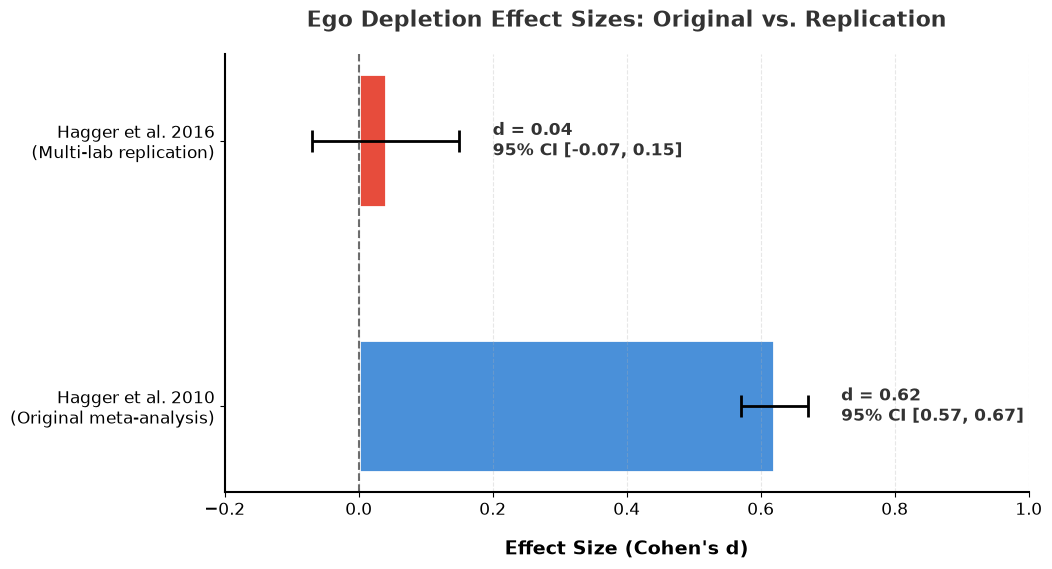
The biggest blow came from a preregistered, multi-lab replication coordinated by Martin Hagger and colleagues. Twenty-three laboratories with a combined sample of 2,141 participants ran a standardized ego-depletion protocol [5].
Result: the effect size was d = 0.04, with confidence intervals that included zero [5]. That's essentially no detectable effect. The original meta-analysis by Hagger et al. (2010) had estimated d = 0.62 [6]. The replication found the effect was about fifteen times smaller.
Objection 2: A second big replication also failed
In 2021, Vohs herself—the researcher behind the choices study—led a 36-lab replication with 3,531 participants [7]. The confirmatory analysis found d = 0.06, not statistically different from zero. Bayesian analysis indicated the data were four times more likely under the null hypothesis [7]. Fatigue correlated with worse performance, but the standard ego-depletion manipulation didn't reliably produce that fatigue [7].
Objection 3: Publication bias explains the original findings
A 2015 meta-analysis by Evan Carter, Michael McCullough, and colleagues at the University of Miami reanalyzed the same studies from Hagger's 2010 meta-analysis [8]. After correcting for small-study effects and publication bias, they found very little evidence that the depletion effect is real, at least as measured by common laboratory tasks [8].
Objection 4: The hungry judges had a scheduling confound
Keren Weinshall-Margel and John Shapard challenged the parole study in a 2011 PNAS letter [9]. They argued that case order wasn't random: prisoners without legal representation—who have lower approval rates regardless of fatigue—were systematically scheduled last in each session [9]. Danziger's team disputed this in a rebuttal, saying the pattern held even after controlling for representation [10], but the debate shows the evidence is messier than the headlines suggested.
Objection 5: Your beliefs about willpower might matter more
In 2010, Veronika Job, Carol Dweck, and Gregory Walton of Stanford proposed that ego depletion only shows up in people who believe willpower is limited [11]. If you think of willpower as unlimited, you don't show the depletion effect. This finding has intuitive appeal, but subsequent replications have been inconsistent, and a recent review called the evidence "weak at best" [12].
The defense rests.
The verdict on decision fatigue: nuanced, not dismissed
After reviewing the evidence, this court finds:
On the charge that willpower is a fixed resource that depletes predictably: Not proven beyond a reasonable doubt. The classic ego-depletion effect does not reliably replicate in large, preregistered studies. The original effect size was likely inflated by publication bias and small samples.
On the charge that mental fatigue affects decision making: Plausible, but complicated. The 2021 replication found that people who reported more fatigue performed worse—but the standard lab tasks didn't reliably produce that fatigue [7]. Real-world fatigue from sleep deprivation, long shifts, or boring work may still impair self-control, even if the lab paradigm doesn't capture it.
On the charge that motivation and beliefs matter: Supported. If you expect to be depleted, you may give yourself permission to slack off. If you believe you can push through, you might. The effect may be more about psychology than physiology.
On the practical question of whether routines and planning help: Still guilty as charged. Regardless of whether "ego depletion" is real in the strict sense, reducing unnecessary decisions does reduce friction. That's not because you're saving a mystical resource. It's because implementation intentions—if-then plans that make the default automatic—remove the need to deliberate in the moment.
The sentence: practical moves for decision fatigue that survive the replication crisis
The theory may be shaky, but the following habits still pass the evidence test. Think of them as reducing friction, not conserving fuel.
1. Build a daily routine for recurring choices.
You don't need to believe in ego depletion to notice that deciding what to eat, wear, and do every morning is annoying. A consistent daily routine eliminates those micro-decisions. Decide once, execute many times. That's not about saving willpower—it's about not wasting attention on things that don't matter. If you're starting a new routine, temporal landmarks like Mondays or the first of the month can help you launch.
2. Front-load hard decisions when you're fresh.
Even if depletion isn't as severe as the original studies claimed, scheduling your toughest work for your peak hours makes sense—though be realistic about how long those tasks will take (the planning fallacy explains why we chronically underestimate). If you're a morning person, do the strategic thinking before lunch. If you're a night owl, protect that late window. You know when your brain is sharpest—use it.
3. Batch similar decisions together.
The Linder study on antibiotic prescribing suggests that repeated decisions of the same type might wear you down—or at least that context matters [4]. Batching decisions (email at set times, meetings clustered, errands in one trip) reduces the switching cost and lets you build momentum.
4. Use if-then rules to pre-decide.
When you make a rule—"If I get home, then I change into workout clothes"—you've done the hard part in advance. Our breakdown of if-then planning covers how these rules short-circuit deliberation. It's not about conserving willpower; it's about making the right choice automatic.
5. Outsource decisions to defaults, tools, or AI.
Default options are powerful because they remove the decision entirely. Automatic savings contributions, meal-prep subscriptions, recurring calendar blocks—all of these let past-you make the call so future-you doesn't have to. Goald AI's smart scheduling does something similar: it finds time for your goals based on your existing commitments, so you're not staring at a blank week wondering where to fit things in. Its AI Mentor can suggest which habit to tackle next based on your history, trimming options so you're not starting from scratch.
Closing arguments: your 3 takeaways
1. The classic ego-depletion effect is much smaller than the headlines suggested. Large replications found effect sizes near zero. Don't build your entire productivity system on the assumption that every decision drains a limited tank.
2. Fatigue and motivation still matter. Even if lab tasks don't reliably deplete you, real exhaustion, boredom, and low motivation clearly hurt your decision making. Sleep, energy, and caring about your goals aren't optional.
3. Routines, defaults, and planning still work—just for different reasons. Reducing unnecessary decisions saves attention, reduces friction, and makes good behavior automatic. That's valuable whether or not willpower is literally limited.
How Goald AI fits in
The lesson of this trial is simple: don't trust your tired self to reinvent the plan every day. Build systems that decide for you.
Goald AI connects your goals, habits, and fitness tracking in one place. Its smart scheduling finds real time in your week for what matters. Its AI Mentor remembers your goals and history, so it can nudge you toward the next step without a fresh round of deliberation. Wondering whether to share those goals? The research says it depends on who's listening—but either way, the AI Mentor holds you accountable. Think of it as pre-deciding the routine so you can save your focus for the work that matters.
Goald AI is coming to iOS soon. Free covers up to 3 goals. Pro is $9.99/month or $99.99/year. Join the waitlist.
Court is adjourned.
Sources
- Baumeister RF, Bratslavsky E, Muraven M, Tice DM. "Ego depletion: Is the active self a limited resource?" Journal of Personality and Social Psychology, 1998. https://pubmed.ncbi.nlm.nih.gov/9599441/
- Danziger S, Levav J, Avnaim-Pesso L. "Extraneous factors in judicial decisions." Proceedings of the National Academy of Sciences, 2011. https://pmc.ncbi.nlm.nih.gov/articles/PMC3084045/
- Vohs KD, Baumeister RF, Schmeichel BJ, Twenge JM, Nelson NM, Tice DM. "Making choices impairs subsequent self-control: A limited-resource account of decision making, self-regulation, and active initiative." Journal of Personality and Social Psychology, 2008. https://doi.org/10.1037/0022-3514.94.5.883
- Linder JA, Doctor JN, Friedberg MW, Reyes Nieva H, Birks C, Meeker D, Fox CR. "Time of day and the decision to prescribe antibiotics." JAMA Internal Medicine, 2014. https://jamanetwork.com/journals/jamainternalmedicine/fullarticle/1910546
- Hagger MS, Chatzisarantis NLD, et al. "A multilab preregistered replication of the ego-depletion effect." Perspectives on Psychological Science, 2016. https://journals.sagepub.com/doi/full/10.1177/1745691616652873
- Hagger MS, Wood C, Stiff C, Chatzisarantis NLD. "Ego depletion and the strength model of self-control: A meta-analysis." Psychological Bulletin, 2010. https://doi.org/10.1037/a0019486
- Vohs KD, Schmeichel BJ, Lohmann S, et al. "A multisite preregistered paradigmatic test of the ego-depletion effect." Psychological Science, 2021. https://journals.sagepub.com/doi/10.1177/0956797621989733
- Carter EC, Kofler LM, Forster DE, McCullough ME. "A series of meta-analytic tests of the depletion effect: Self-control does not seem to rely on a limited resource." Journal of Experimental Psychology: General, 2015. https://doi.org/10.1037/xge0000083
- Weinshall-Margel K, Shapard J. "Overlooked factors in the analysis of parole decisions." Proceedings of the National Academy of Sciences, 2011. https://www.pnas.org/doi/full/10.1073/pnas.1110910108
- Danziger S, Levav J, Avnaim-Pesso L. "Reply to Weinshall-Margel and Shapard: Extraneous factors in judicial decisions persist." Proceedings of the National Academy of Sciences, 2011. https://www.pnas.org/doi/full/10.1073/pnas.1112190108
- Job V, Dweck CS, Walton GM. "Ego depletion—Is it all in your head? Implicit theories about willpower affect self-regulation." Psychological Science, 2010. https://pubmed.ncbi.nlm.nih.gov/20876879/
- Lurquin JH, Miyake A. "On the robustness and replicability of the moderating influence of willpower mindset on the ego-depletion effect: Existing evidence is weak at best." Frontiers in Psychology, 2023. https://www.frontiersin.org/journals/psychology/articles/10.3389/fpsyg.2023.1208299/full
Goald AI is coming to iOS.
Join the waitlist — be first in when we launch.
Related posts
productivity
Your To-Do List Is Lying: Fix the Planning Fallacy
The planning fallacy makes every task take longer than you think. Use the 4-step RULE method, backed by research, to plan a week you can actually finish.
productivity
Your Brain Is Still in That Email: A 5-Day Focus Test
Task switching leaves your brain stuck on the last thing you did. Try this 5-day focus experiment, backed by studies, to track and shrink attention residue.
productivity
AI for Productivity: 5 Myths the Research Busts
Does AI for productivity really make you faster? Five popular myths meet the randomized trials, from coding and writing to consulting and critical thinking.