Keep Your Goals Secret? It Depends Who's Listening

You've probably heard the advice: keep your goals to yourself. Announce that you're writing a novel, and the dopamine of everyone saying "omg, amazing!" will quietly replace the actual writing. It's a great story. It even has a real study behind it. But should you share your goals, or zip it? Here's the contrarian take: the "stay silent" crowd is answering the wrong question. The research says the real question isn't whether to tell people. It's who you tell, what you tell them, and when.
Let's look at both sides first, then rank your audience from best to worst.
The case for keeping quiet
The keep-it-secret advice traces back to a 2009 paper in Psychological Science by Peter Gollwitzer, Paschal Sheeran, Verena Michalski, and Andrea Seifert [1]. It builds on symbolic self-completion theory, which Gollwitzer co-developed with Robert Wicklund in 1981 [2]. The idea: when you're chasing an identity (say, "I'm a lawyer"), you collect symbols of that identity. Telling someone your intention can count as one of those symbols, so you feel like you've already made progress.
The experiments backed that up. In Study 1, 49 psychology students who were committed to becoming psychologists wrote down two intentions. When the experimenter read their intentions, they acted on them on fewer days over the next week than students whose intentions went unread (1.92 vs. 2.70 days, self-reported) [1]. In Study 2, law students whose intention was noticed spent less time working on law cases (41.52 vs. 45.65 minutes) [1]. In Study 4, having intentions heard made law students feel more like a jurist already. That's the "premature sense of completeness" in action [1].
Ouch. But read the fine print:
- These were identity goals ("become a psychologist"), not concrete targets like "run 3 times a week."
- The effect showed up only in people who were strongly committed to the identity. In Study 3, people with weak commitment showed basically no difference [1].
- The samples were small. Each study recruited between 24 and 63 people [1].
Has anyone re-run it?
We went looking. We could not find a large, preregistered, direct replication of the 2009 study. That doesn't mean the effect is fake. It means the evidence is thinner than its fame suggests. The original is four small experiments, and later research (below) points the other way for other kinds of goals. Treat it as a real but narrow warning, not a universal law.
Should you share your goals? The evidence that says yes
Who you tell matters. In 2020, Howard Klein and colleagues at Ohio State published four studies in the Journal of Applied Psychology on what happens when goals are known [3]. In one experiment, 171 undergraduates set a goal for a simple computer task, and a lab assistant checked their goal. Sometimes he wore a suit and introduced himself as a doctoral-level business student who was an expert on the task. Other times he dressed casually and said he was a community college student working part-time [4]. Students who shared with the higher-status version reported stronger goal commitment and actually performed better. Sharing with the lower-status version did no better than telling no one [4]. The engine was evaluation apprehension: you push harder when you care what the listener thinks of you [3]. As Klein put it, you get more benefit from sharing "as long as you share it with someone whose opinion you value" [4].
What you share matters, too. A 2016 meta-analysis in Psychological Bulletin by Benjamin Harkin, Thomas Webb, Paschal Sheeran (yes, a co-author of the 2009 study) and colleagues pooled 138 randomized studies on progress monitoring [5]. Overall, prompting people to monitor their progress improved goal attainment (d = 0.40). Monitoring helped more when the results were reported to at least one other person (d = 0.47) or done in public (d = 0.55) than when they stayed private (d = 0.19). Physically recording progress also beat not recording it (d = 0.43 vs. 0.29) [5].
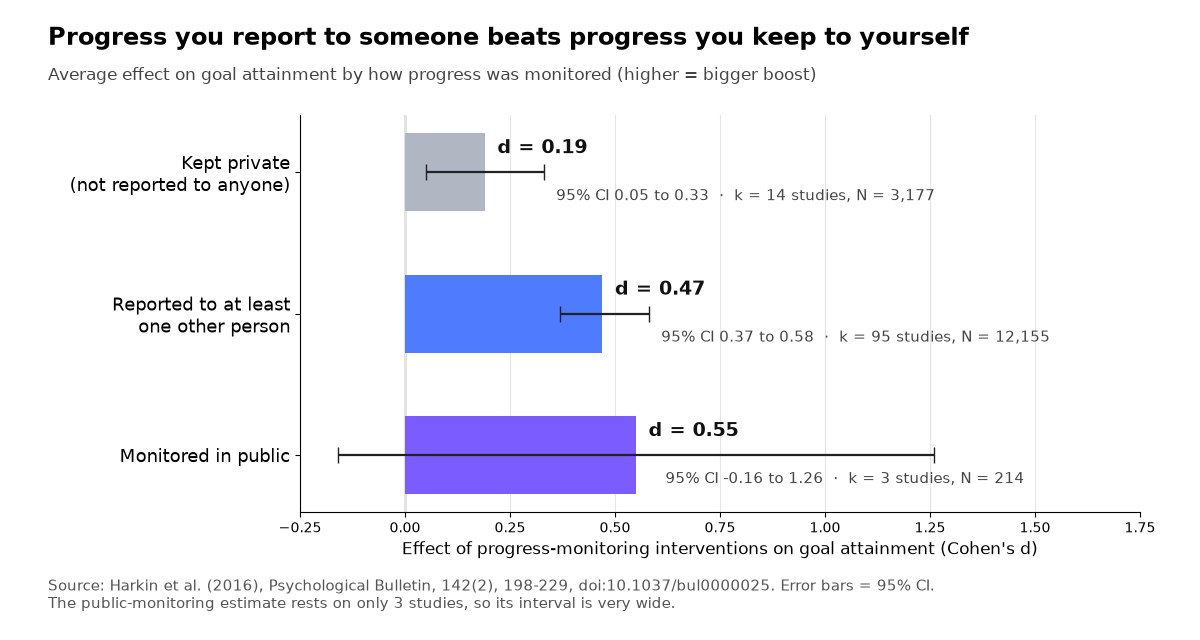
Notice the shift. Gollwitzer's participants shared an identity intention ("here's who I'm going to be"). Harkin's participants shared progress ("here's what I actually did"). One gives you a free hit of feeling accomplished. The other creates a check-in you'll have to face.
Two more data points, with caveats:
- In a weight-loss program, Prashanth Nyer and Stephanie Dellande found that making the commitment more public led to higher motivation and more weight lost [6].
- Gail Matthews of Dominican University ran a study where people who sent weekly progress reports to a friend were the most likely to finish or get at least halfway to their goals. 76% did, compared with 43% of people who only thought about their goals [7]. Big caveat: this wasn't published in a peer-reviewed journal. Only 149 of 267 recruits finished, and progress was self-rated. Call it encouraging, not conclusive.
Who to tell, ranked
Here's how we'd rank your audience, based on the evidence above:
1. Someone you look up to. A mentor, coach, manager, or that friend who's three steps ahead of you. Klein's data say this is where sharing boosts goal commitment the most, because you don't want to let them down [3][4].
2. An accountability partner who gets progress reports. Not a hype squad, a check-in. A weekly "here's what I did, here's what I missed" fits both Harkin's reporting effect and Matthews' (non-peer-reviewed) results [5][7]. Pick an accountability partner whose opinion actually matters to you.
3. A group working on the same thing. Run clubs, study groups, weigh-in groups. Harkin's own example of public monitoring was weighing in at a dieting group, and Nyer and Dellande's public commitments helped weight loss [5][6]. Just remember the public-monitoring estimate rests on only three studies.
4. Your own written log. Not glamorous, but physically recording progress beat not recording it [5]. Even with zero audience, a log turns vague intentions into data.
5. Friends and family who just cheer. Fine for sharing a plan. Riskier for big identity announcements ("I'm becoming a writer!"), where their applause might feel like progress you haven't made yet [1].
6. The whole internet. A splashy "new me starts today" post is the closest thing to the identity announcements in Gollwitzer's studies. To be fair, those studies didn't test social media, so this one is our extrapolation. Still, it's all applause and no check-in.
What to share, and when
Share the plan and the progress, not the identity. "I'm running Monday, Wednesday, and Friday at 7 a.m." is concrete. "I'm a runner now" is a symbol you can collect without running a step. As we covered in Habits vs Goals, habits are the execution layer that actually moves a goal forward. Labels aren't.
Share after you start. Telling your mentor after week one ("I did 3 of 3 runs") gives them something real to react to. You could even time the first check-in to a fresh start, like a new month (here's why that timing helps).
Make it a recurring report, not a one-time announcement. The benefit in Harkin's data comes from monitoring and reporting progress, not from a single reveal [5]. If your week is too scattered to track anything, our 5-day focus test can help you clear room for it.
This is where Goald AI fits in. The upcoming iOS app helps you track goals, habits, and fitness in one place, with smart scheduling and an AI Mentor to help you plan. It's not a social network, and it doesn't replace the human you look up to. Think of it as the written log behind your weekly report. You'll show up to every check-in with real numbers instead of vibes. It's free for up to 3 goals, and Pro is $9.99/month or $99.99/year.
Your sharing script (copy, paste, send)
To your mentor or accountability partner: "Hey, I'm working on [specific goal] by [date]. My plan is [action] on [days/times]. Could I send you a 2-line update every [Sunday]? You don't have to do anything except reply 'seen.'"
Your weekly update: "Week [#]: Did [X of Y] planned sessions. Win: [one thing]. Missed: [one thing] because [reason]. Next week: [one adjustment]."
Skip: "I'm officially a [runner/writer/founder] now!" Save that line for after the results come in.
So, should you tell people your goals? Yes, just don't tell the wrong people, and don't stop at the announcement. Tell someone you respect, show them real progress, and let the follow-up do its job.
Ready to bring real numbers to your check-ins? Join the waitlist for Goald AI.
Sources
- Gollwitzer, P. M., Sheeran, P., Michalski, V., & Seifert, A. E. (2009). When intentions go public: Does social reality widen the intention-behavior gap? Psychological Science, 20(5), 612–618. https://doi.org/10.1111/j.1467-9280.2009.02336.x
- Wicklund, R. A., & Gollwitzer, P. M. (1981). Symbolic self-completion, attempted influence, and self-deprecation. Basic and Applied Social Psychology, 2(2), 89–114. https://doi.org/10.1207/s15324834basp0202_2
- Klein, H. J., Lount, R. B., Park, H. M., & Linford, B. J. (2020). When goals are known: The effects of audience relative status on goal commitment and performance. Journal of Applied Psychology, 105(4), 372–389. https://doi.org/10.1037/apl0000441
- Ohio State News. (2019). Share your goals – but be careful whom you tell. https://news.osu.edu/share-your-goals--but-be-careful-whom-you-tell/
- Harkin, B., Webb, T. L., Chang, B. P. I., Prestwich, A., Conner, M., Kellar, I., Benn, Y., & Sheeran, P. (2016). Does monitoring goal progress promote goal attainment? A meta-analysis of the experimental evidence. Psychological Bulletin, 142(2), 198–229. https://doi.org/10.1037/bul0000025 (open-access version: https://eprints.whiterose.ac.uk/id/eprint/87431/)
- Nyer, P. U., & Dellande, S. (2010). Public commitment as a motivator for weight loss. Psychology & Marketing, 27(1), 1–12. https://doi.org/10.1002/mar.20316
- Gardner, S., & Albee, D. (2015). Study focuses on strategies for achieving goals, resolutions [Press release on Gail Matthews' study; not peer-reviewed]. Dominican University of California. https://scholar.dominican.edu/news-releases/266
Goald AI is coming to iOS.
Join the waitlist — be first in when we launch.
Related posts
goals
The 4-Ingredient Recipe for Goals You Actually Hit
The WOOP method is a four-step recipe—wish, outcome, obstacle, plan—for goals you actually hit. Here's the science, the kitchen disasters, and a taste test.
goals
Stuck in the Middle: The Science of Finishing Goals
The goal gradient effect says effort speeds up near the finish line, but the middle sags. Here's the research on why, plus AI-assisted fixes to finish strong.
goals
The Fresh Start Effect: Your Calendar's Reset Button
The fresh start effect explains why Mondays, birthdays, and January 1 make goals easier to start. Here's the science, plus a playbook for your next restart.