The 4-Ingredient Recipe for Goals You Actually Hit

The WOOP method is a four-ingredient recipe for cooking one goal all the way to a plan.
Recipe card Serves: 1 goal Prep time: a few focused minutes. A clear, pressing wish can take about 30 seconds; a bigger decision deserves longer [8] Skill level: beginner You need: one wish that is challenging and still feasible, and a quiet moment Yield: one if-then plan aimed at the obstacle inside you
You can already see the finished version: easier mornings, the sent draft, the you who just does the thing. That daydream is sweet, and it can spend the energy the cooking needs.
Psychologist Gabriele Oettingen, at New York University and the University of Hamburg, has spent decades on that plot twist. Rosy positive thinking about a future you have not reached yet often lines up with less effort [1][2]. Her accessible version of the lab technique is the WOOP method: Wish, Outcome, Obstacle, Plan. In the papers, the full recipe is mental contrasting with implementation intentions. It is goal setting with the obstacle left in the bowl on purpose.
Ingredients in the WOOP method
Four ingredients, same order every time. Leave one out and you have cooked a different dish.
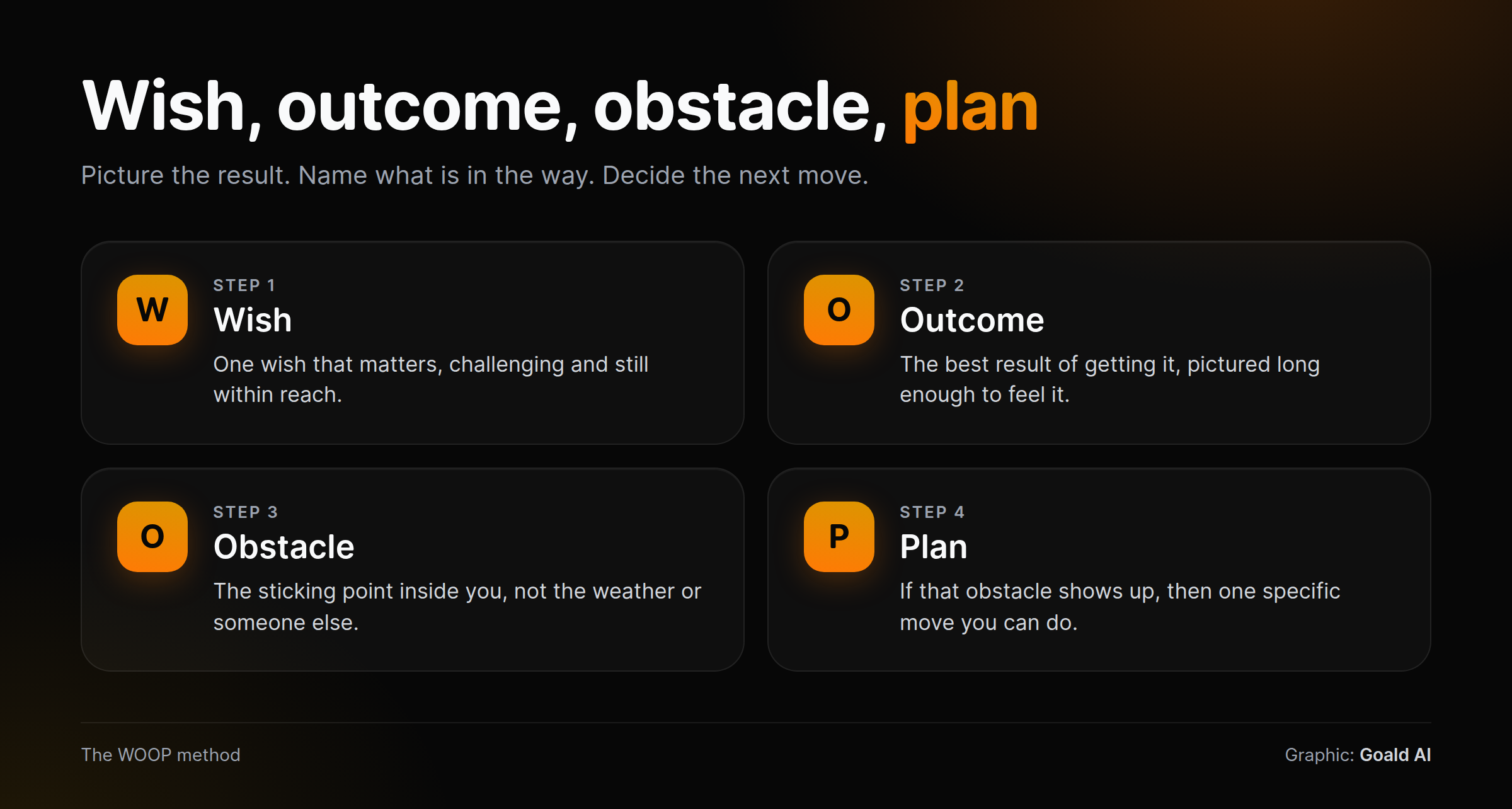
W — Wish
One wish, closest to your heart, challenging, and still something you can fulfill [8]. "Draft the opening scene this week" can go on a board. "Become a new person by Friday" cannot. If the wish is enormous, break off a piece you can cook this month [8].
O — Outcome
Name the best result, then picture it long enough to notice whether you care. A flat outcome usually means the wish is wrong [8].
This is the ingredient people binge. With Doris Mayer, Oettingen separated two kinds of future-thought. Positive expectations, a judgment that success is likely, predicted high effort and better results. Positive fantasies, enjoying images of the desired future, predicted the reverse. They saw it in graduates looking for a job, students with a crush, undergraduates before an exam, and patients undergoing hip-replacement surgery, from weeks later out to two years [1]. One spoonful of the picture belongs in the recipe. The whole jar does not.
O — Obstacle
The main obstacle inside you: the scroll, the snooze, the "I'll start when I feel ready." Outside walls are real. The useful question is how you meet them [8].
Heather Barry Kappes and Oettingen ran four experiments on why the all-outcome version goes quiet. Positive fantasies left people less energized than fantasies that questioned the future, negative fantasies, or neutral ones [2]. One study used systolic blood pressure as a sign of energization. Others asked people how energized they felt. The drop was larger when the fantasy matched a pressing need [2].
P — Plan
One sentence: If [obstacle], then I will [one specific action] [8]. That is an implementation intention, the if-then move Peter M. Gollwitzer developed, covered in our if-then planning guide. "Be disciplined" is a slogan. "Close the tab and write the next heading" is a plan [8]. The site also describes plans that prevent the obstacle or seize a good moment [8]. Start with one obstacle plan.
Method: cook the WOOP method
Order is the recipe. The instructions say to keep the sequence and to give it your attention [8].
- Clear a few quiet minutes. Interruptions wreck the imagery [8].
- Write one challenging wish you can still fulfill.
- Name the best outcome and imagine it. A dull picture means pick another wish [8].
- Name the inner obstacle and where it shows up next.
- Write one plan: If [obstacle], then I will [action]. Say it once [8].
- If the obstacle cannot be moved, shrink the wish, postpone it, or let it go [8].
When the wish changes, cook a new card [8].
Why this recipe works
Angela Duckworth, Teri Kirby, Anton Gollwitzer, and Oettingen, drawing on the fantasy-realization model, separate three modes [5]. Indulging is all outcome. Dwelling is all obstacle. Mental contrasting holds the wished-for future and the present obstacle in mind together, which seems to energize pursuit when the wish is wanted and feasible [5]. The trials below taught that pairing plus an if-then plan, the full WOOP method.
On your feet. Gertraud Stadler, Oettingen, and Peter M. Gollwitzer randomized women in a large German city. Everyone got the same health information. One group also learned the combined strategy. Among the 256 women, ages 30 to 50, who returned a baseline diary, the recipe group was about twice as physically active afterward, nearly an hour more per week. The gap appeared in the first week and was still there at 4, 8, and 16 weeks [3]. Right after the session, the recipe group went from about 46 minutes a week of moderate-to-vigorous activity to about 107. The information-only group went from about 40 to about 56 [3]. Those minutes are 7-day diaries. The authors say self-report is prone to measurement error, and more women in the information-only group were still enrolled at the first follow-up [3]. They also say the technique depends on two things: expecting you can do the activity, and being able to picture a positive outcome [3].
At a desk. Duckworth, Heidi Grant, Benjamin Loew, Oettingen, and Gollwitzer gave 66 high-school students a 30-minute written exercise before summer, or a placebo writing task, while they prepared for the PSAT. The recipe group completed 140 practice questions on average, versus about 84 in the control group, after accounting for gender and prep-course participation. That is more than 60% more questions [4].
On a report card. In a separate study, Duckworth, Kirby, Anton Gollwitzer, and Oettingen randomly assigned 77 fifth graders, about 85% from low-income families, to the real recipe or a positive thinking control that pictured a second nice outcome. Three hour-long sessions, in groups of four or five [5]. Adjusted grades were 80.3 versus 78.1, on-time days 43.3 versus 42.4, and conduct 3.7 versus 3.4 on a 1-to-5 scale [5]. About two grade points, and about one extra on-time day. The next quarter, once a class trip was no longer at stake, the gaps shrank and were no longer statistically significant [5].
The pooled picture. Guoxia Wang, Yi Wang, and Xiaosong Gai, at Northeast Normal University, pooled 21 studies (24 effect sizes, 15,907 people). Goal attainment showed a small-to-medium benefit, Hedges' g = 0.336, 95% CI 0.229 to 0.443 [6]. Person-led sessions (g = 0.465) beat worksheets (g = 0.277). The funnel plot was lopsided, Egger's test suggested publication bias, and trim-and-fill lowered the estimate to g = 0.242, 95% CI 0.143 to 0.342 [6]. Still a benefit. A smaller one.
Ainslea Cross and David Sheffield, at the University of Derby, pooled health studies (1,528 people). Mental contrasting helped up to four weeks, adjusted g = 0.28, 95% CI 0.13 to 0.43, and g = 0.38 in five studies out to three months, 95% CI 0.20 to 0.55 [7]. In seven studies, adding implementation intentions did not clearly strengthen those health results (g = 0.28, 95% CI 0.14 to 0.42) [7]. Some single trials still find the combination ahead of either piece alone [5][6].
Who developed the recipe. Oettingen created mental contrasting and packaged the WOOP method for use outside a lab [8]. The WOOP my life site notice names her as responsible for the site, and the App Store lists her as the app's developer and seller [9]. Gollwitzer and Duckworth coauthored much of the original work. The two meta-analyses come from other universities, which makes them the outside check.
Common kitchen disasters
All garnish. Two nice outcomes and no obstacle. That resembles the positive thinking control that trailed the real recipe with the fifth graders [5].
Blaming the pantry. "No time" often hides an inner obstacle. Ask what you do when it shows up [8].
A wish you do not believe. Stadler and colleagues say it leans on expecting you can do the thing and on picturing a good outcome [3]. Shrink until both are true.
A slogan plan. "If I feel lazy, then I will be disciplined" does nothing. "If I hover over the inbox, then I will write one paragraph before anything else" is a plan [8].
A Thursday that was always a Sunday. Pair this card with the planning fallacy. Shrink the wish until it fits a week you have lived.
Chef's variations
Fitness. Wish: "Strength-train at home Monday, Wednesday, and Friday for 20 minutes." Obstacle: talking yourself out of the first set. Plan: "If I sit down after work and start negotiating, then I will do the first set before I open my phone." The middle of a block is where people stall, which is the goal gradient effect at work. Cook a fresh card there. The obstacle has usually changed.
A work deadline. Wish: "Send the client brief by Thursday at 4." Obstacle: opening Slack "just to check." Plan: "If I open Slack before the brief is sent, then I will close it and write the next heading."
With an AI assistant. A chatbot is a decent sous-chef if you forbid the pep talk. These prompts are ours, not a study protocol.
I'm using the WOOP method. My wish: [one sentence, challenging and feasible].
Ask me only one question at a time, in this order: the best outcome, then my main inner obstacle (not an outside excuse), then one if-then plan in the form "If [obstacle], then I will [one specific action]."
If the wish sounds impossible in the time I named, say so and help me shrink it. Do not skip the obstacle.
WOOP this fitness wish with me: [strength-train at home on Monday, Wednesday, and Friday for 20 minutes].
Walk Wish, Outcome, Obstacle, Plan in that order. The obstacle has to be something inside me. The plan has to name the next time that obstacle shows up and one action I can do in under two minutes.
Help me WOOP a work deadline: [send the project brief by Thursday at 4 p.m.].
Keep each of my answers to two sentences. End with a single if-then plan I can put on my calendar. If I name an external obstacle, ask what I do internally when it appears.
The thinking is the recipe. The week is the hard part. Goald AI, an upcoming iOS app, holds the wish next to the rest of the week: goals, habits, fitness tracking, smart scheduling, and an AI Mentor that can walk these four steps. It is waitlist-only until launch. Free covers up to 3 goals. Pro is $9.99/mo or $99.99/yr. Join the waitlist.
Taste test
Do this once, today, on paper. A few quiet minutes is enough when the wish is already on your mind [8].
Taste test. One wish, one sitting.
Wish. One sentence I could still fulfill this month: _______________
Outcome. The best result. I pictured it. It felt alive / flat: _______________
Obstacle. The inner one, the thing I actually do: _______________
Plan. If ________________, then I will ________________.
Tomorrow's bite. When the "if" showed up, I did the "then" / I did not. If I did not, I will make the action smaller.
If the outcome tasted flat, start over with a wish you can feel. That restart is the recipe doing its job.
Sources
- Oettingen G, Mayer D. "The motivating function of thinking about the future: Expectations versus fantasies." Journal of Personality and Social Psychology, 2002. https://doi.org/10.1037/0022-3514.83.5.1198
- Kappes HB, Oettingen G. "Positive fantasies about idealized futures sap energy." Journal of Experimental Social Psychology, 2011. https://doi.org/10.1016/j.jesp.2011.02.003
- Stadler G, Oettingen G, Gollwitzer PM. "Physical activity in women: Effects of a self-regulation intervention." American Journal of Preventive Medicine, 2009. https://doi.org/10.1016/j.amepre.2008.09.021
- Duckworth AL, Grant H, Loew B, Oettingen G, Gollwitzer PM. "Self-regulation strategies improve self-discipline in adolescents: Benefits of mental contrasting and implementation intentions." Educational Psychology, 2011. https://doi.org/10.1080/01443410.2010.506003
- Duckworth AL, Kirby TA, Gollwitzer A, Oettingen G. "From fantasy to action: Mental contrasting with implementation intentions (MCII) improves academic performance in children." Social Psychological and Personality Science, 2013. https://doi.org/10.1177/1948550613476307
- Wang G, Wang Y, Gai X. "A meta-analysis of the effects of mental contrasting with implementation intentions on goal attainment." Frontiers in Psychology, 2021. https://doi.org/10.3389/fpsyg.2021.565202
- Cross A, Sheffield D. "Mental contrasting for health behaviour change: a systematic review and meta-analysis of effects and moderator variables." Health Psychology Review, 2019. https://doi.org/10.1080/17437199.2019.1594332
- Oettingen G. "How can I practice WOOP?" WOOP my life. https://woopmylife.org/en/practice
- WOOP my life site notice, naming Prof. Dr. Gabriele Oettingen as the person responsible for the site (https://woopmylife.org/site-notice), and the WOOP app on the App Store, listing Gabriele Oettingen as developer and seller (https://apps.apple.com/us/app/woop-app/id790247988).
Goald AI is coming to iOS.
Join the waitlist — be first in when we launch.
Related posts
goals
Stuck in the Middle: The Science of Finishing Goals
The goal gradient effect says effort speeds up near the finish line, but the middle sags. Here's the research on why, plus AI-assisted fixes to finish strong.
goals
Keep Your Goals Secret? It Depends Who's Listening
Should you share your goals or keep them secret? Research says it depends on who you tell, what you share, and when. Here's who to tell, ranked best to worst.
goals
The Fresh Start Effect: Your Calendar's Reset Button
The fresh start effect explains why Mondays, birthdays, and January 1 make goals easier to start. Here's the science, plus a playbook for your next restart.