Stuck in the Middle: The Science of Finishing Goals

Day one of a new goal feels electric. The last week feels like a sprint with the crowd cheering. Somewhere around halfway? Crickets. The spreadsheet goes stale, check-ins get skipped, and the goal quietly slides into a drawer.
That's not a character flaw. It's a pattern researchers have measured for decades. The goal gradient effect says we push harder the closer we get to a finish line. The twist from newer studies: the middle is where motivation can dip the most. Let's map the whole journey, act by act, and fix the saggy part.
Act 1: the rat, the coffee card, and the goal gradient effect
The idea started with rats. In 1932, behaviorist Clark Hull proposed the "goal-gradient hypothesis": the urge to approach a goal grows as you get closer to it [1]. In a follow-up experiment, Hull found that rats in a straight alley ran faster and faster as they moved from the start box toward the food [2].
Fast-forward to 2006, when Ran Kivetz and Oleg Urminsky of Columbia Business School and Yuhuang Zheng of Fordham University took the idea to a real university café [2]. Members of a "buy 10 coffees, get one free" program bought coffee more often as they closed in on the reward. On average, the time between purchases shrank by 20% (about 0.7 days) over the course of the card [2].
Then came the clever bit. Some customers got a 12-stamp card with 2 "bonus" stamps already filled in, so they still needed 10 real purchases. Those customers finished in 12.7 days on average, versus 15.6 days for people with a plain 10-stamp card [2]. Same distance, different feeling of distance.
The same trick worked at a car wash. In a field experiment run by Joseph Nunes of USC and Xavier Drèze of Wharton, the business handed out 300 loyalty cards [3]. Half needed 8 washes with no stamps yet. The other half needed 10 washes, with 2 stamps already on the card. Both groups needed exactly 8 more washes, but 34% of the head-start group redeemed their card, versus 19% of the start-from-zero group [3].
The lesson for Act 1: a goal that feels already started pulls harder than one that feels untouched.
Act 2: why we get stuck in the middle
So the middle should be fine, right? Not quite.
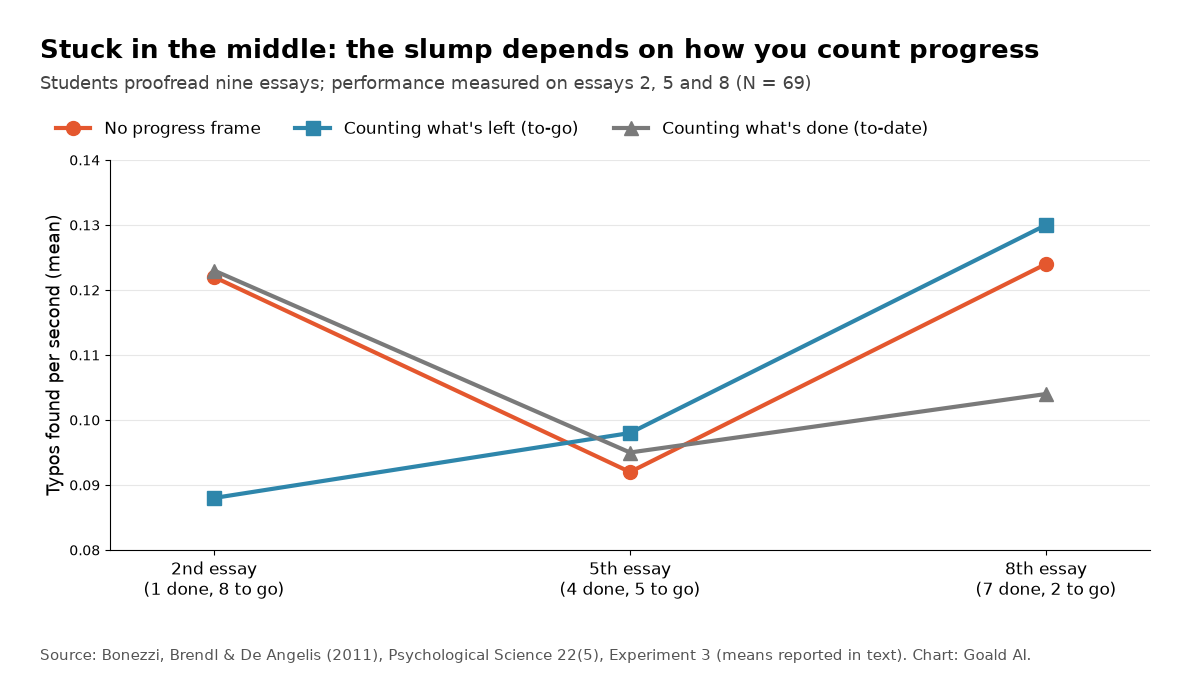
Andrea Bonezzi and C. Miguel Brendl of Northwestern's Kellogg School and Matteo De Angelis of LUISS University argued that motivation can be high near the start and near the end but lower about halfway [4]. Their explanation is all about what you compare yourself to. Early on, people tend to measure progress from the starting line ("look how far I've come"). Near the end, they switch to measuring from the finish line ("almost there"). In the middle, you're far from both reference points, so each extra step feels like it adds less [4].
In one experiment, 69 students proofread nine essays while a diagram showed their progress [4]. With no framing, performance dipped in the middle and recovered at the end. When the diagram counted essays left to go, performance climbed steadily toward the finish. When it counted essays done so far, performance was highest at the start and fell [4].
There's a second kind of middle slump, too: cutting corners. Ayelet Fishbach of the University of Chicago and Maferima Touré-Tillery proposed that actions at the start and end of a sequence feel more like "who I am" than actions in the middle [5]. In one study, 202 Jewish students in Israel reported which nights of Hanukkah they lit the menorah. On night one, 76% did. That fell to between 43% and 50% across nights three through seven, then bounced back to 57% on the final night [5].
Act 3: how to stay motivated through the messy middle
The research above hints at four levers. None is magic, but each targets a reason the middle sags.
1. Change your yardstick at the halfway point. Fishbach also teamed up with Minjung Koo, and they found that focusing on what you've already done boosted effort when people weren't yet sure the goal mattered to them, while focusing on what's left to do boosted effort when commitment was already solid [6]. One way to apply it: early on, celebrate progress. Once you're committed and past halfway, flip your tracker to "remaining."
2. Use sub-goals early, the big goal late. Szu-chi Huang, Liyin Jin, and Ying Zhang ran four lab and field experiments and found that breaking a goal into sub-goals boosted motivation at the start, when people mostly needed to believe the goal was doable [7]. Near the end, focusing on the overall goal worked better, because it made each action feel more valuable [7]. So: chunk the middle into mini finish lines, then zoom back out for the final push.
3. Give yourself an honest head start. The coffee and car wash studies used bonus stamps [2][3]. You don't need fake ones: count real prep work you've already done as progress, so the goal feels underway.
4. Track progress where you can see it. A meta-analysis led by Benjamin Harkin and Thomas Webb of the University of Sheffield pooled 138 randomized studies with 19,951 people [8]. Interventions that got people to monitor their progress more often helped them reach their goals, with a small-to-medium average effect (d = 0.40). The effect was larger when progress was physically recorded or shared with others [8]. Pair it with implementation intentions so each check-in has a set time.
A worked example: one goal, three acts
Meet Maya (made up for this post, not from a study). Her goal: save $3,000 in 12 months, about $250 a month.
- Act 1 (months 1-3): She counts the $200 she'd already set aside as progress toward the $3,000, so the goal starts underway (lever 3). Her tracker shows "saved so far" (lever 1).
- Act 2 (months 4-8): The danger zone. Maya splits the middle into mini targets, $1,200 by month 4 and $1,700 by month 6 (lever 2), and logs each deposit the day it happens (lever 4).
- Act 3 (months 9-12): She flips the tracker to "left to go" and keeps her eyes on the full $3,000 (levers 1 and 2).
For a second wind, time a midpoint reset to a fresh start effect moment, like the first of a month.
Can AI goal setting help in the middle?
We haven't found studies testing AI tools against the middle slump directly, so treat this as our suggestion, not a research result. Still, a chatbot is handy for nudging the levers above:
- Chunking: "Break my 12-month goal into monthly sub-goals with a checkpoint every 4 weeks."
- Reframing: "I'm at 55%. Show my progress as what's left, not what's done."
- Spotting the sag: "Flag any week where I log less than usual, and ask me why."
The AI can only reflect the numbers you give it, so log honestly. For a broader look at what AI coaching can and can't do, see our research roundup on AI habit coaches.
Your middle-mile decision flow
Before you quit, run through this (the percentage cutoffs are our rough rule of thumb, not study numbers):
- Where am I? Under ~40% done → count what's done and set the next sub-goal. Around 40-60% → you're in the danger zone; go to step 2. Over ~60% → switch to "what's left" and look at the whole goal.
- Is the next milestone close enough to see? No → cut it smaller until it's a week or two away.
- Did I log progress this week? No → write it down today, ideally somewhere visible.
- Still stuck? Check whether the goal still matters to you. If yes, schedule the next step. If not, it's fine to rewrite the goal.
How Goald AI fits in
Goald AI is built for the middle mile. Set a goal, split it into sub-goals, and track habits, fitness, and progress in one place. Smart scheduling finds time for the next step, and the AI Mentor remembers your goals and history, so it can help you reframe when you stall.
Goald AI is an upcoming iOS app. The free tier covers up to 3 goals, and Goald AI Pro is $9.99/month or $99.99/year. Join the waitlist.
Sources
- Hull CL. "The goal-gradient hypothesis and maze learning." Psychological Review, 1932.
- Kivetz R, Urminsky O, Zheng Y. "The Goal-Gradient Hypothesis Resurrected: Purchase Acceleration, Illusionary Goal Progress, and Customer Retention." Journal of Marketing Research, 2006.
- Nunes JC, Drèze X. "The Endowed Progress Effect: How Artificial Advancement Increases Effort." Journal of Consumer Research, 2006.
- Bonezzi A, Brendl CM, De Angelis M. "Stuck in the Middle: The Psychophysics of Goal Pursuit." Psychological Science, 2011.
- Touré-Tillery M, Fishbach A. "The end justifies the means, but only in the middle." Journal of Experimental Psychology: General, 2012.
- Koo M, Fishbach A. "Dynamics of self-regulation: How (un)accomplished goal actions affect motivation." Journal of Personality and Social Psychology, 2008.
- Huang SC, Jin L, Zhang Y. "Step by step: Sub-goals as a source of motivation." Organizational Behavior and Human Decision Processes, 2017.
- Harkin B, Webb TL, Chang BPI, Prestwich A, Conner M, Kellar I, Benn Y, Sheeran P. "Does monitoring goal progress promote goal attainment? A meta-analysis of the experimental evidence." Psychological Bulletin, 2016.
Goald AI is coming to iOS.
Join the waitlist — be first in when we launch.
Related posts
goals
The 4-Ingredient Recipe for Goals You Actually Hit
The WOOP method is a four-step recipe—wish, outcome, obstacle, plan—for goals you actually hit. Here's the science, the kitchen disasters, and a taste test.
goals
Keep Your Goals Secret? It Depends Who's Listening
Should you share your goals or keep them secret? Research says it depends on who you tell, what you share, and when. Here's who to tell, ranked best to worst.
goals
The Fresh Start Effect: Your Calendar's Reset Button
The fresh start effect explains why Mondays, birthdays, and January 1 make goals easier to start. Here's the science, plus a playbook for your next restart.