New Year's Resolution Ideas: 50 That Fit Real Life

Staring at a blank page, trying to come up with new year's resolution ideas that aren't "get healthy" for the fifth year in a row? Good news: you don't need more willpower. You need better options. Below are 50 specific, doable resolution ideas for 2027, sorted into eight categories, and each one comes with a tiny "make it stick" tip.
The timing helps you, too. Researchers Hengchen Dai, Katherine Milkman, and Jason Riis found that gym visits and commitments to pursue goals both rose after "temporal landmarks" like the start of a new week, month, or year [2]. (More on that in our fresh start effect deep dive.) January hands you that push. This list helps you point it somewhere worth going.
How to pick good new year's resolutions (the 2-minute science)
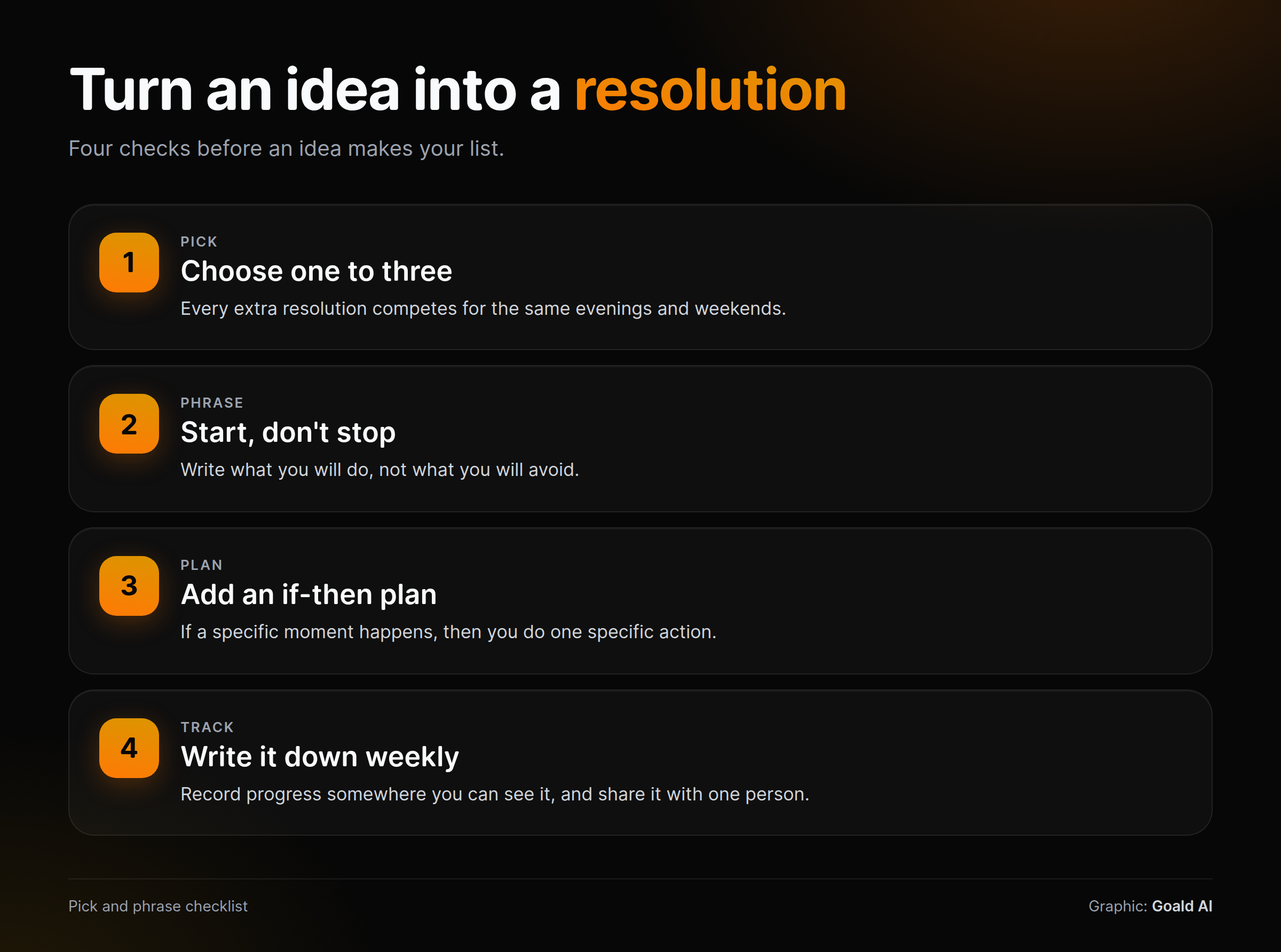
Before you shop the list, three quick rules that seem to separate good new year's resolutions from the ones that quietly die in February.
1. Phrase it as a start, not a stop. In a large New Year's resolutions experiment, Martin Oscarsson, Per Carlbring, Gerhard Andersson, and Alexander Rozental followed 1,066 people for a year. Of those who answered the one-year follow-up, people with approach goals ("start doing X") rated themselves successful more often than people with avoidance goals ("stop doing Y"): 58.9% vs. 47.1% [1]. The effect was small, and success was self-reported, so treat it as a strong hint rather than a guarantee [1]. (Disclosure: three of the authors receive royalties from a book on New Year's resolutions that is partly based on this study [1].)
2. Add an if-then plan. In a meta-analysis of 94 independent tests, Peter Gollwitzer and Paschal Sheeran found that "if situation Y, then I will do X" plans, called implementation intentions, had a medium-to-large effect on goal attainment (d = .65) [3]. That's why every idea below has a tip. Our guide to implementation intentions shows how to write one.
3. Write your progress down. Benjamin Harkin, Thomas Webb, and colleagues pooled 138 randomized studies and found that prompting people to monitor progress helped them reach goals (d = .40), with bigger effects when progress was physically recorded or shared with others [4].
Oh, and pick one to three. Not all 50.
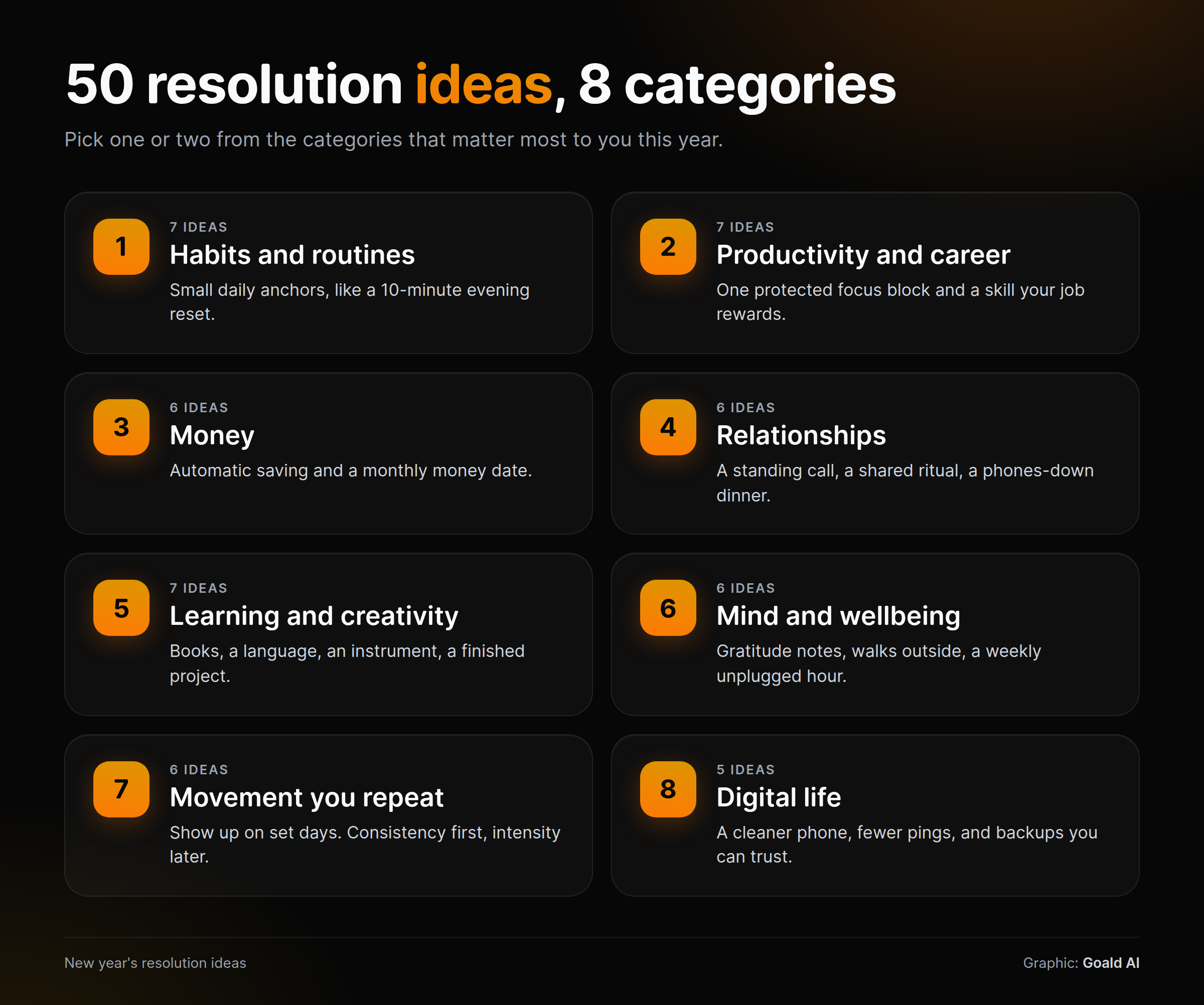
50 new year's resolution ideas, by category
In the Oscarsson study, the single most popular resolution category was physical health, at 33% [1]. This list deliberately goes wider. Skim the categories, circle what lights you up, and steal freely.
Habits and routines
- Make your bed every morning. Tip: If my feet hit the floor, then I make the bed before I check my phone.
- Do a 10-minute evening reset. Tip: Set a timer after dinner and stop when it rings.
- Prep tomorrow's bag the night before. Tip: Keep it by the door so tomorrow-you can't miss it.
- Start a consistent wind-down time. Tip: If it's 10 p.m., then screens go on the charger outside the bedroom.
- Clear your desk at the end of each workday. Tip: If I close my laptop, then I spend two minutes tidying.
- Do a weekly 20-minute life admin block. Tip: Sunday at 5 p.m., bills, emails, and appointments, all at once.
- Keep a "done list" every evening. Tip: Three lines in your notes app before bed.
Productivity and career
- Protect one 90-minute focus block a day. Tip: Put it on the calendar as a meeting with yourself.
- Learn one skill your job rewards. Tip: Name the skill, the course, and the first lesson date.
- Ask for feedback once a quarter. Tip: Add four calendar reminders today.
- Clear your inbox to zero every Friday. Tip: If it's Friday at 4 p.m., then archive, reply, or schedule.
- Build a portfolio or "brag doc." Tip: Add one win every Friday, even small ones.
- Have coffee with one new person in your field each month. Tip: Send the invite on the first business day of the month.
- Plan each week before it starts. Tip: Sunday evening, pick your top three outcomes for the week.
Money
- Automate saving on payday. Tip: Set the transfer for the day your paycheck lands, so you never see the money.
- Hold a monthly money date. Tip: First Sunday of the month, review spending with a coffee.
- Build a starter emergency fund. Tip: Pick a target number and a monthly amount, then automate it.
- Cancel one unused subscription each month. Tip: Check your statement during the money date.
- Give a little on purpose. In a study led by Elizabeth Dunn, people randomly assigned to spend money on others reported more happiness than those assigned to spend it on themselves [5]. Tip: Budget a small monthly "kindness fund."
- Use a 48-hour rule for nonessential buys. Tip: Add it to a wishlist, then decide in two days.
Relationships
- Call a family member every week. Tip: Same day, same time, like a standing appointment.
- Host a simple dinner once a month. Tip: Pick the date first, the menu later.
- Make dinner phones-down. Tip: If we sit down to eat, then phones go in a basket.
- Send one appreciation text a week. Tip: Friday lunch is text-a-friend time.
- Plan a monthly date or friend outing. Tip: Book it before the month starts.
- Remember birthdays. Tip: Spend 15 minutes in January adding every one to your calendar.
Learning and creativity
- Read 20 pages a day. Tip: If I get into bed, then I read before I scroll.
- Practice a language for 10 minutes daily. Tip: Pair it with your morning coffee.
- Learn the basics of an instrument. Tip: Leave it out of its case so starting takes two seconds.
- Finish one creative project. Tip: Define "finished" in one sentence, plus a due date.
- Write 300 words a day. Tip: Same chair, same time, no editing until Friday.
- Take one class in something new. Tip: Register in January while the motivation is hot.
- Teach someone what you learn. Tip: Share one takeaway a week with a friend or online.
Mind and wellbeing
- Write three good things each week. In experiments by Robert Emmons and Michael McCullough, people who listed things they were grateful for showed higher well-being on several, though not all, measures, and the boost in positive mood was the most consistent finding [6]. Tip: Sunday night, three lines.
- Take a 10-minute walk outside daily. Tip: If I finish lunch, then I walk around the block.
- Schedule one unplugged hour a week. Tip: Put it on the calendar like an appointment.
- Try a 5-minute breathing or meditation break. Tip: Anchor it to a daily cue, like before your first meeting.
- Spend more time in a hobby that absorbs you. Tip: Protect one evening a week for it.
- Say no to one thing a week that drains you. Tip: Keep a short "polite no" script in your notes.
Movement you repeat (consistency first)
- Show up three days a week, at set times. Tip: Choose the days now and put them on the calendar.
- Bundle a treat with your workout. Katherine Milkman, Julia Minson, and Kevin Volpp found that people who could only listen to tempting audiobooks at the gym initially visited 51% more often than controls, though the effect faded over time [7]. Tip: Save your favorite podcast for workouts only.
- Do a 10-minute version on bad days. Tip: If I want to skip, then I do ten minutes instead of zero.
- Find a workout buddy. Tip: Book the next session before you leave this one.
- Stretch while the kettle boils. Tip: Same cue every morning.
- Walk your calls. Tip: If it's a phone call with no screen share, then I take it walking.
Digital life
- Turn off all non-human notifications. Tip: Keep alerts only from people, not apps.
- Move social apps off your home screen. Tip: One folder, last page.
- Back up your photos. Tip: Set automatic backup once in January.
- Unsubscribe from five newsletters a week. Tip: Do it during your Friday inbox clear.
- Use a password manager. Tip: Add five accounts a week until they're all in.
Missed a day? Don't spiral. In Phillippa Lally's habit-formation study at University College London, a single missed day had little impact on how automatic a new behavior became, and it took 66 days on average to reach peak automaticity, with a range of 18 to a predicted 254 days [8]. Expect the first few weeks to feel like work.
Your copy-paste new year's resolutions list template
Copy this into your notes app. One block per resolution, three blocks max.
MY NEW YEAR'S RESOLUTIONS LIST
==============================

Resolution (start, not stop):
  "In 2027, I will ______________________."

[ ] It's phrased as something I'll DO
[ ] It's specific enough to check off
[ ] I can do the smallest version in under 10 minutes

If-then plan:
  If ______________________, then I will ______________________.

Bad-day version:
  If I can't do the full thing, then I will ______________.

Tracking:
  [ ] Where I write progress: ______________
  [ ] Weekly check-in time:   ______________
  [ ] One person I'll tell:   ______________
Want a deeper build, with quarterly milestones and a year review? Our step-by-step guide on how to set goals for the new year turns any of these ideas into full-blown new year goals.
Where Goald AI fits
A list of ideas is the easy part. Remembering your if-then plan on a rainy Tuesday in March is the hard part. Goald AI is an upcoming iOS app that keeps goals, habits, fitness tracking, and smart scheduling in one place, with an AI Mentor that can help turn a vague idea like "read more" into a specific plan and a weekly check-in. It's waitlist-only until launch. Free covers up to 3 goals, and Pro is $9.99/mo or $99.99/yr.
FAQ: new year's resolution ideas
What are good new year's resolutions for beginners? Pick small, specific actions you can repeat, like reading 20 pages a night or a weekly call home. Small wins build momentum faster than heroic plans.
How many resolutions should I make? One to three. Each one needs its own if-then plan and tracking, and that adds up fast.
Are there resolution ideas for 2027 that don't involve the gym? Plenty. Money, relationships, learning, and digital life make up most of this list. If you do pick movement, aim for consistency over intensity.
What if I break my resolution in January? Restart the next day. Lally's study suggests one missed day matters less than you might think [8]. If you keep missing, shrink the resolution rather than dropping it.
Sources
- Oscarsson M, Carlbring P, Andersson G, Rozental A. "A large-scale experiment on New Year's resolutions: Approach-oriented goals are more successful than avoidance-oriented goals." PLOS ONE, 2020;15(12):e0234097. https://doi.org/10.1371/journal.pone.0234097
- Dai H, Milkman KL, Riis J. "The Fresh Start Effect: Temporal Landmarks Motivate Aspirational Behavior." Management Science, 2014;60(10):2563-2582. https://doi.org/10.1287/mnsc.2014.1901
- Gollwitzer PM, Sheeran P. "Implementation intentions and goal achievement: A meta-analysis of effects and processes." Advances in Experimental Social Psychology, 2006;38:69-119. https://doi.org/10.1016/S0065-2601(06)38002-1
- Harkin B, Webb TL, Chang BPI, Prestwich A, Conner M, Kellar I, Benn Y, Sheeran P. "Does monitoring goal progress promote goal attainment? A meta-analysis of the experimental evidence." Psychological Bulletin, 2016;142(2):198-229. https://doi.org/10.1037/bul0000025
- Dunn EW, Aknin LB, Norton MI. "Spending money on others promotes happiness." Science, 2008;319(5870):1687-1688. https://doi.org/10.1126/science.1150952
- Emmons RA, McCullough ME. "Counting blessings versus burdens: An experimental investigation of gratitude and subjective well-being in daily life." Journal of Personality and Social Psychology, 2003;84(2):377-389. https://doi.org/10.1037/0022-3514.84.2.377
- Milkman KL, Minson JA, Volpp KGM. "Holding the Hunger Games Hostage at the Gym: An Evaluation of Temptation Bundling." Management Science, 2014;60(2):283-299. https://doi.org/10.1287/mnsc.2013.1784
- Lally P, van Jaarsveld CHM, Potts HWW, Wardle J. "How are habits formed: Modelling habit formation in the real world." European Journal of Social Psychology, 2010;40(6):998-1009. https://doi.org/10.1002/ejsp.674 (summary: Jarrett C, BPS Research Digest, https://www.bps.org.uk/research-digest/how-form-habit)
Goald AI is coming to iOS.
Join the waitlist — be first in when we launch.
Related posts
goals
How to Set Goals for the New Year: A 7-Step Template
Learn how to set goals for the new year in 7 research-backed steps, from a quick year review to if-then plans, plus a goal setting template you can copy.
goals
The 4-Ingredient Recipe for Goals You Actually Hit
The WOOP method is a four-step recipe—wish, outcome, obstacle, plan—for goals you actually hit. Here's the science, the kitchen disasters, and a taste test.
goals
Stuck in the Middle: The Science of Finishing Goals
The goal gradient effect says effort speeds up near the finish line, but the middle sags. Here's the research on why, plus AI-assisted fixes to finish strong.