How to Set Goals for the New Year: A 7-Step Template
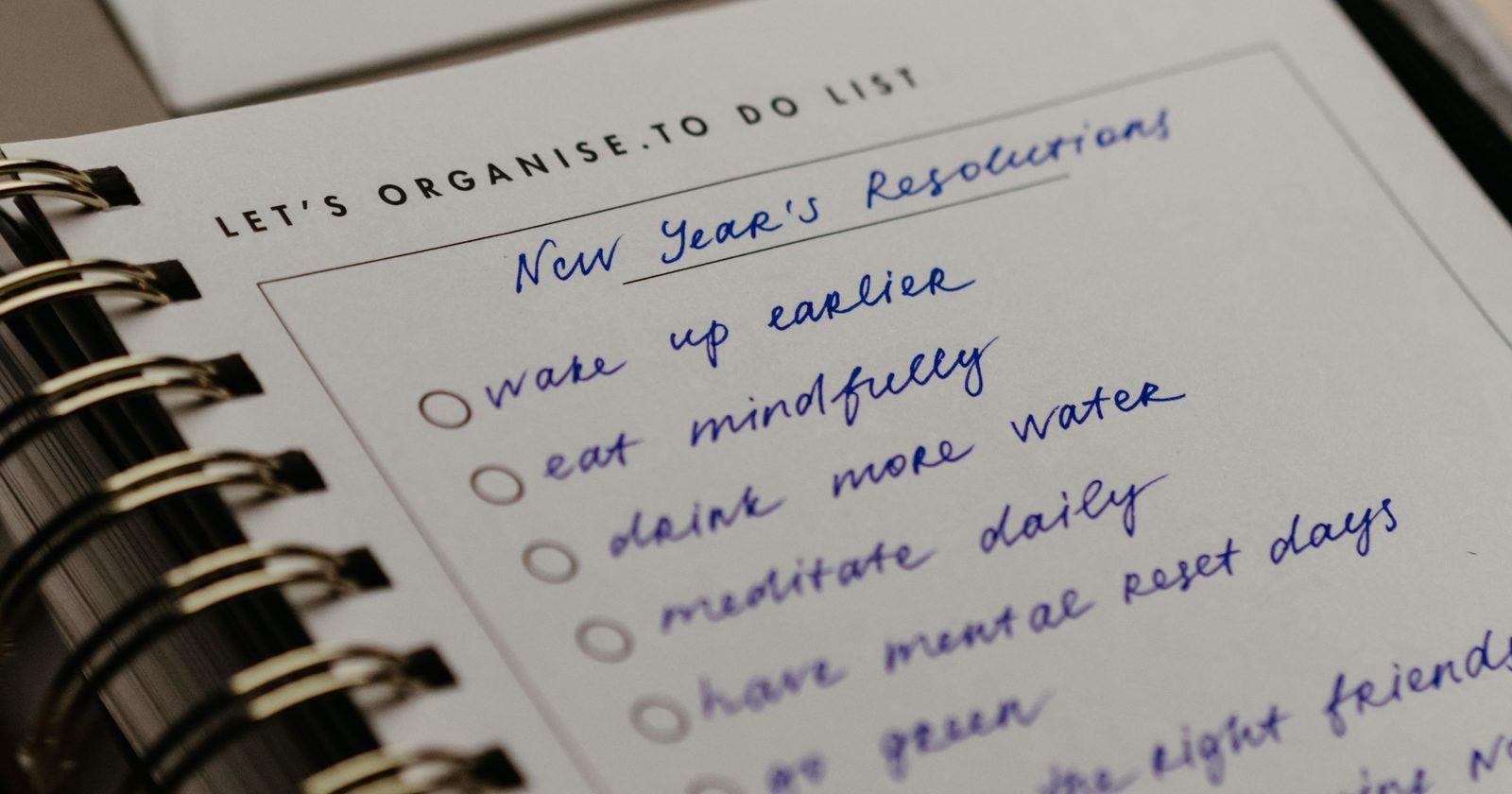
If you have ever wondered how to set goals for the new year without writing the same list you abandoned last February, this guide is your build sheet. Seven steps, about an hour total, one copyable template at the end. Grab a pen, a coffee, and a little honesty.
Why now? Because the calendar is about to hand you a free push. Researchers Hengchen Dai, Katherine Milkman, and Jason Riis found that people on the goal-contract site stickK were 145.3% more likely to commit to a goal at the start of a new year, relative to baseline [1]. We dug into that "fresh start" push in our fresh start effect deep dive. This post is about what to do with it: turning a burst of January energy into new year goals that are still standing in June.
How to set goals for the new year in 7 steps
Each step has a job, a time box, and the research that suggests why it matters. Do them in order. Skipping ahead is how you end up with "get healthy" scrawled on a napkin.
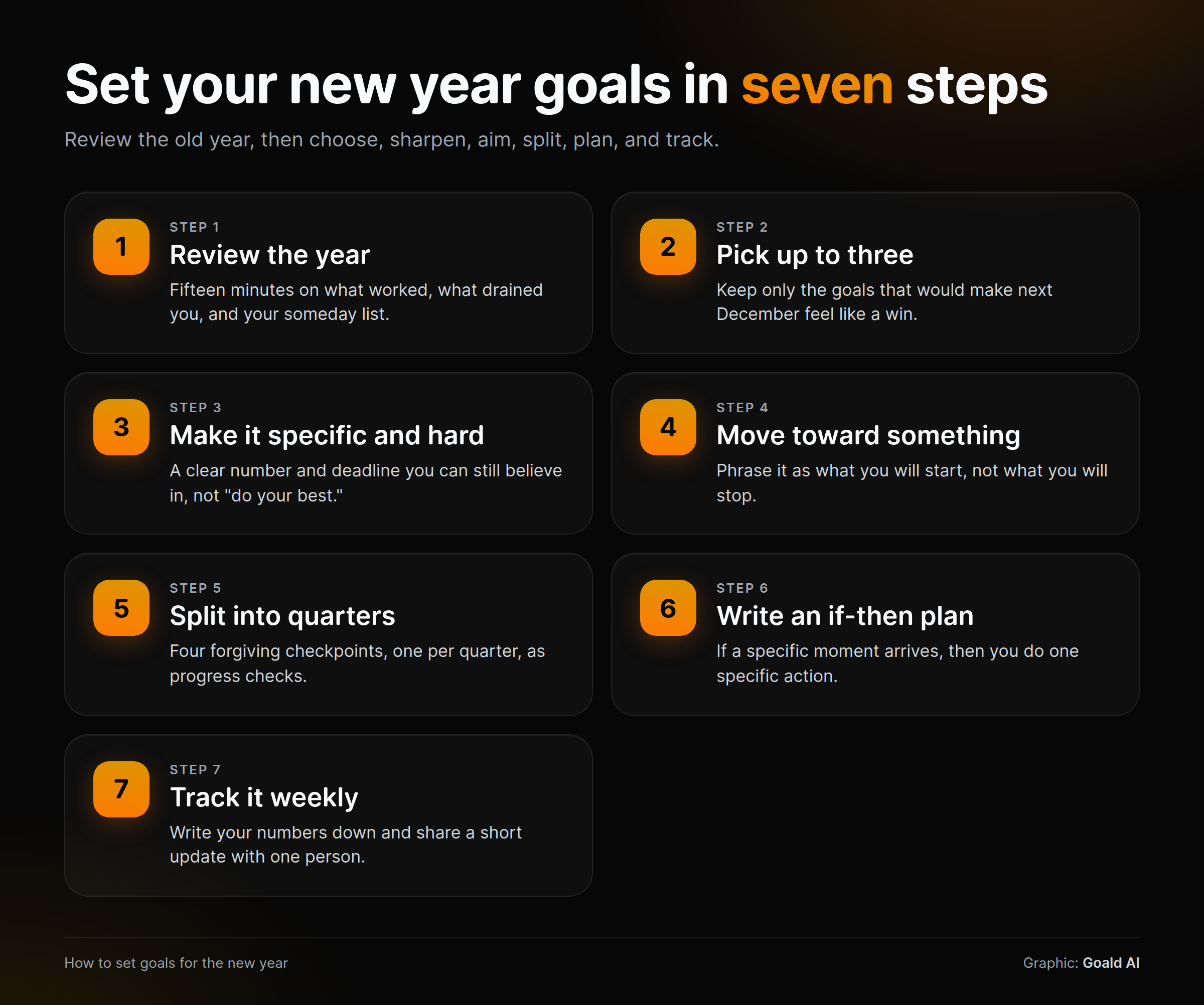
Step 1: Run a 15-minute year review
Before you plan the next year, look at the one you are finishing. Answer three questions on paper:
- What worked? Three things you would happily repeat.
- What drained me? Three things you want less of.
- What did I keep saying "someday" about? That list is where good goals hide.
This is not therapy, and it is not a performance review. It is a scouting report. You are looking for patterns, like "I felt best in the months I trained with a friend," that the next steps can build on.
Step 2: Pick one to three goals, not twelve
Circle the items from your review that would make the biggest difference next December. Then cut until you have three at most. Every extra goal competes for the same evenings, weekends, and willpower.
Not sure which to cut? Ask: "If I only hit this one, would the year feel like a win?" Keep the ones that get a fast yes.
Step 3: Make each goal specific and hard (but doable)
This is the step with the deepest research behind it. Psychologists Edwin Locke and Gary Latham spent decades on goal-setting studies. In their 2002 review, they report that specific, difficult goals consistently led to higher performance than telling people to "do your best," with effect sizes in meta-analyses ranging from .42 to .80 [2]. Their explanation is that "do your best" has no clear target, so almost any result can feel acceptable [2].
There is a ceiling, though. Performance leveled off when people hit the limits of their ability or when their commitment to a very hard goal lapsed [2]. So aim for a stretch you can still believe in.
- Vague: "Read more."
- Specific and hard: "Read 20 books in 2027, about one every two and a half weeks."
Step 4: Point it toward something, not away from something
Now check the wording. In a large New Year's resolutions experiment, Martin Oscarsson, Per Carlbring, Gerhard Andersson, and Alexander Rozental followed 1,066 people for a year. Participants with approach goals were more successful than those with avoidance goals: 58.9% vs. 47.1% [3]. (Disclosure: three of the authors receive royalties from a book on New Year's resolutions that is partly based on this study [3].)
Flip "stop" into "start":
- "Stop doom-scrolling at night" becomes "Read 10 pages in bed at 10 p.m."
- "Quit skipping workouts" becomes "Lift three mornings a week."
The study measured self-reported success, so treat it as a strong hint, not a guarantee [3].
Step 5: Split your yearly goals into quarterly milestones
A December finish line is easy to ignore in March. Locke and Latham describe a business-game study in which adding near-term goals to a distant goal led to higher self-efficacy and profits than a distant goal alone [2].
Give each goal four checkpoints, one per quarter. For the reading goal, that is 5 books by March 31, 10 by June 30, and so on.
Keep the checkpoints forgiving. In the Oscarsson study, the group that got the most help, which included SMART-goal advice and six interim goals, did not beat the control group, and the group with lighter support did best [3]. The authors suggest that extra deadlines can also mean extra chances to feel like you failed [3]. A milestone is a progress check, not a pass-fail exam.
Step 6: Write one if-then plan per goal
Goals tell you where you are going. If-then plans tell you what you will do at a specific moment. In a meta-analysis of 94 independent tests, Peter Gollwitzer and Paschal Sheeran found that these plans, called implementation intentions, had a medium-to-large effect on goal attainment (d = .65) [4].
The format is simple: If [situation], then I will [action].
- "If it's 7 a.m. on Monday, Wednesday, or Friday, then I put on my gym shoes before I check my phone."
- "If I get home tired and want to skip the workout, then I do ten minutes instead of zero."
We cover the mechanics and plenty of examples in our guide to implementation intentions. If you want to stress-test the plan against your biggest inner obstacle first, run it through the four-step WOOP method.
Step 7: Track it weekly and tell one person
The last step keeps the other six alive. Benjamin Harkin, Thomas Webb, Paschal Sheeran, and colleagues pooled 138 randomized studies with 19,951 participants and found that prompting people to monitor their progress helped them reach their goals (d = .40) [5]. The effect was larger when progress was physically recorded and when it was reported to others or made public [5].
The Oscarsson study points the same way. The group that did best named one person to support them all year and answered monthly follow-ups [3].
So: pick a weekly check-in time (Sunday evening works), write your numbers down, and send a short update to one person who will cheer you on.
(Which kind of sharing helps, and which backfires, is in our post on whether you should share your goals.)
Your copy-paste goal setting template
Copy this into your notes app or print it out. Fill in one block per goal, three blocks max.
NEW YEAR GOAL SETTING TEMPLATE
==============================

STEP 1: YEAR REVIEW (15 min)
[ ] 3 things that worked:   ___________________________
[ ] 3 things that drained me: _________________________
[ ] My "someday" list:      ___________________________

STEP 2: MY GOALS (max 3)
1. ____________________
2. ____________________
3. ____________________

FOR EACH GOAL:

Goal (specific + hard, but doable):
  "By December 31, I will _______________________."

Approach check (start, not stop):
  [ ] Phrased as something I move toward

Quarterly milestones:
  Q1 (by Mar 31): _____________
  Q2 (by Jun 30): _____________
  Q3 (by Sep 30): _____________
  Q4 (by Dec 31): _____________

If-then plan:
  If ______________________, then I will ______________________.

Backup plan for a bad day:
  If I can't do the full version, then I will ______________.

Tracking:
  [ ] Weekly check-in time: _______________
  [ ] Where I record progress: _____________
  [ ] My check-in person: _________________

FIRST STEP THIS WEEK:
  ____________________________________________
The "backup plan" line matters. In Phillippa Lally's habit study at University College London, missing one opportunity to perform a new behavior did not materially affect how the habit formed [6]. A research summary of the study adds that many missed days, even spread out, seemed to add up and lower the automaticity people reached [7]. So one bad day is data, not a verdict. A string of them is a signal to make the plan smaller.
What to expect after January
Even with a great plan, new routines take time to feel automatic. In Lally's study, people repeated one daily behavior in the same context, and the time it took to reach 95% of their personal automaticity plateau ranged from 18 to 254 days [6]. The longest estimates were projections past the 84-day study [7]. If your new habit still feels like work in week three, you are not doing it wrong. You are just early.
Use that range when you plan. Expect the first quarter to feel effortful, and treat it as a good sign if the second quarter feels lighter.
Where Goald AI fits
Paper works. But if you'd rather not juggle a planner, a habit tracker, and a calendar, Goald AI is built to keep the whole template in one place. It's an upcoming iOS app with goals, habits, fitness tracking, smart scheduling, and an AI Mentor that can help you turn a fuzzy wish into specific milestones and if-then plans. It's waitlist-only until launch. Free covers up to 3 goals (handy, since that's our limit anyway), and Pro is $9.99/mo or $99.99/yr.
FAQ: how to set goals for the new year
How many new year goals should I set? One to three. This guide uses that cap because each goal needs its own milestones, if-then plan, and weekly check-in, and that work adds up fast. If you have more ideas, park them on a "next quarter" list.
When should I start new year goal setting? Late December is ideal for the review and planning steps, so you can start on January 1 with a plan ready. You don't have to wait, though. Dai and colleagues found the same kind of motivation boost at the start of new weeks and months, too [1].
What's the difference between yearly goals and resolutions? A resolution is often a wish, like "be healthier." A goal in this template has a specific target, a deadline, quarterly milestones, and an if-then plan. Same hope, much more structure.
What if I fall behind by March? Adjust, don't abandon. Look at your Q1 milestone, figure out what got in the way, write a new if-then plan for that obstacle, and reset the next milestone if you need to. Missing one day did not derail habit formation in Lally's study [6], and missing one milestone doesn't have to derail your year.
Sources
- Dai H, Milkman KL, Riis J. "The Fresh Start Effect: Temporal Landmarks Motivate Aspirational Behavior." Management Science, 2014;60(10):2563-2582. https://doi.org/10.1287/mnsc.2014.1901
- Locke EA, Latham GP. "Building a practically useful theory of goal setting and task motivation: A 35-year odyssey." American Psychologist, 2002;57(9):705-717. https://doi.org/10.1037/0003-066X.57.9.705
- Oscarsson M, Carlbring P, Andersson G, Rozental A. "A large-scale experiment on New Year's resolutions: Approach-oriented goals are more successful than avoidance-oriented goals." PLOS ONE, 2020;15(12):e0234097. https://doi.org/10.1371/journal.pone.0234097
- Gollwitzer PM, Sheeran P. "Implementation intentions and goal achievement: A meta-analysis of effects and processes." Advances in Experimental Social Psychology, 2006;38:69-119. https://doi.org/10.1016/S0065-2601(06)38002-1
- Harkin B, Webb TL, Chang BPI, Prestwich A, Conner M, Kellar I, Benn Y, Sheeran P. "Does monitoring goal progress promote goal attainment? A meta-analysis of the experimental evidence." Psychological Bulletin, 2016;142(2):198-229. https://doi.org/10.1037/bul0000025
- Lally P, van Jaarsveld CHM, Potts HWW, Wardle J. "How are habits formed: Modelling habit formation in the real world." European Journal of Social Psychology, 2010;40(6):998-1009. https://doi.org/10.1002/ejsp.674
- Jarrett C. "How to form a habit." BPS Research Digest, British Psychological Society, 2010. https://www.bps.org.uk/research-digest/how-form-habit
Goald AI is coming to iOS.
Join the waitlist — be first in when we launch.
Related posts
goals
New Year's Resolution Ideas: 50 That Fit Real Life
50 new year's resolution ideas in 8 categories, from habits and money to relationships and digital life, each with a tiny tip to make it stick past January.
goals
The 4-Ingredient Recipe for Goals You Actually Hit
The WOOP method is a four-step recipe—wish, outcome, obstacle, plan—for goals you actually hit. Here's the science, the kitchen disasters, and a taste test.
goals
Stuck in the Middle: The Science of Finishing Goals
The goal gradient effect says effort speeds up near the finish line, but the middle sags. Here's the research on why, plus AI-assisted fixes to finish strong.